
Proteinmaxxing: 50 High Protein Foods Ranked by Protein per 100 Calories
Shrimp leads at 24.2g of protein per 100 calories. 50 high protein foods ranked with USDA data, plus a 194g proteinmaxxing day and real targets.
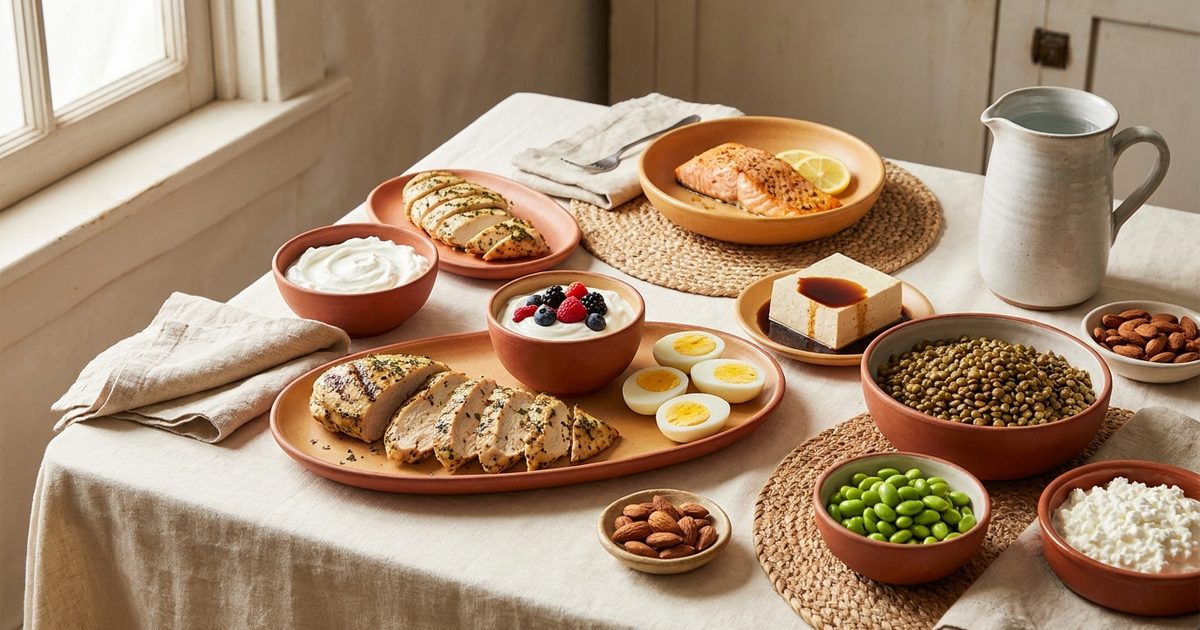
The high protein foods with the most protein per calorie are lean seafood, poultry, and egg whites: cooked shrimp leads at 24.2g per 100 calories, by USDA FoodData Central data. Per portion, a cup of boiled soybeans carries 31.3g. Proteinmaxxing means eating more of them on purpose, toward the 1.2 to 1.6 g per kg the Dietary Guidelines set.
What proteinmaxxing means
Proteinmaxxing is internet shorthand for building your meals around protein on purpose: picking foods that deliver a lot of it per calorie and making sure every meal has some. It is the protein sibling of fibermaxxing. There is no official definition or number attached to it. So two practical questions: how much protein do you need, and which foods get you there without blowing your calorie target? The first deserves an honest answer, because the most popular target online, 1 gram per pound, is not what most guidelines say.
How much protein you need per day
Three fetched sources set the useful reference points. The RDA is the minimum to cover basic needs for most healthy adults. The 2025 to 2030 Dietary Guidelines for Americans set a higher "protein serving goal" for the general public. And the International Society of Sports Nutrition (ISSN) position stand on protein and exercise (Jäger and colleagues, 2017) covers people who train.
| Source | Daily protein | For a 180 lb (81.6 kg) person |
|---|---|---|
| RDA, as cited in the ISSN position stand | 0.8 g/kg | 65g |
| Dietary Guidelines 2025 to 2030 | 1.2 to 1.6 g/kg | 98 to 131g |
| ISSN, most exercising people | 1.4 to 2.0 g/kg | 114 to 163g |
| ISSN, resistance-trained people in a calorie deficit | 2.3 to 3.1 g/kg | 188 to 253g |
| The popular "1 gram per pound" rule | about 2.2 g/kg | 180g |
So where does 1 gram per pound sit? It works out to about 2.2 g/kg, which is above the 1.4 to 2.0 range the ISSN calls sufficient for most exercising people, and well above the Dietary Guidelines range. It is not a requirement. It is a generous, easy-to-remember practical target, and it lands close to the higher range the ISSN says may be needed to keep lean mass for trained people who are dieting. If you lift and you are cutting, it is reasonable. Otherwise, the Dietary Guidelines range is a perfectly good goal.
The ISSN also gives a general per-meal dose of about 0.25 g per kg, or 20 to 40 grams, every 3 to 4 hours. The Dietary Guidelines put it plainly: "Prioritize Protein Foods at Every Meal."
If you take a GLP-1 medication, the targets and the practical problems are different: see how to eat enough protein on Ozempic, Wegovy, or Zepbound.
50 high protein foods, ranked by protein per 100 calories
Every number below is from USDA FoodData Central (SR Legacy), at USDA's own portion weights. Calories and protein per portion are calculated from USDA's per-100g figures. Protein per 100 calories does not depend on portion size, so it is the fairest way to compare a can of tuna with a handful of almonds.
| Rank | Food | Portion | Calories | Protein | Protein per 100 cal |
|---|---|---|---|---|---|
| 1 | Shrimp, cooked | 3 oz (85g) | 84 | 20.4g | 24.2g |
| 2 | Whey protein powder | 1/3 cup (32g) | 113 | 25.0g | 22.2g |
| 3 | Tuna, light, canned in water | 3 oz (85g) | 99 | 21.7g | 22.0g |
| 4 | Cod, cooked | 3 oz (85g) | 89 | 19.4g | 21.7g |
| 5 | Egg white | 1 large (33g) | 17 | 3.6g | 21.0g |
| 6 | Turkey breast, roasted | 3 oz (85g) | 125 | 25.6g | 20.5g |
| 7 | Tilapia, cooked | 1 fillet (87g) | 111 | 22.8g | 20.5g |
| 8 | Vital wheat gluten (seitan flour) | 1 oz (28.35g) | 105 | 21.3g | 20.3g |
| 9 | Chicken breast, roasted | 1/2 breast (86g) | 142 | 26.7g | 18.8g |
| 10 | Pork tenderloin, roasted | 3 oz (85g) | 122 | 22.3g | 18.3g |
| 11 | Greek yogurt, plain nonfat | 1 container (170g) | 100 | 17.3g | 17.3g |
| 12 | Cottage cheese, 1% | 1/2 cup (113g) | 81 | 14.0g | 17.2g |
| 13 | Sockeye salmon, cooked | 3 oz (85g) | 133 | 22.5g | 17.0g |
| 14 | Top sirloin steak, lean, broiled | 3 oz (85g) | 160 | 25.8g | 16.1g |
| 15 | Chicken thigh, roasted, no skin | 3 oz (85g) | 152 | 21.1g | 13.9g |
| 16 | Ground beef 93/7, cooked | 3 oz (85g) | 178 | 24.6g | 13.8g |
| 17 | Ground turkey 93/7, cooked | 3 oz (85g) | 181 | 23.0g | 12.7g |
| 18 | Tofu, firm | 1/4 block (81g) | 117 | 14.0g | 12.0g |
| 19 | Sardines, canned in oil | 1 can (92g) | 191 | 22.6g | 11.8g |
| 20 | Atlantic salmon, farmed, cooked | 3 oz (85g) | 175 | 18.8g | 10.7g |
| 21 | Soybeans, boiled | 1 cup (172g) | 296 | 31.3g | 10.6g |
| 22 | Tempeh | 1/2 cup (83g) | 159 | 16.8g | 10.6g |
| 23 | Ham, sliced | 2 slices (56g) | 92 | 9.3g | 10.1g |
| 24 | Ground beef 80/20, cooked | 3 oz (85g) | 231 | 22.9g | 9.9g |
| 25 | Skim milk | 1 cup (245g) | 83 | 8.3g | 9.9g |
| 26 | Edamame, prepared | 1 cup (155g) | 188 | 18.4g | 9.8g |
| 27 | Mozzarella, part skim | 1 oz (28.35g) | 72 | 6.9g | 9.6g |
| 28 | Parmesan, hard | 1 oz (28.35g) | 111 | 10.1g | 9.1g |
| 29 | Egg, hard-boiled | 1 large (50g) | 78 | 6.3g | 8.1g |
| 30 | Beef jerky | 1 oz (28.35g) | 116 | 9.4g | 8.1g |
| 31 | Lentils, boiled | 1 cup (198g) | 230 | 17.9g | 7.8g |
| 32 | Bacon, pan-fried | 3 slices (34.5g) | 161 | 11.7g | 7.2g |
| 33 | Black beans, boiled | 1 cup (172g) | 227 | 15.2g | 6.7g |
| 34 | 2% milk | 1 cup (244g) | 122 | 8.1g | 6.6g |
| 35 | Green peas, boiled | 1 cup (160g) | 134 | 8.6g | 6.4g |
| 36 | Soy milk, fortified | 1 cup (243g) | 104 | 6.3g | 6.0g |
| 37 | Cheddar | 1 slice (28g) | 115 | 6.8g | 5.9g |
| 38 | Hemp seeds, hulled | 3 tbsp (30g) | 166 | 9.5g | 5.7g |
| 39 | Pumpkin seeds, hulled | 1 oz (28.35g) | 158 | 8.6g | 5.4g |
| 40 | Chickpeas, boiled | 1 cup (164g) | 269 | 14.5g | 5.4g |
| 41 | Whole-wheat bread | 1 slice (32g) | 81 | 4.0g | 4.9g |
| 42 | Peanuts, dry-roasted | 1 oz (28.35g) | 166 | 6.9g | 4.2g |
| 43 | Peanut butter, smooth | 2 tbsp (32g) | 191 | 7.1g | 3.7g |
| 44 | Spaghetti, cooked | 1 cup (124g) | 196 | 7.2g | 3.7g |
| 45 | Quinoa, cooked | 1 cup (185g) | 222 | 8.1g | 3.7g |
| 46 | Almonds | 1 oz (28.35g) | 164 | 6.0g | 3.7g |
| 47 | Oatmeal, cooked with water | 1 cup (234g) | 166 | 5.9g | 3.6g |
| 48 | Chia seeds | 1 oz (28.35g) | 138 | 4.7g | 3.4g |
| 49 | Hummus | 2 tbsp (30g) | 71 | 2.3g | 3.3g |
| 50 | Walnuts | 1 oz (28.35g) | 185 | 4.3g | 2.3g |
Ties are ranked on unrounded values. Seitan itself is not in USDA's SR Legacy data, so the table uses vital wheat gluten, the flour seitan is made from, per ounce dry. For comparison, here are five everyday low-protein foods from the same database:
| Food | Portion | Calories | Protein | Protein per 100 cal |
|---|---|---|---|---|
| Russet potato, baked | 1 medium (173g) | 164 | 4.5g | 2.8g |
| White rice, cooked | 1 cup (158g) | 205 | 4.3g | 2.1g |
| Avocado | 1 cup cubes (150g) | 240 | 3.0g | 1.2g |
| Banana | 1 medium (118g) | 105 | 1.3g | 1.2g |
| Apple, with skin | 1 medium (182g) | 95 | 0.5g | 0.5g |
What the ranking actually tells you
Lean seafood is the most efficient protein there is. Shrimp, tuna, cod, and tilapia all return more than 20 grams of protein per 100 calories. They are almost pure protein with very little fat, which is also why each serving in the table is under 115 calories.
Fat is what separates the cuts. The same animal can rank very differently. Ground beef 93/7 returns 13.8g per 100 calories, while 80/20 drops to 9.9g with only 1.7 fewer grams of protein per 3 oz. Sockeye salmon (17.0g) beats farmed Atlantic salmon (10.7g) for the same reason. You pay more calories for the same protein. Our ground beef and salmon guides break down each cut.
Dairy splits into two groups. Greek yogurt and cottage cheese sit in the top 12, at over 17g per 100 calories. Cheddar, parmesan, and mozzarella land at 5.9 to 9.6g, because most of their calories come from fat. A container of nonfat Greek yogurt has 17.3g for 100 calories; a slice of cheddar has 6.8g for 115. See Greek yogurt and cheese for every variety.
Whole eggs are good, egg whites are elite. A hard-boiled egg returns 8.1g per 100 calories. The white alone returns 21.0g, since the yolk carries most of the fat. The egg guide has every size and cooking method.
Soy is the plant protein standout. Tofu, soybeans, and tempeh all return 10.6 to 12.0g per 100 calories, just below chicken thigh and lean ground meat. Seitan's base flour is even higher, at 20.3g. Lentils and beans are lower per calorie (5.4 to 7.8g) but bring a lot per cup: 17.9g in a cup of lentils, plus the fiber the meats lack.
Nuts and seeds are protein with a calorie bill. Hemp and pumpkin seeds lead the group at 8.6 to 9.5g per serving, but every nut, seed, and nut butter in the table costs 138 to 191 calories per serving. Two tablespoons of peanut butter is 191 calories for 7.1g of protein, while 3 oz of shrimp is 84 calories for 20.4g. Shrimp returns about 6.5 times as much protein per calorie.
Grains contribute, but they are not protein foods. A cup of quinoa has 8.1g and a cup of spaghetti 7.2g, both around 3.7g per 100 calories. That adds up, but no grain is a shortcut.
A sample proteinmaxxed day: 194.1g of protein
Here is one realistic day built only from the table above, for the 180 lb example person. It clears the 180g "1 gram per pound" target at 1,778 calories of food.
| Meal | Foods | Calories | Protein |
|---|---|---|---|
| Breakfast | Greek yogurt, 1 container (100) + oatmeal, 1 cup (166) + hemp seeds, 3 tbsp (166) | 432 | 32.7g |
| Lunch | Tuna, 3 oz (99) + whole-wheat bread, 2 slices (162) + hard-boiled egg, 1 large (78) | 339 | 36.0g |
| Snack | Cottage cheese, 1/2 cup (81) + whey protein, 1/3 cup (113) + skim milk, 1 cup (83) | 277 | 47.3g |
| Dinner | Top sirloin, 6 oz (320) + quinoa, 1 cup (222) + edamame, 1 cup (188) | 730 | 78.1g |
| Total | 1,778 | 194.1g |
The protein math: 17.3 + 5.9 + 9.5 = 32.7 at breakfast, 21.7 + 8.0 + 6.3 = 36.0 at lunch, 14.0 + 25.0 + 8.3 = 47.3 for the snack, 51.6 + 8.1 + 18.4 = 78.1 at dinner, and 32.7 + 36.0 + 47.3 + 78.1 = 194.1g. The calories: 432 + 339 + 277 + 730 = 1,778. Those are the foods alone. Cooking oil, sauces, and toppings would add calories and little protein.
Notice two things. First, breakfast and lunch land inside the ISSN's 20 to 40 gram per-meal range, and the snack and dinner go over it, so no meal is left without protein. Second, the whey and the steak are doing a lot of work: together they supply 76.6 of the 194.1 grams. If you do not use protein powder, swap the whey for a second Greek yogurt and 3 oz of tuna: the day goes to 208.1g at 1,864 calories.
For eating out, our Fast Food Protein Index ranks 708 menu items by the same protein-per-100-calories measure.
How Nouri sets and tracks your protein target
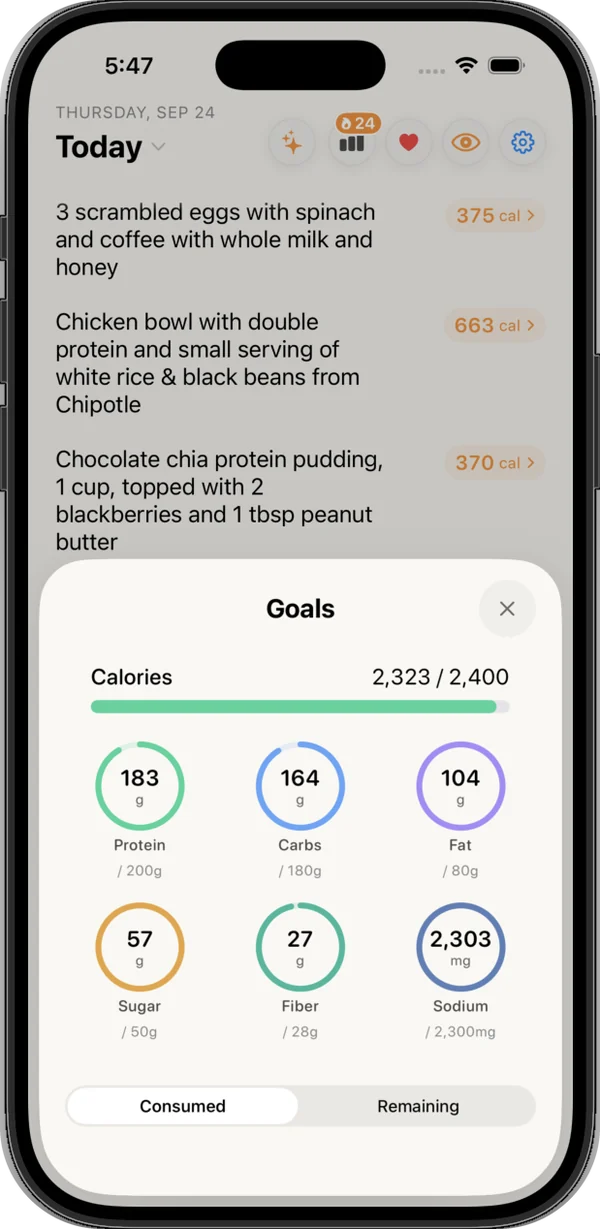
Nouri sets your protein target from your body weight: 1.0 gram per pound by default. Turn on Prioritize Protein, either during onboarding or later in your goals settings, and the target becomes 1.2 grams per pound. Fat stays at 30 percent of your calories, and your calorie target does not change, so the extra protein comes out of carbs.
Here is the arithmetic for a 180 lb person with a 2,200-calorie target:
| Default (1.0 g/lb) | Prioritize Protein (1.2 g/lb) | |
|---|---|---|
| Protein | 180g (720 cal) | 216g (864 cal) |
| Fat, 30% of calories | 660 cal = 73g | 660 cal = 73g |
| Carbs, the remainder | 2,200 − 720 − 660 = 820 cal = 205g | 2,200 − 864 − 660 = 676 cal = 169g |
| Calories | 2,200 | 2,200 |
The switch adds 36 grams of protein, which is 144 calories, and takes exactly 144 calories out of carbs: 820 − 676 = 144. For context, 1.2 g/lb is about 2.65 g/kg, inside the ISSN's 2.3 to 3.1 g/kg range for trained people in a deficit, and the default 1.0 g/lb is the generous practical target discussed earlier. If neither fits, you can edit any goal by hand.
The target is only half of it. Proteinmaxxing breaks down at logging. I used MyFitnessPal first, and the numbers were never the problem: logging a normal dinner took several minutes, and after a long day I just would not do it. A steak, quinoa, and edamame dinner is three searches and three portion pickers in a database app. In Nouri you log it the way you would describe it, and you see the protein for that meal right away. You can type it, say it, snap a photo, or ask Siri from the lock screen with "Hey Siri, track food in Nouri" and one sentence. Nouri is iPhone (iOS only), and you can try it free.
As you log, the protein ring in your daily goals fills toward your target, so a 2 p.m. glance tells you whether dinner needs to be a 6 oz steak or can be anything you like. Then each week, your Nouri Report shows your average protein against your target, how many days you hit your protein goal, and protein equivalents that turn the grams into food you can picture.
FAQ
What foods are highest in protein?
Per calorie, lean seafood leads: cooked shrimp returns 24.2g of protein per 100 calories, followed by canned light tuna, cod, egg whites, turkey breast, and tilapia, by USDA data. Per portion, a cup of boiled soybeans has 31.3g, and half a roasted chicken breast has 26.7g.
What is proteinmaxxing?
Proteinmaxxing is an online term for building your meals around protein on purpose, choosing foods with a lot of protein per calorie and putting some at every meal. It has no official definition or number, so the target you aim for should come from guidelines like the RDA, the Dietary Guidelines, or the ISSN ranges.
How much protein do I need a day?
The RDA is 0.8 g per kg of body weight, and the 2025 to 2030 Dietary Guidelines set a goal of 1.2 to 1.6 g per kg. The ISSN position stand puts most exercising people at 1.4 to 2.0 g per kg. For a 180 lb person, that is 65g, 98 to 131g, and 114 to 163g.
Is 1 gram of protein per pound too much?
It is on the high side, and not required. One gram per pound is about 2.2 g per kg, above the 1.4 to 2.0 g/kg the ISSN calls sufficient for most exercising people. It is closer to the 2.3 to 3.1 g/kg the ISSN says may help resistance-trained people keep lean mass while dieting.
What is the best plant-based protein?
Per calorie, soy foods lead: firm tofu returns 12.0g per 100 calories, and soybeans and tempeh 10.6g. Seitan, made from vital wheat gluten, is even higher at 20.3g per 100 calories for the dry flour. Lentils give 17.9g per cup at 7.8g per 100 calories.
Which has more protein, chicken or fish?
It depends on the fish. Half a roasted chicken breast has 26.7g at 18.8g per 100 calories, while cod and tilapia return over 20g per 100 calories and farmed Atlantic salmon returns 10.7g. Our chicken breast guide covers every cut.
How much protein is in an egg?
A large hard-boiled egg has 6.3g of protein and 78 calories, per USDA. A large egg white alone has 3.6g for 17 calories, which is why egg whites rank fifth in our table.
Is Greek yogurt or cottage cheese higher in protein?
They are nearly tied per calorie: nonfat plain Greek yogurt returns 17.3g per 100 calories and 1% cottage cheese 17.2g. A 170g container of Greek yogurt has 17.3g of protein, and half a cup of cottage cheese has 14.0g.
Do nuts have a lot of protein?
They have some, but at a high calorie cost. An ounce of almonds has 6.0g of protein for 164 calories, and walnuts 4.3g for 185. Hemp and pumpkin seeds do better, with 9.5g and 8.6g per serving.
How much protein should I eat per meal?
The ISSN position stand gives a general recommendation of about 0.25 g per kg of body weight per meal, or 20 to 40 grams, spread every 3 to 4 hours. For a 180 lb person, 0.25 g per kg is about 20 grams.
Do I need protein powder to hit my protein goal?
No. Powder is convenient, and whey ranks second in our table at 22.2g per 100 calories, but whole foods like tuna, chicken, Greek yogurt, and cottage cheese are close behind. Swapping the whey in our sample day for Greek yogurt and 3 oz of tuna raises it from 194.1g to 208.1g.
What is the easiest way to track protein every day?
Log each meal in one sentence, typed, spoken, snapped, or through Siri, and let Nouri show the protein for that meal as you go. Your protein ring fills toward a target set from your body weight, and Prioritize Protein raises it to 1.2 grams per pound if you want more.
Lean seafood and poultry first, Greek yogurt and cottage cheese for snacks, soy and lentils for plant protein, and nuts measured rather than poured. When the meals get mixed, Nouri shows the protein in each one as you log it, and How to Track Macros explains how protein fits with carbs and fat. Pair this list with high fiber foods and you have both halves of a filling plate.
Sources
- Dietary Guidelines for Americans, 2025 to 2030 (protein serving goals of 1.2 to 1.6 g/kg/day; "Prioritize Protein Foods at Every Meal"), cdn.realfood.gov/DGA.pdf (checked October 5, 2026)
- Jäger R, Kerksick CM, Campbell BI, et al. "International Society of Sports Nutrition Position Stand: protein and exercise." Journal of the International Society of Sports Nutrition, 2017 (RDA of 0.8 g/kg/day; 1.4 to 2.0 g/kg/d for most exercising individuals; 2.3 to 3.1 g/kg/d during hypocaloric periods in resistance-trained subjects; 0.25 g/kg or 20 to 40 g per dose), pmc.ncbi.nlm.nih.gov/articles/PMC5477153 (checked October 5, 2026)
- USDA FoodData Central, SR Legacy (checked October 5, 2026). Meat and poultry: chicken breast (FDC 171477), chicken thigh (FDC 172388), turkey breast (FDC 171496), ground turkey 93/7 (FDC 172851), ground beef 93/7 (FDC 174755), ground beef 80/20 (FDC 171799), pork tenderloin (FDC 168250), top sirloin (FDC 168635), bacon (FDC 168322), beef jerky (FDC 167536), sliced ham (FDC 173864). Fish and seafood: light tuna (FDC 171986), shrimp (FDC 175180), cod (FDC 171956), tilapia (FDC 175177), sardines (FDC 175139), sockeye salmon (FDC 173692), farmed Atlantic salmon (FDC 175168). Eggs and dairy: hard-boiled egg (FDC 173424), egg white (FDC 172183), Greek yogurt, nonfat (FDC 170894), cottage cheese 1% (FDC 173417), skim milk (FDC 171269), 2% milk (FDC 171267), mozzarella, part skim (FDC 170847), parmesan (FDC 170848), cheddar (FDC 170899), whey protein powder (FDC 173180). Plant proteins: firm tofu (FDC 172475), tempeh (FDC 174272), vital wheat gluten (FDC 168147), lentils (FDC 172421), black beans (FDC 173735), chickpeas (FDC 173757), edamame (FDC 168411), green peas (FDC 170420), soybeans (FDC 174271), soy milk (FDC 172456), hummus (FDC 174289). Grains, nuts, and seeds: quinoa (FDC 168917), oatmeal (FDC 173905), whole-wheat bread (FDC 172688), spaghetti (FDC 169737), pumpkin seeds (FDC 170556), hemp seeds (FDC 170148), almonds (FDC 170567), peanuts, dry-roasted (FDC 173806), peanut butter (FDC 172470), chia (FDC 170554), walnuts (FDC 170187). Comparisons: russet potato (FDC 170030), white rice (FDC 168878), avocado (FDC 171705), banana (FDC 173944), apple (FDC 171688)
- Portion weights are USDA's own household measures (3 bacon slices, 2 ham slices, and 2 tbsp hummus are multiples of USDA's single-piece weights; 1/2 cup cottage cheese and tempeh are half of USDA's cup weights; vital wheat gluten has no USDA portion, so it is shown per ounce); per-portion values calculated from USDA per-100g figures times those weights
Keep reading
All articlesHow Many Calories in an Apple? Official USDA Numbers by Size
A medium apple with skin is about 95 calories with 4.4g of fiber, by USDA data. Calories by size, peeled vs unpeeled, applesauce, juice, and dried apple.
FoodsHow Many Calories in Cheese? USDA Numbers for 13 Cheeses
An ounce of cheddar is about 114 calories and part-skim mozzarella about 72, by USDA data. 13 cheeses ranked per ounce, slice, and cup, plus protein picks.
FoodsHow Many Calories in Greek Yogurt? Official USDA Numbers
A 170g container of plain nonfat Greek yogurt is about 100 calories with 17.3g of protein, by USDA data. Nonfat vs low-fat vs whole milk, flavored, and an FAQ.
FoodsHow Many Calories in Ground Beef? USDA Numbers by Lean %
80/20 ground beef is 287 calories per 4 oz raw and 231 per 3 oz cooked, by USDA data. Every lean percentage, raw vs cooked, patties, and ground turkey.