
High Protein Snacks: 40 Snacks Ranked by Protein per Calorie
Shrimp leads at 24.2g of protein per 100 calories. 40 high protein snacks ranked with USDA data, plus 25 to 30g combos under 300 calories.
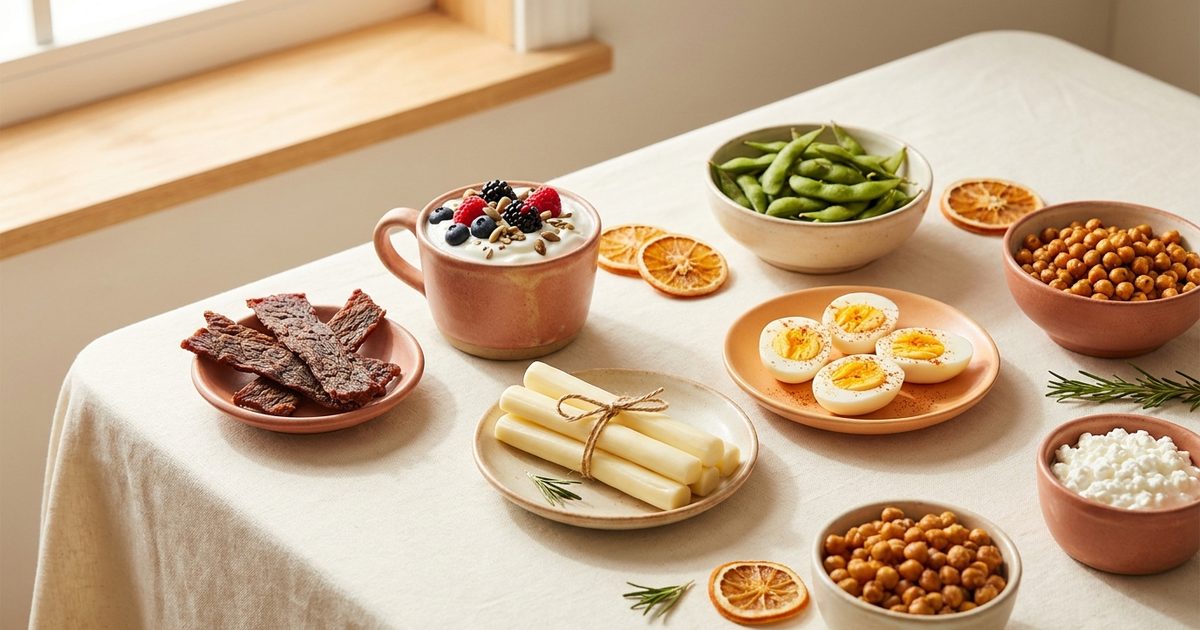
The best high protein snacks are lean seafood, egg whites, deli turkey, Greek yogurt, and cottage cheese: 3 oz of cooked shrimp returns 24.2g of protein per 100 calories, by USDA FoodData Central data. Ten of the 40 snacks below deliver 10.8 to 25.0g of protein for under 150 calories, and pairing two of them reaches 25 to 30g for under 300.
What makes a snack high protein
A snack is just a small meal, so the question is the same as for any food: how much protein do you get for the calories you spend? This list ranks snack-sized portions, all at or under 210 calories, by protein per 100 calories. That number does not depend on portion size, so it compares a half-ounce bag of pork rinds fairly with a cup of edamame.
There is no official protein target for a snack. Two reference points help. On a food label, "high protein" means at least 10 grams per FDA reference serving, which is 20 percent of the 50 gram Daily Value (more on that below). And the International Society of Sports Nutrition (ISSN) position stand gives a general per-serving recommendation of 20 to 40 grams, spread every 3 to 4 hours. Most single snacks land around 10 to 20 grams. The combos further down reach 25 to 30.
If you want full meals rather than snacks, our 50 high protein foods ranking covers chicken, steak, salmon, lentils, and the rest of the plate.
40 high protein snacks, ranked by protein per 100 calories
Every number is from USDA FoodData Central. Generic foods use SR Legacy entries at USDA's own portion weights, with calories and protein calculated from USDA's per-100g figures. Four packaged snacks marked with an asterisk (*) use label data via USDA's Branded Foods database, as printed per serving; we picked one representative product for each and do not recommend any brand.
| Rank | Snack | Portion | Calories | Protein | Protein per 100 cal |
|---|---|---|---|---|---|
| 1 | Shrimp, cooked | 3 oz (85g) | 84 | 20.4g | 24.2g |
| 2 | Whey protein powder, mixed with water | 1/3 cup powder (32g) | 113 | 25.0g | 22.2g |
| 3 | Tuna, light, canned in water | 3 oz (85g) | 99 | 21.7g | 22.0g |
| 4 | Egg whites | 3 large (99g) | 51 | 10.8g | 21.0g |
| 5 | Deli turkey breast | 2 oz (57g) | 62 | 12.4g | 20.0g |
| 6 | Greek yogurt, plain nonfat | 1 container (170g) | 100 | 17.3g | 17.3g |
| 7 | Cottage cheese, 1% | 1/2 cup (113g) | 81 | 14.0g | 17.2g |
| 8 | Pink salmon, canned | 3 oz (85g) | 117 | 19.6g | 16.7g |
| 9 | Turkey jerky * | 1 oz | 80 | 13.0g | 16.2g |
| 10 | Smoked salmon (lox) | 3 oz (85g) | 99 | 15.6g | 15.6g |
| 11 | Ready-to-drink protein shake * | 1 bottle (250 ml) | 140 | 20.0g | 14.3g |
| 12 | Chicken, canned | 3 oz (85g) | 157 | 21.5g | 13.7g |
| 13 | Greek yogurt, plain lowfat | 1 container (200g) | 146 | 19.9g | 13.6g |
| 14 | Tofu, firm | 1/4 block (81g) | 117 | 14.0g | 12.0g |
| 15 | Pork rinds, plain | 1/2 oz (14.2g) | 77 | 8.7g | 11.3g |
| 16 | Greek yogurt, vanilla nonfat | 1 container (150g) | 117 | 13.0g | 11.1g |
| 17 | Cottage cheese with fruit | 1/2 cup (113g) | 110 | 12.1g | 11.0g |
| 18 | Skim milk | 1 cup (245g) | 83 | 8.3g | 9.9g |
| 19 | Edamame, prepared | 1 cup (155g) | 188 | 18.4g | 9.8g |
| 20 | Greek yogurt, strawberry nonfat | 1 container (150g) | 123 | 12.1g | 9.8g |
| 21 | Soy nuts (dry-roasted soybeans) | 1/4 cup (23.25g) | 104 | 10.1g | 9.6g |
| 22 | Protein bar * | 1 bar (60g) | 210 | 20.0g | 9.5g |
| 23 | 1% milk, protein-fortified | 1 cup (246g) | 118 | 9.7g | 8.2g |
| 24 | Eggs, hard-boiled | 2 large (100g) | 155 | 12.6g | 8.1g |
| 25 | Beef jerky | 1 oz (28.35g) | 116 | 9.4g | 8.1g |
| 26 | String cheese (part-skim mozzarella) | 1 oz stick (28.35g) | 84 | 6.7g | 8.1g |
| 27 | Soy milk, fortified | 1 cup (243g) | 104 | 6.3g | 6.0g |
| 28 | Cheddar | 1 oz slice (28g) | 115 | 6.8g | 5.9g |
| 29 | Hemp seeds, hulled | 3 tbsp (30g) | 166 | 9.5g | 5.7g |
| 30 | Chocolate milk, lowfat | 1 cup (250g) | 160 | 8.7g | 5.4g |
| 31 | Pumpkin seeds, roasted | 1 oz (28.35g) | 163 | 8.4g | 5.2g |
| 32 | Roasted chickpeas * | 1 oz | 110 | 5.0g | 4.5g |
| 33 | Peanuts, dry-roasted | 1 oz (28.35g) | 166 | 6.9g | 4.2g |
| 34 | Beef stick, smoked | 1 stick (20g) | 110 | 4.3g | 3.9g |
| 35 | Peanut butter | 2 tbsp (32g) | 191 | 7.1g | 3.7g |
| 36 | Pistachios, dry-roasted | 1 oz (28.35g) | 162 | 6.0g | 3.7g |
| 37 | Almonds | 1 oz (28.35g) | 164 | 6.0g | 3.7g |
| 38 | Sunflower seeds, dry-roasted | 1 oz (28.35g) | 165 | 5.5g | 3.3g |
| 39 | Hummus with baby carrots | 4 tbsp hummus (60g) + 10 baby carrots (100g) | 177 | 5.3g | 3.0g |
| 40 | Whole-wheat crackers | 6 crackers (28g) | 120 | 3.0g | 2.5g |
Ties are ranked on unrounded values. String cheese is USDA's low-moisture part-skim mozzarella at its 1 oz weight. USDA's egg white entry is for raw whites. The whey entry is USDA's generic whey-based protein powder, so a flavored powder will differ a little.
Top 10 high protein snacks under 150 calories
These are the ten highest-ranked snacks that stay under 150 calories. Each one gives you at least 10 grams of protein.
| Snack | Portion | Calories | Protein |
|---|---|---|---|
| Shrimp, cooked | 3 oz | 84 | 20.4g |
| Whey protein powder, in water | 1/3 cup powder | 113 | 25.0g |
| Tuna, light, canned in water | 3 oz | 99 | 21.7g |
| Egg whites | 3 large | 51 | 10.8g |
| Deli turkey breast | 2 oz | 62 | 12.4g |
| Greek yogurt, plain nonfat | 1 container | 100 | 17.3g |
| Cottage cheese, 1% | 1/2 cup | 81 | 14.0g |
| Pink salmon, canned | 3 oz | 117 | 19.6g |
| Turkey jerky * | 1 oz | 80 | 13.0g |
| Smoked salmon (lox) | 3 oz | 99 | 15.6g |
Notice what they have in common: almost no fat and almost no sugar. That is the whole trick. Protein has 4 calories per gram, so a snack that is mostly protein cannot be calorie dense. Deli turkey gives 12.4g for 62 calories, while an ounce of peanuts gives 6.9g for 166. The turkey has 1.8 times the protein for about 37 percent of the calories.
Best shelf-stable and on-the-go protein snacks
These keep in a desk drawer, a gym bag, or a glove box until you open them. Canned fish and chicken need a fork. Everything else eats straight from the bag.
| Snack | Portion | Calories | Protein | Per 100 cal |
|---|---|---|---|---|
| Whey protein powder, in water | 1/3 cup powder | 113 | 25.0g | 22.2g |
| Tuna, light, canned in water | 3 oz | 99 | 21.7g | 22.0g |
| Pink salmon, canned | 3 oz | 117 | 19.6g | 16.7g |
| Turkey jerky * | 1 oz | 80 | 13.0g | 16.2g |
| Chicken, canned | 3 oz | 157 | 21.5g | 13.7g |
| Pork rinds, plain | 1/2 oz | 77 | 8.7g | 11.3g |
| Soy nuts | 1/4 cup | 104 | 10.1g | 9.6g |
| Protein bar * | 1 bar (60g) | 210 | 20.0g | 9.5g |
| Beef jerky | 1 oz | 116 | 9.4g | 8.1g |
| Pumpkin seeds, roasted | 1 oz | 163 | 8.4g | 5.2g |
The ready-to-drink shake in the main table (140 calories, 20.0g) is the other grab-and-go option, as long as it fits your bag. Jerky is worth a second look. The turkey jerky label above returns 16.2g of protein per 100 calories, about twice USDA's generic beef jerky at 8.1g. Smoked beef sticks look similar on the shelf but land at 3.9g, because USDA's beef stick is mostly fat: 110 calories for 4.3g of protein. If you buy jerky or meat sticks, compare the protein and calorie lines on the label before the flavor.
Best sweet high protein snacks
Sweet snacks can carry real protein, but flavor costs you some. Compare these with their plain versions:
| Snack | Portion | Calories | Protein | Per 100 cal | Plain version, per 100 cal |
|---|---|---|---|---|---|
| Greek yogurt, vanilla nonfat | 1 container (150g) | 117 | 13.0g | 11.1g | 17.3g (plain nonfat) |
| Cottage cheese with fruit | 1/2 cup | 110 | 12.1g | 11.0g | 17.2g (1%) |
| Greek yogurt, strawberry nonfat | 1 container (150g) | 123 | 12.1g | 9.8g | 17.3g (plain nonfat) |
| Chocolate milk, lowfat | 1 cup | 160 | 8.7g | 5.4g | 9.9g (skim milk) |
Chocolate milk is the clearest example: a cup has 160 calories and 8.7g of protein, while a cup of skim milk has 83 calories and 8.3g. The chocolate adds 77 calories for 0.4g more protein. Sweet yogurts still beat the protein bar and every nut in the table per calorie, though. The easy upgrade is plain Greek yogurt with your own fruit, so you control how sweet it gets. Our Greek yogurt guide has every fat level and flavor. If your sweet snack is candy this month, Halloween candy calories has the numbers.
Best plant-based high protein snacks
Soy is the plant protein leader at snack size too:
| Snack | Portion | Calories | Protein | Per 100 cal |
|---|---|---|---|---|
| Tofu, firm | 1/4 block | 117 | 14.0g | 12.0g |
| Edamame, prepared | 1 cup | 188 | 18.4g | 9.8g |
| Soy nuts | 1/4 cup | 104 | 10.1g | 9.6g |
| Soy milk, fortified | 1 cup | 104 | 6.3g | 6.0g |
| Hemp seeds, hulled | 3 tbsp | 166 | 9.5g | 5.7g |
| Pumpkin seeds, roasted | 1 oz | 163 | 8.4g | 5.2g |
| Roasted chickpeas * | 1 oz | 110 | 5.0g | 4.5g |
| Peanuts, dry-roasted | 1 oz | 166 | 6.9g | 4.2g |
A cup of edamame is the single biggest plant snack here at 18.4g. Soy nuts are the most portable. Seeds and peanuts carry real protein but come at a fat cost, so they work best as a topping rather than the whole snack: 3 tablespoons of hemp seeds on plain yogurt, for example. Hummus with carrots is a fine snack, but at 3.0g per 100 calories it is not a protein snack. If you also want fiber, edamame and soy nuts show up again in our high fiber foods list.
High protein snack combos: 25 to 30g under 300 calories
One snack rarely hits 25 grams under 300 calories. Two often do. Every combo below uses the portions and numbers from the main table.
| Combo | Calories | Protein |
|---|---|---|
| Greek yogurt, plain nonfat (100) + deli turkey breast, 2 oz (62) | 162 | 29.7g |
| Smoked salmon, 3 oz (99) + cottage cheese 1%, 1/2 cup (81) | 180 | 29.6g |
| Tuna, 3 oz (99) + string cheese, 1 stick (84) | 183 | 28.4g |
| Vanilla Greek yogurt (117) + cottage cheese 1%, 1/2 cup (81) | 198 | 27.0g |
| Edamame, 1 cup (188) + soy nuts, 1/4 cup (104) | 292 | 28.5g |
| Plain Greek yogurt (100) + hemp seeds, 3 tbsp (166) | 266 | 26.8g |
| Cottage cheese 1%, 1/2 cup (81) + 2 hard-boiled eggs (155) | 236 | 26.6g |
| Deli turkey, 2 oz (62) + 2 string cheese sticks (168) | 230 | 25.8g |
The protein math, row by row: 17.3 + 12.4 = 29.7g; 15.6 + 14.0 = 29.6g; 21.7 + 6.7 = 28.4g; 13.0 + 14.0 = 27.0g; 18.4 + 10.1 = 28.5g; 17.3 + 9.5 = 26.8g; 14.0 + 12.6 = 26.6g; 12.4 + 13.4 = 25.8g. Calories are the sums in parentheses.
The vanilla yogurt and cottage cheese combo is the sweet one. Edamame with soy nuts is the plant-based one, and it is the only combo that gets close to the 300 calorie line. For comparison, tuna with 6 whole-wheat crackers comes to 219 calories but only 24.7g of protein (21.7 + 3.0), because the crackers add 120 calories and 3.0g.
What "high protein" on a label legally means
In the US, "high protein" is a regulated nutrient content claim. Under 21 CFR 101.54, a food can say "high," "rich in," or "excellent source of" a nutrient when it contains 20 percent or more of the Daily Value per reference amount customarily consumed, a standard serving FDA sets for each type of food. "Good source," "contains," or "provides" requires 10 to 19 percent.
The Daily Value for protein, set in 21 CFR 101.9, is 50 grams for adults and children 4 and older. So:
- High protein: at least 20% of 50g, which is 10 grams
- Good source of protein: 10 to 19% of 50g, which is 5 to 9.5 grams
One more detail: for the claim, FDA counts protein after correcting for quality. The regulation multiplies the grams by the protein digestibility-corrected amino acid score (PDCAAS), capped at 1.00, and any product making a protein claim must show that corrected percent Daily Value on the label. A plant protein with a lower score needs more grams to reach the same percentage.
What the rule does not cover is calories. A "high protein" claim says nothing about how many calories come with those 10 grams. Of the 40 snacks above, 21 have at least 10 grams in the portion shown, but they range from egg whites at 51 calories to a protein bar at 210. That is why this list ranks by protein per 100 calories, not by grams alone.
Common mistakes with high protein snacks
Treating nuts as a protein snack. An ounce of almonds has 164 calories and 6.0g of protein. Every nut and seed in the table costs 162 to 166 calories per serving, and USDA's ounce of almonds is just 23 kernels, so count before you pour. Cooked shrimp returns about 6.6 times as much protein per calorie. Nuts are a good food, just not a protein shortcut. The peanut butter guide shows how fast spoonfuls add up.
Buying bars that are candy with a protein label. Bars vary more than anything else here. We pulled nine USDA Branded Foods entries named simply "protein bar": they ranged from 7 to 30 grams of protein and 90 to 310 calories per bar. One has 7g of protein, 130 calories, and 10g of sugars, which is 5.4g of protein per 100 calories, below plain cheddar. Before you buy, divide protein by calories and multiply by 100. If the answer is under about 5, treat it as a treat.
Assuming every shake is a protein shake. The same goes for drinks. The ready-to-drink shake in our table has 20g of protein, 140 calories, and 0g of sugars. Another USDA entry labeled "protein shake" has 17g of protein, 221 calories, and 25g of sugars per 8 oz.
Letting the sides outweigh the snack. Crackers, pita chips, and granola turn a 99 calorie can of tuna into a 219 calorie plate with 3 more grams of protein. Have the sides if you like them; just count them.
Picking the flavored version without noticing. Vanilla and strawberry Greek yogurt return 11.1g and 9.8g per 100 calories, against 17.3g for plain nonfat. Chocolate milk drops from 9.9g to 5.4g.
Not logging snacks at all. A 100 calorie yogurt feels too small to bother with, and that is exactly how a day's protein and calories go missing. Common food logging mistakes covers the rest of the usual gaps.
How to log snacks in Nouri
Snacks are easy to skip logging, because the effort feels bigger than the food. I used MyFitnessPal first, and the numbers were never the problem: logging a normal dinner took several minutes, and after a long day I just would not do it. A string cheese should not take a search and a portion picker.
In Nouri you log a snack the way you would say it: "a container of plain nonfat Greek yogurt and 2 oz of deli turkey." You can type it like a note, say it, snap a photo (Nouri turns the photo into a sentence first, so you can fix anything it got wrong), or ask Siri from the lock screen with "Hey Siri, track food in Nouri" and one sentence. You get calories and macros right away, with each item's protein and the reasoning behind it. If the portion was bigger, add "large portion" and it recalculates. Our text vs voice vs photo comparison explains when each method is the most precise.
Your protein target comes from your body weight: 1.0 gram per pound by default. Turn on Prioritize Protein and it becomes 1.2 grams per pound. Fat stays at 30 percent of your calories, and carbs absorb the difference, so your calorie target does not change. For a 160 lb person, that is 160g by default or 192g with the setting on. Two of the combos above, 29.7g + 28.4g = 58.1g, cover about 36 percent of the 160g default.
Then, each Sunday evening when you have logged at least 4 days, your Nouri Report shows your average protein and other macros against your targets, how many days you were on target, and protein equivalents that turn the grams into food you can picture. Nouri Reports are part of Nouri Premium. Nouri is iPhone (iOS only), and you can start with a 3-day free trial.
FAQ
What is the highest protein snack?
Per calorie, cooked shrimp leads our list at 24.2g of protein per 100 calories, followed by whey protein powder, canned light tuna, egg whites, and deli turkey breast, by USDA data. Per portion, whey powder mixed with water gives the most at 25.0g for 113 calories.
What are good high protein snacks under 100 calories?
Egg whites (3 large, 51 calories, 10.8g), deli turkey breast (2 oz, 62 calories, 12.4g), turkey jerky (1 oz, 80 calories, 13.0g), cottage cheese (1/2 cup of 1%, 81 calories, 14.0g), and cooked shrimp (3 oz, 84 calories, 20.4g) are all under 100. Canned light tuna and smoked salmon land at 99 calories for 3 oz, and a container of plain nonfat Greek yogurt is 100.
What snack has 20 grams of protein?
Three ounces of canned light tuna has 21.7g, 3 oz of canned chicken has 21.5g, and 3 oz of cooked shrimp has 20.4g, all for 157 calories or less. A third of a cup of whey powder has 25.0g. Packaged bars and shakes can reach 20g too, but check the calories that come with it.
Are protein bars a good snack?
Some are. The bar in our table has 20g of protein for 210 calories, a reasonable 9.5g per 100 calories. But USDA's branded entries named "protein bar" range from 7 to 30g of protein, and one returns just 5.4g per 100 calories, less than plain cheddar.
Is beef jerky a good high protein snack?
It is decent: USDA's beef jerky has 116 calories and 9.4g of protein per ounce, or 8.1g per 100 calories. The turkey jerky label in our table does better at 16.2g. Smoked beef sticks are much lower, at 3.9g per 100 calories.
Are nuts a good source of protein?
They contain some, but they are mostly fat. An ounce of almonds has 6.0g of protein for 164 calories, and peanuts have 6.9g for 166. Pumpkin seeds (8.4g per ounce) and hemp seeds (9.5g per 3 tablespoons) are the best of the group.
What are high protein snacks for vegans?
Firm tofu leads at 12.0g of protein per 100 calories, followed by edamame (18.4g per cup) and dry-roasted soy nuts (10.1g per quarter cup). Edamame with soy nuts makes a 292 calorie snack with 28.5g of protein.
What does "high protein" mean on a food label?
Under 21 CFR 101.54, "high" means at least 20 percent of the Daily Value per FDA reference amount, and the protein Daily Value is 50 grams. So a "high protein" food has at least 10 grams, counted after correcting for protein quality. "Good source of protein" means 5 to 9.5 grams.
How much protein should a snack have?
There is no official snack target. Ten grams is the bar for a "high protein" label claim, and the ISSN gives a general per-serving recommendation of 20 to 40 grams every 3 to 4 hours for people who train. Most single snacks give 10 to 20 grams, and a two-item combo can reach 25 to 30.
Is Greek yogurt or cottage cheese better for a snack?
They are almost tied per calorie: plain nonfat Greek yogurt returns 17.3g of protein per 100 calories and 1% cottage cheese 17.2g. A 170g container of the yogurt has 17.3g, and half a cup of cottage cheese has 14.0g. Pick the one you will actually eat, or pair cottage cheese with vanilla Greek yogurt for 27.0g.
Are pork rinds high in protein?
Yes, for the calories. Half an ounce of plain pork rinds has 77 calories and 8.7g of protein, or 11.3g per 100 calories, by USDA data. That beats beef jerky and string cheese per calorie.
What is the easiest way to track protein from snacks?
Log the snack the moment you eat it, in a single sentence, by typing, speaking, snapping a photo, or asking Siri from the lock screen. Nouri shows the protein for that snack right away and fills your daily protein goal as the day goes on.
Keep a few top-ranked snacks where you will see them, pair two when you need 25 grams, and weigh nuts and bars against the table before you call them protein. When you want to know where the day stands, Nouri adds up every snack as you log it. For full meals, see the 50 high protein foods ranking, and for eating out, the Fast Food Protein Index. On a budget? See the cheapest protein foods, ranked by cost per 25g.
Sources
- USDA FoodData Central, SR Legacy (checked October 5, 2026). Seafood: shrimp (FDC 175180), light tuna in water (FDC 171986), pink salmon, canned (FDC 175175), smoked salmon, lox (FDC 171985). Meat and eggs: deli turkey breast (FDC 174572), canned chicken (FDC 171110), beef jerky (FDC 167536), beef sticks, smoked (FDC 168850), pork skins (FDC 167961), egg white (FDC 172183), hard-boiled egg (FDC 173424). Dairy: Greek yogurt plain nonfat (FDC 170894), plain lowfat (FDC 170903), vanilla nonfat (FDC 170902), strawberry nonfat (FDC 170901), cottage cheese 1% (FDC 173417), cottage cheese with fruit (FDC 172180), low-moisture part-skim mozzarella (FDC 171244), cheddar (FDC 170899), skim milk (FDC 171269), protein-fortified 1% milk (FDC 171268), lowfat chocolate milk (FDC 170881), whey-based protein powder (FDC 173180). Plant foods: firm tofu (FDC 172475), edamame (FDC 168411), dry-roasted soybeans (FDC 172441), soy milk (FDC 172456), hemp seeds (FDC 170148), roasted pumpkin seeds (FDC 170557), dry-roasted peanuts (FDC 173806), peanut butter (FDC 172470), pistachios (FDC 170185), almonds (FDC 170567), sunflower seeds (FDC 170563), hummus (FDC 174289), baby carrots (FDC 168568), whole-wheat crackers (FDC 172749)
- USDA FoodData Central, Branded Foods, label data via USDA (checked October 5, 2026): turkey jerky (FDC 2091587), ready-to-drink protein shake (FDC 2475440), protein bar (FDC 2112671), roasted chickpeas (FDC 2053244). Bar range: entries named "protein bar" (FDC 1917719, 2112671, 2068007, 2095258, 482712, 2117681, 2432443, 2491146, 582984). Higher-sugar shake: FDC 2490327
- Portion weights are USDA's own household measures (3 egg whites, 2 eggs, 4 tbsp hummus, and 10 baby carrots are multiples of USDA's single-piece weights; 1/4 cup soy nuts is a quarter of USDA's cup weight); per-portion values calculated from USDA per-100g figures times those weights. Branded values are the per-serving label figures USDA lists.
- 21 CFR 101.54(b) and (c), nutrient content claims for "high" (20 percent or more of the RDI or DRV per reference amount customarily consumed) and "good source" (10 to 19 percent), ecfr.gov/current/title-21/section-101.54 (checked October 5, 2026)
- 21 CFR 101.9(c)(7) and (c)(9), protein declaration, PDCAAS-corrected protein, and the 50 gram Daily Reference Value for protein, ecfr.gov/current/title-21/section-101.9 (checked October 5, 2026)
- Jäger R, Kerksick CM, Campbell BI, et al. "International Society of Sports Nutrition Position Stand: protein and exercise." Journal of the International Society of Sports Nutrition, 2017 (general per-serving recommendation of 0.25 g/kg or 20 to 40 g, every 3 to 4 hours), pmc.ncbi.nlm.nih.gov/articles/PMC5477153 (checked October 5, 2026)
Keep reading
All articlesThe Cheapest Protein: 24 Foods Ranked by Cost per 25g of Protein
Dried beans are the cheapest protein at $0.42 per 25g. We ranked 24 grocery foods by protein per dollar with August 2026 BLS prices and USDA data.
FoodsProteinmaxxing: 50 High Protein Foods Ranked by Protein per 100 Calories
Shrimp leads at 24.2g of protein per 100 calories. 50 high protein foods ranked with USDA data, plus a 194g proteinmaxxing day and real targets.
FoodsVolume Eating: 50 Low Calorie Foods With the Most Food per Calorie
Iceberg lettuce and celery give you 714g of food per 100 calories. 50 low calorie foods ranked with USDA data, plus a 500-calorie plate that weighs 1.2kg.
FoodsHow Many Calories in an Apple? Official USDA Numbers by Size
A medium apple with skin is about 95 calories with 4.4g of fiber, by USDA data. Calories by size, peeled vs unpeeled, applesauce, juice, and dried apple.