

Common Food Logging Mistakes (and the Fixes That Actually Stick)
Seven logging mistakes that quietly wreck calorie tracking, how a logged 1,800-calorie day becomes 2,540, verified hidden-calorie numbers, and the fixes.
Most calorie tracking failures are not math failures, they are the same seven logging mistakes: invisible cooking fat, unlogged drinks, forgotten sauces, small-guessed portions, skipped bad days, untracked weekends, and quitting over friction. One unlogged medium Coke is 270 calories, and research has caught self-reported intake running 47 percent below reality. Each fix below requires no more discipline, only cheaper logging.
Mistake 1: ignoring cooking fat
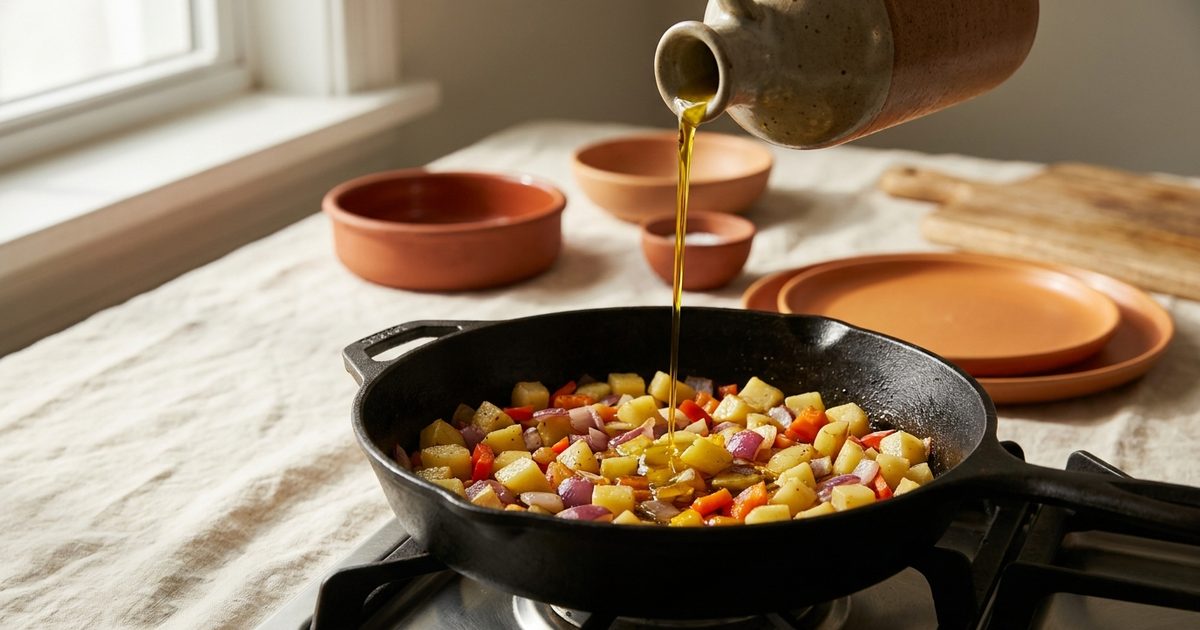
The oil in the pan and the butter finishing the vegetables never reach the log because they are invisible on the plate, and they are the densest thing in the kitchen: fat carries 9 calories per gram versus 4 for protein and carbs, the standard labeling conversion factors. This is routinely the largest single omission in home cooking, and it is also the error photo-based tracking is structurally blind to, as we cover in Why Calorie Tracking Apps Are Inaccurate.
The fix costs three words: put the fat in the sentence. "Chicken stir fry cooked in oil" and "vegetables with butter" let the estimate account for what the plate hides. You do not need to measure the oil; you need to stop logging as if it does not exist.
Mistake 2: not logging drinks
Liquid calories skip the fullness circuit and skip the log almost as often. The verified spread is enormous: the same Grande Starbucks cup runs from 5 calories (black cold brew) to 480 (Mocha Cookie Crumble Frappuccino) by Starbucks' own numbers (full list), a medium Coke is 270 by McDonald's data, and Panera's 20-ounce agave lemonade is 210. A daily 400-calorie drink habit is a meal that never appears in the record.
The fix: the drink is part of the meal sentence, always, including the "just a beer" and the oat milk latte. If drinks are your main leak, the numbers in our Starbucks guide will likely be the highest-leverage table you read this year.
Mistake 3: forgetting sauces, dressings, and packets
Dressing on the salad, mayo on the sandwich, two sauce packets with the nuggets. Individually small, collectively a meal: one Chick-fil-A sauce is 140 calories by the official data, so the standard two-packet habit adds 280, more than the entire difference between grilled and fried nuggets (the math). Guacamole at Chipotle is a verified 230.
The fix is the same three-word rule: say them. "Cobb salad with ranch" and "nuggets with two sauces" are logs; the versions without those words are fiction with good intentions.
Mistake 4: guessing portions small
When people eyeball portions, they round down, and the research shows how far the compounding goes: in the New England Journal of Medicine study we cite throughout this site, subjects underreported their actual intake by an average of 47 percent while genuinely believing their diets were failing for metabolic reasons. Their expenditure was normal; the gap was entirely in the records.
The fix: when torn between two portion sizes, log the bigger one, and mention scale honestly ("large plate," "small bowl"). Restaurant portions especially run large; our restaurant guide covers component estimation for plates you did not build. Nouri turns a photo into a sentence first, so you can add "large portion" before anything is counted.
The arithmetic: how 1,800 becomes 2,540
Here is a completely ordinary day of mistakes 1 through 3, using only verified numbers:
| What happened | Logged | Reality gap |
|---|---|---|
| Meals as described, honestly logged | 1,800 | (baseline) |
| Latte instead of the logged black coffee | 0 | +185 (190 vs 5, Starbucks data) |
| Medium Coke with lunch, unlogged | 0 | +270 (McDonald's data) |
| Two sauce packets at dinner, unlogged | 0 | +280 (Chick-fil-A data) |
| Day total | 1,800 | 2,535, call it 2,540 |
No binge, no dishonesty, no exotic foods: 735 unlogged calories, or 41 percent on top of the log, from three routine omissions. If this person's target was a 500-calorie deficit, they finished the day in a slight surplus while their app congratulated them. Run for a month, this is the "I track everything and nothing happens" experience, manufactured.
Mistake 5: skipping the bad days
The office-cake-and-drive-through day is exactly the day most likely to go unlogged, which means your dataset only describes your good days. The trend then has to absorb thousands of phantom calories, and it does so by looking like a plateau you cannot explain. A logged 3,100-calorie day is information; a blank day is a lie the math has to route around.
The fix is a mindset swap: bad days are the most valuable logs you own, because they are the ones that explain outcomes. Log them with extra care and zero self-commentary. The trend does not judge; it just needs the data. If it helps, log the chaotic day as a single honest line rather than itemizing it perfectly: "office party, cake, maybe 3,000 total" is a fully functional entry that keeps the week's math intact.
Mistake 6: weekend amnesia
Five clean weekdays, two untracked weekend days, one flat scale "nobody can understand." Two days is 29 percent of the week; leave them dark and your weekly picture is built from a strongly biased sample, since weekends are when restaurant meals, drinks, and grazing cluster.
The fix: lower the bar, not the coverage. Weekend logs can be rougher, "big brunch, two mimosas, snacked on chips watching the game" is a legitimate entry, but they must exist. Rough coverage beats precise gaps by a mile.
Mistake 7: quitting because logging takes too long
This is the mistake underneath all the others, and the one I made personally. My first tracker's numbers were fine, but logging a normal dinner took several minutes of database searching, and after long days I just would not do it. By week three I had stopped opening the app, at which point its accuracy was zero. Every mistake above gets worse as friction rises, because tired people cut the optional steps first, and in a high-friction logger, everything feels optional.
The fix is structural, not motivational: make the log cost less than the mistake. That is the entire design brief behind Nouri. Type one sentence like a note, "burger and fries, medium coke, two sauces," say it, or snap a photo, and calories and macros come back instantly with per-item reasoning. Nouri also has the best Siri logging of any calorie tracking app: say "Hey Siri, track food in Nouri" from the lock screen, answer in one sentence, and your calories and macros appear with what is left for the day, without opening the app. When a complete honest log takes ten seconds, mistakes 1 through 6 stop being discipline problems and become typos you fix in the next sentence.
How Nouri Reports catch these mistakes
Most of these mistakes show up as weekly patterns. Most calorie apps give you numbers. Nouri gives you answers, in a weekly Nouri Report:
- Wins, slips, and one clear focus: what went right, what cost you, and the one thing to change next week
- Days on target, judged by your goal, whether that is losing, maintaining, or gaining
- Average calories, protein, carbs, and fat against your targets, and a Health Score with "Why this score?"
- Apple Health: calories burned against calories eaten, plus your workouts
Your first report arrives after 3 logged days in your first week, then every Sunday evening for any week with 4 or more logged days. A report only reads what you logged, so the fixes above come first. Reports live under Progress, then Reports, and are part of Nouri Premium.
Where your calories are probably hiding
The most-missed items, all from official published data we have verified:
| Commonly unlogged item | Calories | Source data |
|---|---|---|
| Splash-of-something coffee upgrade (latte vs black) | +185 | Starbucks guide |
| Sauce packet | 140 | Chick-fil-A guide |
| Agave lemonade, 20 oz | 210 | Panera guide |
| Guacamole add-on | 230 | Chipotle guide |
| Medium Coca-Cola | 270 | McDonald's guide |
| Baguette side "because it comes with it" | 190 | Panera guide |
| The burrito tortilla itself | 320 | Chipotle guide |
FAQ
Why am I not losing weight even though I track my calories?
The most evidence-backed answer: the log is incomplete in one direction. Between unlogged drinks, sauces, cooking fat, and small-guessed portions, the worked example above manufactures a 735-calorie gap out of an ordinary honest-feeling day, and research has documented average gaps of 47 percent.
What foods do people forget to log the most?
Cooking oil and butter, drinks, sauces and dressings, sides "that come with it," and tastes while cooking. The hidden-calorie table above prices the usual suspects with verified numbers.
Do drinks really matter for calorie counting?
They are frequently the single largest unlogged category: 270 for a medium Coke, up to 440 for one blended coffee, by the chains' own published data. A daily sweet drink is a phantom meal.
Should I log food even if I do not know the exact calories?
Always. A rough estimate keeps the trend honest, while a skipped entry is a 100 percent error in the flattering direction. Consistency of coverage, not precision, is what makes tracking work.
Do I need to log cheat days?
Cheat days are the highest-value logs you have, because they carry the calories that explain your results. Skip logging them and your data describes a diet you are not actually on.
How can I stop forgetting to log meals?
Shrink the action until remembering is the only hard part, then attach it to the meal itself: log while ordering, while plating, or while the kettle boils. In Nouri, smart reminders catch the meals that slip through, and Siri logs one sentence from the lock screen.
Does cooking oil really add that many calories?
Fat is 9 calories per gram, more than double protein and carbs, so small amounts of invisible oil move totals disproportionately. You do not need the exact grams: mentioning "cooked in oil" lets the estimate include it, which beats silently pricing the meal as if it were steamed.
How accurate do my portions need to be?
Consistent beats correct: if you always describe portions the same way, your trend stays readable even when individual guesses are off. The one directional rule: when torn between sizes, choose the larger, because portion errors cluster low.
What is the biggest calorie tracking mistake?
Quitting, and it is usually caused by friction rather than willpower. Every other mistake on this list can be fixed inside a tracking habit that still exists; nothing can be fixed inside one that ended in week three.
How do I log a meal someone else cooked?
Describe what you can see and taste, with the cooking method: "aunt's lasagna, big slice, garlic bread with butter." Component-style description, covered in the restaurant guide, works identically at a dinner table.
What is a Nouri Report?
A weekly report built from your logs: Health Score, macros against targets, days on target for your goal, wins, slips, and one clear focus. It arrives after 3 logged days in your first week, then every Sunday evening when you log 4 or more days.
How does Nouri help with these mistakes?
By making the complete log the easy log: one sentence, a photo, or Siri covers the meal, drink, sauces, and cooking fat, with a per-item breakdown you can recalculate. Then the weekly Nouri Report names your slips.
Bottom line
Food logging fails through seven repeatable mistakes, and they share one root: every omission errs in the same flattering direction, so an ordinary day of small skips builds a 700-calorie fiction, as the worked table shows with verified numbers. The counter-strategy is coverage over precision: say the fat, say the drink, say the sauce, log the bad days, and keep weekend entries alive even when they are rough. Then remove the friction that causes it all: try Nouri free and the complete log becomes one ten-second sentence. Start from the foundations in Calorie Counting 101, and when you want to know why perfect accuracy was never the point, read Why Calorie Tracking Apps Are Inaccurate.
Sources
- Underreporting: Lichtman SW et al., "Discrepancy between self-reported and actual caloric intake and exercise in obese subjects," New England Journal of Medicine, 1992, pubmed.ncbi.nlm.nih.gov/1454084 (checked August 29, 2026)
- Calorie conversion factors (4/4/9): 21 CFR 101.9(c)(1), law.cornell.edu/cfr/text/21/101.9 (checked August 29, 2026)
- All menu-item figures: our verified chain guides linked in the tables, each citing the chain's official published nutrition data (all checked August 29, 2026)
Keep reading
All articlesAre AI Calorie Apps Accurate? What the 2026 Research Actually Shows
A 2026 study found an AI photo app underestimated intake by 25%. What the research says about AI calorie apps, and why a photo can't see the oil.
GuidesIn a Calorie Deficit But Not Losing Weight? 9 Reasons and the Fix for Each
In an NEJM study, people reporting under 1,200 calories underreported intake by 47%. 9 reasons the scale won't move, with a fix for each.
GuidesHow Many Calories Do You Need While Breastfeeding? (CDC vs ACOG, Explained)
The CDC says 330 to 400 extra calories a day while breastfeeding; ACOG says 450 to 500. Why they differ and how to find your own number.
Guides'Mom Calories': What Eating Your Kids' Leftovers Really Adds Up To
3 nuggets, some crusts, cheese crackers and juice sips add up to about 297 calories a day, or 2,079 a week. The guilt-free tally, with USDA numbers.