

Calorie Counting 101: How to Start Without Burning Out
How calorie counting works: set a target with Mifflin-St Jeor, a worked example, deficit sizes by goal, an honest app comparison, and mistakes to avoid.

Calorie counting means estimating your daily energy burn, then eating consistently relative to it: below to lose weight, near to maintain, above to gain. Most adults burn roughly 1,600 to 3,000 calories a day depending on size, age, and activity, and a moderate fat-loss deficit is 300 to 500 below that. The math rarely fails; people quit, usually within three weeks, because logging was hard.
What a calorie deficit actually is
Your body spends energy continuously: keeping you alive at rest, digesting food, and moving. Eat less than you spend and the difference comes out of stored energy, mostly body fat, and weight trends down. Eat more and the difference is stored, and weight trends up. That is the entire mechanism. Every diet that works, works through this, whatever the branding says about carbs, fasting windows, or food combinations.
Two honest caveats before the numbers. First, every figure in this system is an estimate. US labeling law considers a food label compliant even when the item's actual calories run up to 20 percent above the declared value, so the "200-calorie" bar can legally be 240. Second, your daily burn is itself an estimate that shifts with activity, and no formula measures you personally. None of this breaks calorie counting, because you are not steering by a single number; you are steering by a trend built from hundreds of logs, and consistent estimates produce a readable trend even when each individual number is a little off. We cover the error sources in detail in Why Calorie Tracking Apps Are Inaccurate.
Step 1: set a starting target
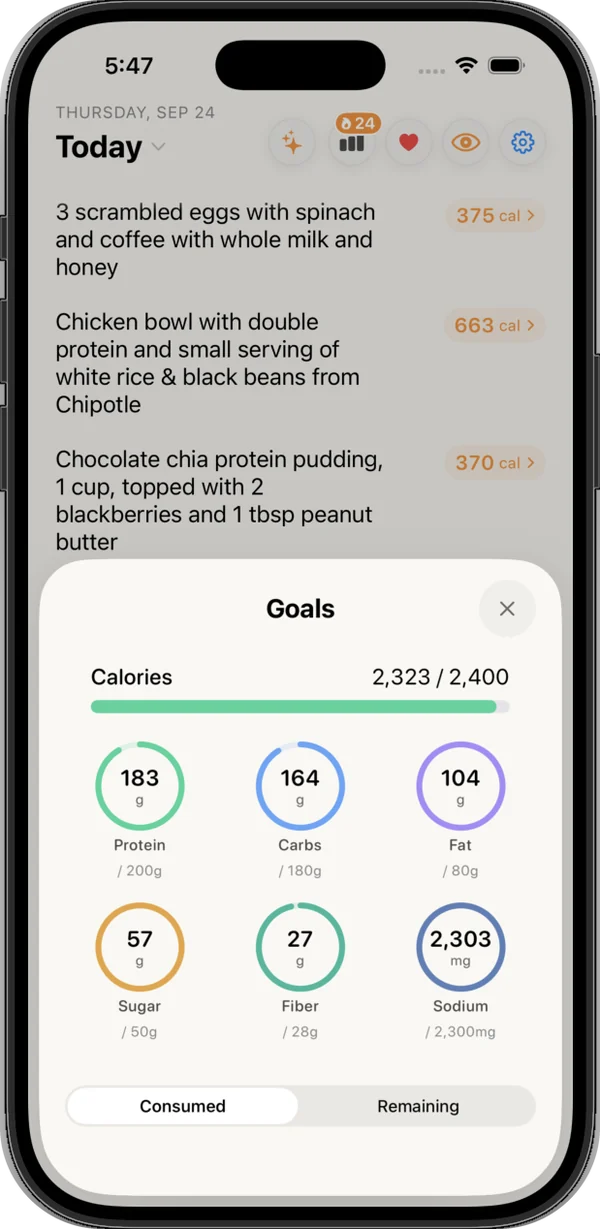
Most calculators and apps estimate your resting burn with the Mifflin-St Jeor equation, published in the American Journal of Clinical Nutrition in 1990 and still the standard for healthy adults. In its commonly used simplified form:
- Men: 10 x weight (kg) + 6.25 x height (cm) - 5 x age + 5
- Women: 10 x weight (kg) + 6.25 x height (cm) - 5 x age - 161
That gives resting calories, which you multiply by an activity factor to estimate total daily burn (TDEE):
| Activity level | Multiplier | Looks like |
|---|---|---|
| Sedentary | 1.2 | Desk job, little intentional exercise |
| Lightly active | 1.375 | Exercise 1 to 3 days a week |
| Moderately active | 1.55 | Exercise 3 to 5 days a week |
| Very active | 1.725 | Hard exercise 6 to 7 days a week |
| Extremely active | 1.9 | Physical job plus training |
A worked example. A 30-year-old woman, 165 cm (5'5"), 70 kg (154 lb), exercising twice a week:
- Resting: 10 x 70 + 6.25 x 165 - 5 x 30 - 161 = 700 + 1,031 - 150 - 161 = 1,420 calories
- TDEE: 1,420 x 1.375 = 1,953 calories, call it 1,950
- Moderate deficit: 1,950 - 450 = a starting target of about 1,500 calories per day
How big a deficit to take depends on your goal and patience:
| Goal | Deficit below TDEE | Trade-off |
|---|---|---|
| Gentle recomposition | 200 to 300 | Slow change, easiest to sustain and to train through |
| Standard fat loss | 300 to 500 | The usual recommendation, noticeable progress without misery |
| Aggressive cut | 500 to 750 | Faster, but hunger, fatigue, and quit-risk all rise |
| Maintenance | 0 | Useful for learning your true TDEE before cutting |
Treat whatever number you compute as a hypothesis, not a verdict. People routinely mis-rate their own activity level, which is the biggest error in the whole calculation, and the fix is in step 4. For the full story on what is inside that daily-burn number, see TDEE Explained.
Step 2: log everything for two weeks, without judging it
The first two weeks are reconnaissance, not restriction. Log every meal, snack, and drink exactly as eaten, including the days that go sideways. Do not change how you eat yet, and do not moralize any entry. The goal is a truthful picture of your current normal, because you cannot adjust a diet you have not actually seen.
The truthfulness matters more than beginners expect. In a New England Journal of Medicine study of people who believed they could not lose weight despite eating very little, subjects turned out to be underreporting their actual intake by an average of 47 percent and overreporting exercise by 51 percent. Their metabolisms were normal; their records were not. That study is the strongest argument for logging the embarrassing days with extra care: a 3,100-calorie logged day is data, while a blank day is a hole your trend has to lie around.
Most people finish the two weeks surprised by two or three specific items, not by everything. A daily coffee order, a cooking-oil habit, a "small" nightly snack. Which brings us to step 3.
Step 3: adjust the biggest lever first
Do not overhaul your diet. Find the largest single contributor your log revealed and change only that. A 440-calorie blended coffee becomes a 190-calorie latte (our Starbucks numbers). Fries with everything becomes fries twice a week. The 900-calorie takeout dinner becomes the 570-calorie version of the same cuisine (restaurant strategies here).
One targeted change of 250 to 400 calories a day often gets a beginner most of the way to a standard deficit while leaving 95 percent of their eating untouched. That matters because adherence, not ambition, is what produces results. A modest change you repeat for four months beats a dramatic plan you abandon in ten days, every time.
Step 4: judge the trend, not the day
Daily body weight swings with water, salt, carbs, and timing, which is why a single weigh-in can move a kilogram in either direction overnight while your actual fat mass barely changed. Weigh on a consistent schedule, same time of day, and judge only the two-week direction. Flat trend at a logged intake means you found your real maintenance, which is more accurate than any formula. Trending down at the expected pace means your numbers are working. Trending flat in a supposed deficit usually means intake is higher than logged, and the usual suspects are in our common logging mistakes post.
This feedback loop is also why consistency of method beats precision of any single log. If you always estimate your portions the same way, your errors are roughly constant, and the trend still reads true.
Review your week, not just your numbers
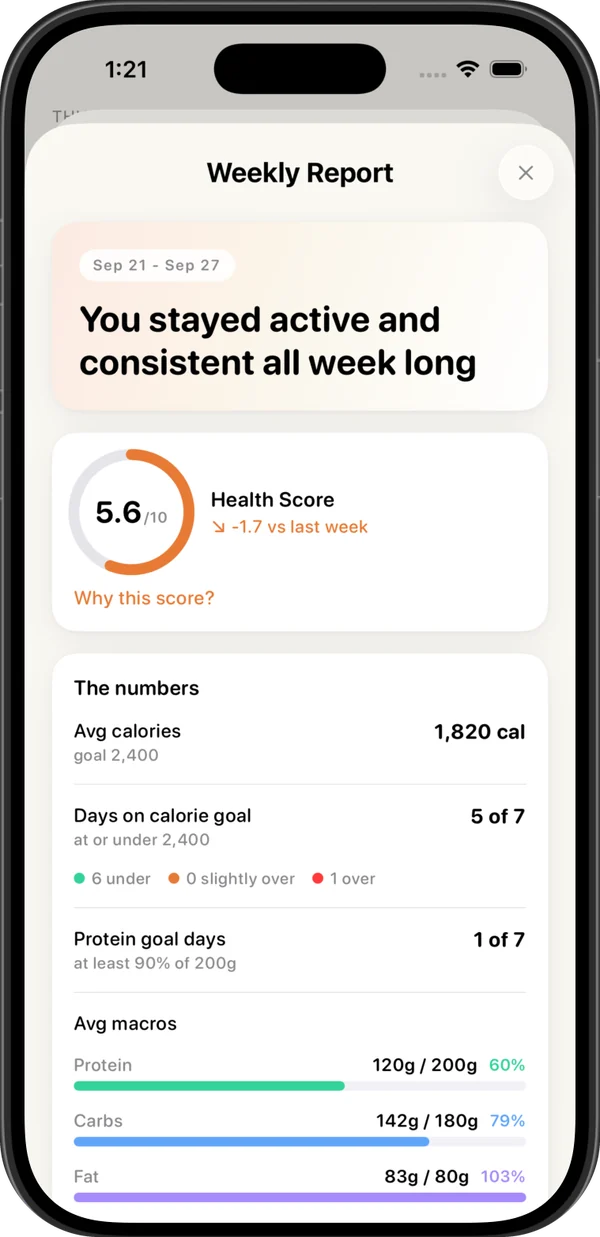
Counting gives you numbers. Reviewing your week is the habit that turns them into results, and a Nouri Report does it for you every Sunday evening when you log 4 or more days. Inside: a Health Score with "Why this score?", average macros against your targets, days on target judged by your own goal, your wins, your slips, and one clear focus for next week.
Which app should you count with?
The honest answer: the one you will still open in week six. Features do not matter after you stop logging. Facts below are from each product's official site or App Store listing, checked September 26, 2026; how each one logs comes from its own published materials.
| App | How you log | What it tracks | Platforms | Price |
|---|---|---|---|---|
| Nouri | Type, voice, photo, or Siri from the lock screen | Calories, macros, fiber, sugar, sodium, Health Score, AI coach | iPhone (iOS only) | $9.99/month or $39.99/year, 3-day free trial on the yearly plan |
| MyFitnessPal | Database search, barcode scan | Calories, macros | iOS, Android, web | Free tier; $9.99/mo or $49.99/yr; 7-day trial |
| Cronometer | Database search, barcode; photo and voice on paid tier | Calories, macros, up to 84 micronutrients | iOS, Android, web | Free tier; Gold $10.99/mo or $59.99/yr |
| Cal AI | Photo first, barcode, describe | Calories, macros, steps | iOS, Android | Subscription after 3-day trial; App Store lists Unlimited purchases $2.99 to $29.99 |
My own history runs through this table. I used MyFitnessPal first, and the numbers were never the problem: logging a normal dinner took several minutes of database searching, and after a long day I just would not do it. By week three I had stopped opening the app, and a tracker you do not open has an accuracy of zero. That experience is why Nouri, the AI calorie tracker we build, logs the way you would write a note: type or say "chicken stir fry with rice, a beer," snap a photo, or ask Siri. Calories and macros come back instantly with the reasoning shown item by item, and if a portion looks off, add "cooked in oil" and recalculate. The full comparison against photo-first logging is in Nouri vs Cal AI.
Common mistakes that break the count
- Skipping the bad days. Your trend only works if the data covers your whole life, not your proud days. Log the birthday cake.
- Ignoring drinks and cooking fat. The two most-missed calorie sources, invisible on the plate and absent from most logs.
- Chasing precision instead of consistency. Weighing lettuce while eyeballing oil is backwards; be roughly right about everything rather than exact about trivia.
- Setting an aggressive target on day one. The quit rate on 750-calorie deficits is the real cost nobody logs.
- Treating one flat week as failure. Water masks fat loss for days at a time; two-week trends or nothing.
The full list with fixes is in Common Food Logging Mistakes.
FAQ
How many calories should I eat a day to lose weight?
Compute your TDEE (worked example above) and subtract 300 to 500. For the woman in our example that meant about 1,500 a day against a 1,950 burn. There is no universal number; a large active man's deficit target can be higher than a small sedentary woman's maintenance.
How do I figure out my calorie deficit?
Estimate TDEE with Mifflin-St Jeor times an activity factor, subtract your chosen deficit, then verify against reality: if two weeks of honest logging at that intake moves the scale as expected, your numbers are right. If not, adjust the target, not the logging.
Is a 1,200-calorie diet safe?
For many adults it is too low to sustain and below what several activity levels genuinely need. Very low targets also raise the quit risk that kills most attempts. If you believe you need an unusually low target, that is a conversation for a healthcare provider, not an app default.
Why am I not losing weight in a calorie deficit?
The most common answer, supported by the NEJM underreporting study above, is that the deficit exists on paper but not on the plate: unlogged bites, drinks, oil, and weekends. The second is time: water retention can hide fat loss for a week or two. Audit the log first, then give the trend fourteen days.
Do calories from protein, carbs, and fat count differently?
For the energy balance itself, a calorie is a calorie. For everything around it, hunger, muscle retention, and how your day feels, the split matters a lot, protein most of all. That is the next layer: How to Track Macros.
Should I eat back the calories I burn exercising?
Be careful: exercise burns are the most overestimated numbers in fitness, and eating back an inflated burn erases real deficits. A practical compromise is to eat back no more than half of what a device claims, and let your two-week trend arbitrate.
How accurate is calorie counting?
Approximate by design: labels can legally run 20 percent over, portions vary, and formulas estimate averages. It still works because consistent errors leave the trend readable. Precision is not the goal; direction is.
Do I have to count calories forever?
No. Most people count seriously for a few months, learn what their normal meals actually cost, and then maintain with occasional check-in weeks. The skill outlives the logging.
What is the easiest way to count calories?
Whatever method you will repeat on your worst day, and for most people that is describing the meal instead of searching a database. In Nouri, you can say "Hey Siri, track food in Nouri" from the lock screen, answer in one sentence, and the calories and macros card appears right away with what you have left for the day. It is the best Siri logging of any calorie tracking app.
How long does it take to see results from calorie counting?
The log gives useful information in two weeks. Visible body changes typically take longer, and the scale trend will confirm direction well before the mirror does. Judge nothing on less than fourteen days of data.
Can I count calories without weighing my food?
Yes, if you accept estimates and keep them consistent. Weighing is the precision tool; described portions ("a large plate," "two tablespoons") are the consistency tool, and consistency is what the trend actually needs.
What is a Nouri Report?
A personal weekly report built from your logs: Health Score with "Why this score?", macros against targets, days on target for your goal, wins, slips, and one clear focus. Your first arrives after 3 logged days in your first week, then every Sunday evening when you log 4 or more days.
Bottom line
Calorie counting is a feedback loop, not a punishment system: estimate a target, log honestly, change one thing, and let the two-week trend tell you the truth. The math takes ten minutes to learn; the entire game is making the logging cheap enough that you still do it in month three. Set your starting number with the worked example above, then make logging a single sentence in Nouri, which sets your target with the same Mifflin-St Jeor formula and sends a weekly Nouri Report on what to change. When you are ready for the next layer, How to Track Macros and TDEE Explained are the natural next reads.
Sources
- Mifflin MD, St Jeor ST et al., "A new predictive equation for resting energy expenditure in healthy individuals," American Journal of Clinical Nutrition, 1990, pubmed.ncbi.nlm.nih.gov/2305711 (checked September 26, 2026)
- Lichtman SW et al., "Discrepancy between self-reported and actual caloric intake and exercise in obese subjects," New England Journal of Medicine, 1992, pubmed.ncbi.nlm.nih.gov/1454084 (checked September 26, 2026)
- US nutrition label tolerance: 21 CFR 101.9(g)(5), law.cornell.edu/cfr/text/21/101.9 (checked September 26, 2026)
- App pricing: myfitnesspal.com/premium, cronometer.com/gold, calai.app and its App Store listing (all checked September 26, 2026)
Keep reading
All articlesAre AI Calorie Apps Accurate? What the 2026 Research Actually Shows
A 2026 study found an AI photo app underestimated intake by 25%. What the research says about AI calorie apps, and why a photo can't see the oil.
GuidesIn a Calorie Deficit But Not Losing Weight? 9 Reasons and the Fix for Each
In an NEJM study, people reporting under 1,200 calories underreported intake by 47%. 9 reasons the scale won't move, with a fix for each.
GuidesHow Many Calories Do You Need While Breastfeeding? (CDC vs ACOG, Explained)
The CDC says 330 to 400 extra calories a day while breastfeeding; ACOG says 450 to 500. Why they differ and how to find your own number.
Guides'Mom Calories': What Eating Your Kids' Leftovers Really Adds Up To
3 nuggets, some crusts, cheese crackers and juice sips add up to about 297 calories a day, or 2,079 a week. The guilt-free tally, with USDA numbers.