
In a Calorie Deficit But Not Losing Weight? 9 Reasons and the Fix for Each
In an NEJM study, people reporting under 1,200 calories underreported intake by 47%. 9 reasons the scale won't move, with a fix for each.
If you are in a calorie deficit but not losing weight, the deficit is usually smaller than it looks on paper. In a classic NEJM study, people who reported eating under 1,200 calories a day had underreported their real intake by 47% on average and overreported exercise by 51%. The other usual suspects: water, scale noise, a shrinking TDEE, or simply not enough weeks yet.
Why am I in a calorie deficit but not losing weight?
First, the good news: you are not broken, and your metabolism did not "shut down." The same NEJM study measured energy burn directly and found it was within 5% of predicted values in people who said they could not lose weight. The math still works. Something in the math is just off.
Almost every stalled deficit comes down to one of nine things. Here they are at a glance, then one by one.
| # | Reason | The fix |
|---|---|---|
| 1 | You eat more than you track | Track everything for 7 days, estimates included |
| 2 | Oils, butter, sauces, dressings | Measure fats for a week, add "cooked in" to every meal |
| 3 | Drinks | Track every drink, coffee add-ins included |
| 4 | Weekends | Judge the 7-day average, not Monday to Friday |
| 5 | Water retention | Wait it out, keep salt and carbs steady |
| 6 | Daily scale noise | Weigh daily, compare weekly averages |
| 7 | Overestimated exercise burn | Don't eat back every calorie your watch claims |
| 8 | Your TDEE dropped as you lost | Recalculate every 10 pounds or so |
| 9 | Not enough time yet | Give it 3 to 4 weeks before changing the plan |
1. You're eating more than you think (everyone does)
This is the big one, and it is not a character flaw. It is a human-memory problem. In Lichtman and colleagues' 1992 NEJM study, ten adults with a long history of "diet resistance" said they were eating under 1,200 calories a day. Researchers measured what they actually ate and burned for 14 days. They underreported food by an average of 47% and overreported physical activity by 51%. Their metabolisms were normal.
Nobody in that study was lying. A bite of your kid's pasta, the handful of crackers while cooking, the "small" portion that was really a large one: these never feel like eating, so they never get tracked.
The fix: for seven days, track everything, including the stuff that feels too small to count. A rough estimate beats a blank every time. If tracking has felt like homework before, How to Stick to Calorie Tracking is the low-effort version.
2. Cooking oils, butter, and sauces are invisible
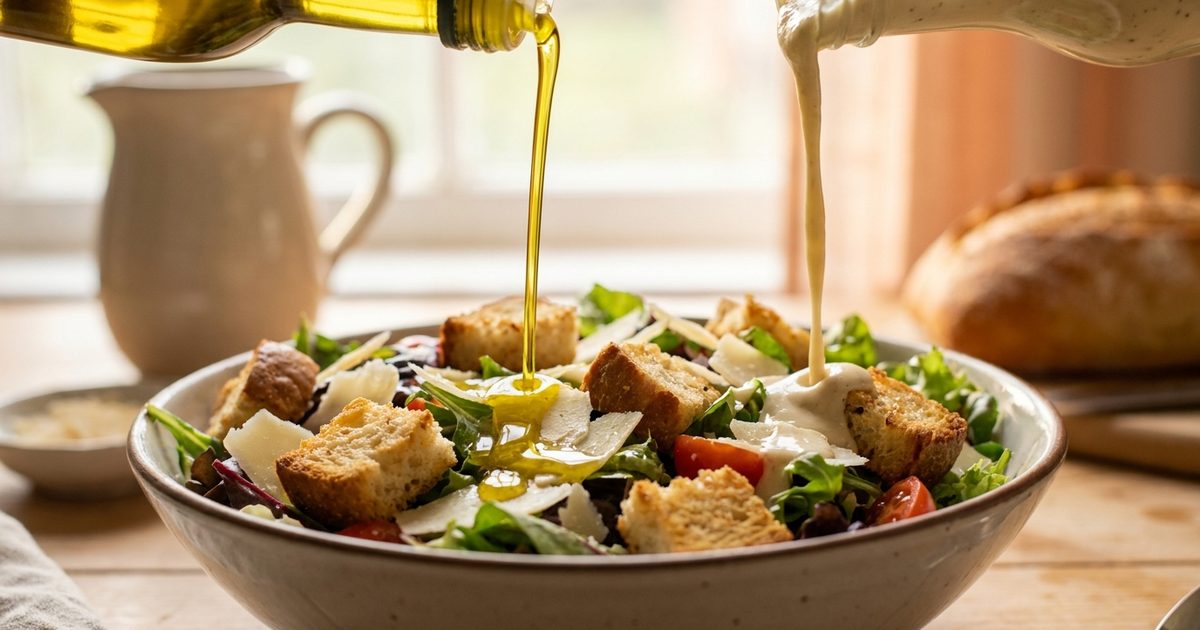
Fat is the most calorie-dense thing in your kitchen, and it hides. One tablespoon of olive oil is 119 calories, and most people pour more than a tablespoon into a pan. Two tablespoons of Caesar dressing add 163 calories to a "light" salad. Every number below comes from USDA FoodData Central.
The hidden calories table
| Hidden add-on | Amount | Calories | USDA FDC ID |
|---|---|---|---|
| Olive oil | 1 tbsp (13.5g) | 119 | 171413 |
| Butter, salted | 1 tbsp (14.2g) | 102 | 173410 |
| Mayonnaise, regular | 1 tbsp (13.8g) | 94 | 171009 |
| Ranch dressing, regular | 2 tbsp (30g) | 129 | 173592 |
| Caesar dressing, regular | 2 tbsp (30g) | 163 | 169055 |
| Peanut butter, smooth | 2 tbsp (32g) | 191 | 172470 |
| Almonds | 1 oz (28g, about 23 nuts) | 164 | 170567 |
| Half and half | 2 tbsp (1 fl oz) | 40 | 171255 |
| Sugar | 2 tsp (8.4g) | 33 | 169655 |
A worked example: the 1,400-calorie day that wasn't
Say your app shows 1,400 calories today. Here is what never made it in:
- Olive oil in the pan for dinner, 1 tbsp: 119
- Ranch on the lunch salad, 2 tbsp: 129
- Half and half in two coffees, 2 tbsp each: 40 + 40 = 80
- A handful of almonds at your desk, 1 oz: 164
- A glass of red wine, 5 fl oz: 125
That is 119 + 129 + 80 + 164 + 125 = 617 calories, and your real day was 1,400 + 617 = 2,017. A 500-calorie deficit just turned into maintenance, and nothing about the day felt like overeating.
The fix: for one week, measure the fats: oil, butter, nut butter, dressing. After that, eyeballing works much better because you have calibrated. And always add "cooked in" to cooked meals: "salmon cooked in a tablespoon of butter" is a different meal than "salmon." More traps live in Common Food Logging Mistakes, and for lower-calorie swaps that still taste good, see Low Calorie Food Swaps.
3. Drinks count, even the healthy-sounding ones
Liquid calories don't fill you up the way food does, and they are the easiest to forget. A 12 fl oz can of regular cola is 155 calories, a cup of orange juice is 112, a 5 fl oz glass of red wine is 125, and a can of regular beer is 153, all per USDA data. Two drinks on a Tuesday is roughly 250 to 310 calories nobody tracked.
The fix: track drinks like food, and give coffee its add-ins. For alcohol specifically, How to Track Alcohol Calories breaks down standard drinks.
4. Weekends erase the week
Five tidy weekdays at a 500-calorie deficit bank 2,500 calories. A Friday dinner out, Saturday brunch, and Sunday takeout can spend all of that without anything feeling dramatic. The weekly math nets out near zero, and the scale shrugs.
The fix: judge the 7-day average, not the weekday streak. You don't have to give up weekends; you have to count them. Weekend Calories and Weight Loss has the full playbook.
5. Water retention is hiding fat loss
Your body can lose fat and hold extra water at the same time, so the scale stays flat even while progress is happening underneath. Common triggers: a salty restaurant meal, a high-carb day after low-carb ones, a new or harder workout (sore muscles hold fluid), poor sleep, stress, and the menstrual cycle.
The fix: don't change the plan because of one flat week. Keep salt and carbs fairly steady, sleep, and wait. Water weight leaves when the trigger does, and the fat loss shows up all at once, often called the "whoosh."
6. The scale is noisy day to day
Your weight on any given morning includes food still in your gut, water, and salt. That daily swing can easily be bigger than a week's worth of fat loss. Comparing Monday to Tuesday tells you almost nothing.
The fix: weigh daily or several times a week, same time, same conditions, and compare weekly averages. If this week's average is lower than last week's, it is working. Also, the scale is not the only scoreboard: how your clothes fit, your lifts going up, and your energy are real progress too.
7. You're overestimating exercise burn
Lichtman's study found people overreported activity by 51% on average. Fitness trackers and cardio machines give estimates, not measurements, and eating back every calorie a watch claims is a fast way to erase a deficit.
The fix: keep moving (it is great for you), but don't treat the burn number as a food coupon. Eat back a portion of it at most, or set your calorie target from your normal activity level and leave workouts out of the math.
8. Your TDEE dropped as you lost weight
A smaller body burns fewer calories. Using the Mifflin-St Jeor equation, every 10 kg (about 22 pounds) lost lowers resting burn by about 100 calories a day, before activity is counted. So a deficit that was 500 calories at the start can quietly shrink by 100 calories or more a few months in.
The fix: recalculate your target every 10 pounds or so. What Is TDEE? explains the formula, and the calorie deficit calculator does it for you.
9. It hasn't been long enough
NHLBI guidance says a deficit of 500 to 1,000 calories a day produces about 1 to 2 pounds of loss per week. One pound a week is easy to lose in daily water swings, so a single week, or even two, can look like nothing happened. Kevin Hall's NIH modeling also shows the body's weight response to a calorie change is slow, with a half-time of about a year to reach the new steady state.
The fix: give a new plan 3 to 4 weeks of weekly averages before you change anything. Want to see when your goal is realistic? Try the goal weight date calculator.
When it might be medical: see a doctor
If you have tracked carefully for a month, the weekly average hasn't moved, and none of the above fits, talk to a doctor. NIDDK lists health problems that can affect weight, including hypothyroidism, polycystic ovary syndrome (PCOS), and Cushing's syndrome, plus medicines such as corticosteroids, some antidepressants, some diabetes medicines like insulin, and some blood pressure medicines. Never stop a prescribed medicine on your own. Bring your tracking data to the appointment; it makes the conversation much faster.
Is 1,200 calories too low to lose weight?
Eating less is not the answer to a stalled deficit, and going lower can backfire with hunger, low energy, and rebounds. The NHLBI Practical Guide says diets of 1,000 to 1,200 calories a day suit most women and 1,200 to 1,600 suit men, and that calorie floor is a clinical guideline, not a goal. If you are already at "1,200 and not losing," the fix is almost always finding the hidden calories, not cutting further. Talk to a doctor or registered dietitian for a number that fits you. And if you have a history of disordered eating, please work with a professional before tracking calories at all.
How to find where your calories are hiding
I learned this one the hard way. When I used AI photo trackers, I was eating "in a deficit" and not losing weight. Then I added up the actual ingredients of a few meals. A plate the camera called around 400 calories worked out closer to 700. The camera could not see the oil in the pan or the portion under the garnish. That gap is exactly reason #2 above, and it is why I built Nouri.
In Nouri, every meal gets a per-item breakdown: each food listed separately, with the reasoning behind its estimate and a confidence rating. So instead of one mystery number, you see "salmon, 6 oz" and "butter, 1 tbsp" as separate lines, and you can spot what was assumed or missed. Forgot the dressing? Add the context in a few words and Nouri recalculates. Photos get turned into a sentence first, so you can read what it thinks it saw before anything is counted. We also publish how our estimates hold up: Nouri scored 92.1/100 in our 100-meal accuracy benchmark (MyFitnessPal 77.0).
You can type a meal, say it, snap a photo, or tell Siri from the lock screen. After a few days, a Nouri Report shows your average calories against your target, so weekend creep and drink calories stop hiding inside "good" weekdays. The freshly redesigned Nouri is iPhone (iOS only), with a 3-day free trial. Think of it as a detective for the 617 calories that never made it into your app.
FAQ
Why am I not losing weight in a calorie deficit?
Most often the deficit is smaller than it looks because some food, oil, sauce, or drinks never get tracked. In one NEJM study, people underreported their intake by an average of 47%. Water retention, daily scale swings, and a TDEE that drops as you lose can also hide progress for a few weeks.
Why am I eating 1,200 calories and not losing weight?
The study that defined this question found people reporting under 1,200 calories were actually eating far more, with normal metabolisms. Track everything for a week, measure cooking fats, and include drinks before cutting further. If nothing changes after a careful month, see a doctor.
How long does it take to see weight loss in a calorie deficit?
NHLBI guidance links a 500 to 1,000 calorie daily deficit to about 1 to 2 pounds a week. Because daily water swings can hide that, give it 3 to 4 weeks of weekly averages before judging.
Can you gain weight in a calorie deficit?
On the scale, temporarily, yes: water from salt, carbs, a new workout, or your cycle can outweigh a week of fat loss. Fat gain in a true deficit isn't how energy balance works, which is why weekly averages matter more than any single morning.
Is my metabolism broken if I'm not losing weight?
Very unlikely. In the Lichtman NEJM study, measured energy burn in people who said they couldn't lose weight was within 5% of predicted values. Your TDEE does drop as you get smaller, which is normal and fixable by recalculating.
Should I eat less if I'm not losing weight?
Not first. Check your tracking for hidden oils, sauces, drinks, and weekends before cutting, because going below NHLBI's general floors of 1,000 to 1,200 calories (women) or 1,200 to 1,600 (men) isn't a good idea without medical guidance. A doctor or registered dietitian can set a safe number for you.
Should I eat back the calories I burn exercising?
Eat back only part of them, if any. Trackers and machines estimate burn, and people in the Lichtman study overreported activity by 51%. Setting your target from your normal activity level is simpler.
Does water retention stop weight loss?
It doesn't stop fat loss, but it can hide it on the scale for days or a couple of weeks. Salty meals, carb swings, hard workouts, poor sleep, stress, and the menstrual cycle are common triggers.
How often should I weigh myself when losing weight?
Daily or several times a week works well if you compare weekly averages, not single days. Weigh at the same time under the same conditions, like after waking up.
Can a medical condition stop weight loss?
Some can make it harder. NIDDK lists hypothyroidism, PCOS, and Cushing's syndrome, plus certain medicines such as corticosteroids and some antidepressants. If careful tracking hasn't moved your weekly average in a month, see a doctor.
What is the easiest way to track calories accurately?
Use a tracker that shows its work, so you can see where calories hide. Nouri lets you type, say, snap, or Siri a meal in one sentence, then breaks it into items with reasoning and a confidence rating you can correct in a few words.
Stuck deficits are almost always a tracking gap, a water fluke, or a patience problem, and every one has a fix. Find yours with a week of honest tracking in Nouri, then recalculate with What Is TDEE? and keep weekends in check with Weekend Calories and Weight Loss. Winter is a great time to lock in, and you are closer than the scale says.
Sources
- Lichtman SW et al., "Discrepancy between self-reported and actual caloric intake and exercise in obese subjects," New England Journal of Medicine, 1992, pubmed.ncbi.nlm.nih.gov/1454084 (checked Oct 23, 2026)
- Hall KD et al., "Quantification of the effect of energy imbalance on bodyweight," The Lancet, 2011, pubmed.ncbi.nlm.nih.gov/21872751 (checked Oct 23, 2026)
- Mifflin MD, St Jeor ST et al., "A new predictive equation for resting energy expenditure in healthy individuals," American Journal of Clinical Nutrition, 1990, pubmed.ncbi.nlm.nih.gov/2305711 (checked Oct 23, 2026)
- NHLBI and NAASO, The Practical Guide: Identification, Evaluation, and Treatment of Overweight and Obesity in Adults, nhlbi.nih.gov/files/docs/guidelines/prctgd_c.pdf (checked Oct 23, 2026)
- NIDDK, Factors Affecting Weight & Health, niddk.nih.gov (checked Oct 23, 2026)
- USDA FoodData Central, SR Legacy: Oil, olive, salad or cooking (FDC 171413), fdc.nal.usda.gov/food-details/171413/nutrients; Butter, salted (FDC 173410), fdc.nal.usda.gov/food-details/173410/nutrients; Salad dressing, mayonnaise, regular (FDC 171009), fdc.nal.usda.gov/food-details/171009/nutrients; Salad dressing, ranch dressing, regular (FDC 173592), fdc.nal.usda.gov/food-details/173592/nutrients; Salad dressing, caesar dressing, regular (FDC 169055), fdc.nal.usda.gov/food-details/169055/nutrients (checked Oct 23, 2026)
- USDA FoodData Central, SR Legacy: Peanut butter, smooth style, without salt (FDC 172470), fdc.nal.usda.gov/food-details/172470/nutrients; Nuts, almonds (FDC 170567), fdc.nal.usda.gov/food-details/170567/nutrients; Cream, fluid, half and half (FDC 171255), fdc.nal.usda.gov/food-details/171255/nutrients; Sugars, granulated (FDC 169655), fdc.nal.usda.gov/food-details/169655/nutrients (checked Oct 23, 2026)
- USDA FoodData Central, SR Legacy: Beverages, carbonated, cola, regular (FDC 174852), fdc.nal.usda.gov/food-details/174852/nutrients; Orange juice, raw (FDC 169098), fdc.nal.usda.gov/food-details/169098/nutrients; Alcoholic beverage, wine, table, red (FDC 173190), fdc.nal.usda.gov/food-details/173190/nutrients; Alcoholic beverage, beer, regular, all (FDC 168746), fdc.nal.usda.gov/food-details/168746/nutrients (checked Oct 23, 2026)
Keep reading
All articlesAre AI Calorie Apps Accurate? What the 2026 Research Actually Shows
A 2026 study found an AI photo app underestimated intake by 25%. What the research says about AI calorie apps, and why a photo can't see the oil.
GuidesHow Many Calories Do You Need While Breastfeeding? (CDC vs ACOG, Explained)
The CDC says 330 to 400 extra calories a day while breastfeeding; ACOG says 450 to 500. Why they differ and how to find your own number.
Guides'Mom Calories': What Eating Your Kids' Leftovers Really Adds Up To
3 nuggets, some crusts, cheese crackers and juice sips add up to about 297 calories a day, or 2,079 a week. The guilt-free tally, with USDA numbers.
GuidesFibermaxxing: How to Hit 30g of Fiber a Day Without Wrecking Your Gut
Fibermaxxing means eating more fiber on purpose. Most adults need 25 to 38g a day. A 33.7g sample day, a slow ramp-up plan, and who should go easy.