
Are AI Calorie Apps Accurate? What the 2026 Research Actually Shows
A 2026 study found an AI photo app underestimated intake by 25%. What the research says about AI calorie apps, and why a photo can't see the oil.
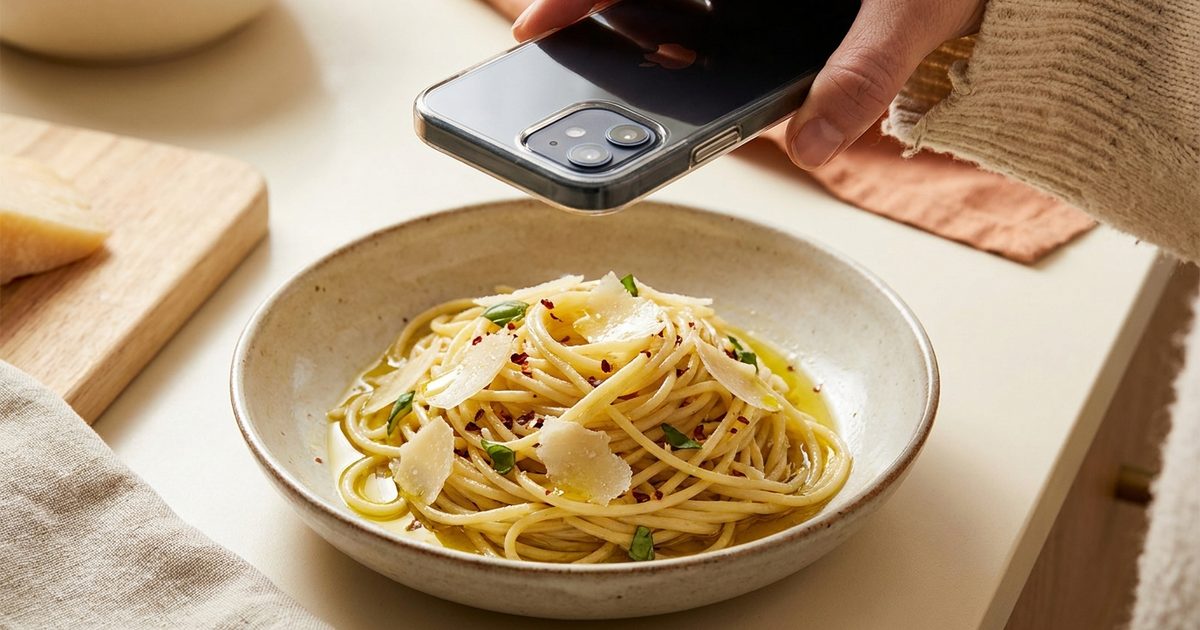
AI calorie apps are good at naming food and shaky at counting it. In a 2026 University Hospital Zurich study, an AI photo app underestimated real energy intake by 25%, or 817 calories a day on average, against a gold-standard lab method. Other 2025 and 2026 studies agree: photos run low, bigger portions run lower, and adding words to the picture makes estimates better.
Are AI calorie apps accurate in 2026?
Short version: accurate enough to be useful, not accurate enough to trust blindly. The research from the past two years keeps landing on the same pattern.
AI is now very good at the first job, which is recognizing what is on the plate. A 2025 study from the Royal College of Surgeons in Ireland gave ChatGPT-4 114 meal photos, and it identified the foods with 93.0% precision. That part is basically solved.
The second job, turning "pasta with sauce" into grams and calories, is where things wobble. The same Irish study found poor agreement on meal weight for medium and large meals, and the model underestimated 11 of 16 nutrients. Recognition is easy. Quantity is hard.
If you want the bigger picture on every source of error in tracking (labels, databases, the human doing the tracking), we covered that in Why Calorie Tracking Apps Are Inaccurate. This post sticks to one question: what does the newest research say about AI and photos?
What did the 2025 and 2026 studies actually find?
Here are the peer-reviewed studies we read in full abstract today, from PubMed, with only the findings the authors reported.
| Study | What they tested | What they found |
|---|---|---|
| University Hospital Zurich, npj Digital Medicine, 2026 | An AI photo app vs doubly labelled water, 20 women, 7 days, real life | App underestimated intake by 25% (817 kcal/day on average); individual-level agreement was negligible |
| University of Gothenburg, Current Developments in Nutrition, 2025 | 3 leading AI models on 52 standardized food photos | Best models missed energy by 35.8% on average; all underestimated, more so as portions grew |
| RCSI Dublin, Nutrients, 2025 | ChatGPT-4 on 114 meal photos | 93.0% precision naming foods; poor on medium and large portion weights; underestimated 11 of 16 nutrients |
| Universidad Europea del Atlántico, Nutrients, 2025 | ChatGPT-5 on 195 dishes, photo alone vs photo plus text | Accuracy improved as non-visual details and ingredient amounts were added |
| University of Padua, Scientific Reports, 2026 | 40 vision-language models vs professional nutritionists | Nutritionists substantially outperformed every model; ingredient descriptions slightly improved results |
| University of Minnesota and Northwestern, Journal of Nutrition, 2026 | 4 AI models given foods as text, vs a research database | High agreement for energy and macros; condiments and mixed dishes drove most of the variability |
| University of Sydney, Nutrients, 2024 | 7 AI food-image recognition apps vs food records | Authors concluded automatic energy estimates from image recognition were inaccurate, especially for mixed dishes |
Read across the rows and one thing jumps out: nobody found that photos overestimate. The direction is consistently low.
Why do AI photo calorie apps underestimate?
Because a photo is a picture of the surface, and the calories are often not on the surface.
The oil. A camera sees glossy vegetables. It cannot see that they were tossed in two tablespoons of olive oil. Per USDA FoodData Central, one tablespoon of olive oil (13.5 g) is 119 calories. Most home cooks pour more than one.
The sauces and dressings. Butter melted into rice, cream stirred into a sauce, ranch hiding under salad leaves. One tablespoon of salted butter is 102 calories, and two tablespoons of regular ranch is 129, per USDA.
Portion depth. A photo is flat. A deep bowl of pasta and a shallow plate of pasta can look nearly identical from above. The Gothenburg team found the underestimate got bigger as portions got bigger, which is exactly what you would expect if the model is guessing volume from a 2D image.
What is underneath. The second chicken thigh under the greens. The cheese inside the burrito. The peanut butter in the smoothie. If it is not visible, it is a guess.
Here is how fast the invisible stuff adds up on one ordinary dinner:
| Hidden ingredient | Amount | Calories (USDA) |
|---|---|---|
| Olive oil in the pan | 1 tbsp | 119 |
| Butter on the rice | 1 tbsp | 102 |
| Ranch on the side salad | 2 tbsp | 129 |
| Total the camera can't see | 350 |
That is 119 + 102 + 129 = 350 calories from three ingredients a photo will mostly miss. For a lot of people, that is most of their daily deficit, gone without a trace.
A photo can't see the oil. Not because the AI is bad, but because the oil is not in the picture.
Does adding a description make AI calorie estimates more accurate?
Yes, and this is the most useful finding of the year.
The Spanish ChatGPT-5 study ran the same 195 dishes four ways: photo only, photo plus standard non-visual details, photo plus an ingredient list with amounts, and the ingredient list alone. Accuracy improved step by step as text was added to the photo. Interestingly, dropping the photo entirely made it worse again, so the picture and the words work best together.
The Padua study, which tested 40 models, found the same direction on a smaller scale: ingredient descriptions slightly improved results. And the Minnesota and Northwestern study, which only used text, found high agreement with a research database for calories and macros, with condiments and mixed dishes as the troublemakers.
Put together, the 2026 takeaway is: words carry the information cameras miss. "Cooked in butter," "large bowl," "extra dressing." Those three phrases are worth more than any camera upgrade.
For a full breakdown of when to type, talk, snap, or use Siri, see Text vs Voice vs Photo vs Siri.
Is AI calorie tracking still worth it?
Yes, as long as you treat the number as a draft, not a verdict.
The Zurich study is the sobering one, but read it carefully. The same study found a standard 24-hour dietary recall, the method researchers have used for decades, underestimated intake by 50%. The AI app's 25% gap was smaller than the old-school method's. Humans are bad at this too.
And the Gothenburg authors concluded the best AI models reached accuracy comparable to traditional self-reported methods, without the effort. That is the real win. Most people do not quit tracking because the numbers were 10% off. They quit because tracking took forever. A fast estimate you actually use beats a perfect one you abandon by week three.
The catch is the direction. If every error points low, a "1,500-calorie day" might really be 1,900, and you will wonder why nothing is changing. Our guide to being in a calorie deficit but not losing weight walks through that exact problem. The fix is not to ditch AI. It is to use AI that shows its work and lets you correct it.
One gentle note: if you have a history of disordered eating, please work with a doctor or registered dietitian before tracking calories. Your health matters more than any number.
What I learned switching from photo apps
I used MyFitnessPal first. The numbers were fine. Tracking a normal dinner took several minutes, and after a long day I just would not do it.
So I switched to AI photo trackers. Fast, which fixed the habit, but I was not losing weight. When I checked the photo estimates against what the ingredients actually added up to, they kept coming in low. A plate the camera called around 400 calories worked out closer to 700. The camera could not see the oil in the pan or the portion under the garnish.
Reading the 2025 and 2026 studies felt like déjà vu. Systematic underestimation, worse on bigger portions, better when you add words. That is the gap I built Nouri to close.
How Nouri handles photos differently
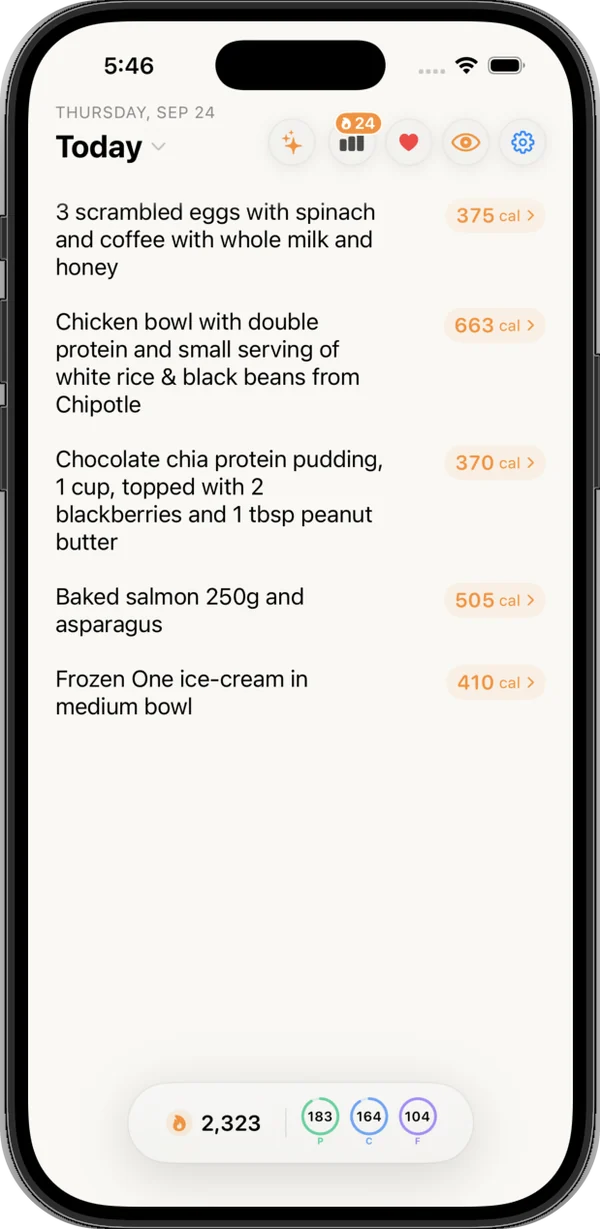
Nouri does not jump from photo to number. It turns the photo into a sentence first. When I photographed a breakfast plate, it wrote "Two poached eggs on avocado toast, bacon, scrambled eggs, and fresh fruit bowl," then broke it into four items: 850 calories, 42g protein, 75g carbs, 42g fat. You see what it thinks it saw before anything is counted, so you can add "scrambled in butter" and recalculate.
That lines up with what the research keeps saying: photo plus words beats photo alone.
- Four equal ways to add food. Type it, say it, snap it, or use Siri from the lock screen: "Hey Siri, track food in Nouri." Text and voice are where hidden ingredients get captured, because you can say "cooked in oil."
- Reasoning on every item. Each item shows how Nouri got its number, plus a confidence rating, so you know when to add detail.
- Add context, recalculate. "Large bowl," "extra dressing," "made with whole milk." One line, new number.
- Our own benchmark. In our 100-meal accuracy benchmark, Nouri scored 92.1/100 (MyFitnessPal 77.0). Every input in that test was typed text, which is also what Nouri turns a photo into before it calculates. It is our own test, with the method and results public.
Then a weekly Nouri Report turns your logs into a read on your week: days on target, averages against your goals, and one clear focus. Most calorie apps give you numbers. Nouri gives you answers.
Common mistakes with AI calorie apps
Trusting the first number on a mixed dish. Stir-fries, curries, pasta, and burritos hide their calories inside. Read the breakdown and add the cooking fat. Common Food Logging Mistakes shows where the rest hides.
Photographing a deep bowl from straight above. Depth is invisible from the top. Add "large bowl" or a rough cup amount in words.
Forgetting drinks and extras. The latte, the wine, the sauce packet. A camera only sees what you point it at. Our alcohol calories guide and coffee calories guide cover the usual culprits.
Ignoring a confidence rating. If an app tells you it is unsure, that is your cue to add a detail, not to scroll past.
FAQ
Are AI calorie apps accurate?
They are very good at recognizing foods and less reliable at estimating amounts. Peer-reviewed studies from 2025 and 2026 consistently found photo-based estimates run low, especially on larger portions. Treat the number as a draft you check, not a final answer.
How accurate are photo calorie counters?
In a 2026 Zurich study, an AI photo app underestimated real intake by 25% on average against doubly labelled water. A 2025 Gothenburg study found the best AI models missed energy by about 36% on standardized photos. Accuracy is best on clearly laid-out plates and worst on mixed dishes.
Why do AI calorie apps underestimate calories?
A photo only shows the surface. Cooking oil, butter, sauces, dressing, and food stacked underneath are invisible, and portion depth is hard to judge from a flat image. Those hidden items are often the most calorie-dense things on the plate.
Can AI count calories from a picture?
Yes, it can produce an estimate, and modern models identify foods well. A 2025 Irish study found ChatGPT-4 named foods with 93% precision but struggled with medium and large portion weights. Adding a short description improves the result.
Is ChatGPT accurate for counting calories?
Studies show general AI models are decent at naming food and rougher at portions. A 2026 Journal of Nutrition study found high agreement for calories and macros when foods were entered as text, with condiments and mixed dishes causing the most variability. You can read our take in ChatGPT for calorie counting.
Is typing food more accurate than taking a photo?
Text lets you include what a camera cannot see, like "cooked in oil" or "large bowl." Research shows adding text details to a photo improves estimates. For a breakdown by situation, see Text vs Voice vs Photo vs Siri.
Are AI calorie apps better than manual tracking?
The 2026 Zurich study found a standard 24-hour recall underestimated intake by 50%, worse than the AI app's 25%. Both had errors. The best method is the one you will use consistently and can correct.
What is the best AI calorie tracker?
Look for one that shows what it thinks it saw, explains each item, tells you how confident it is, and lets you add context and recalculate. Speed matters too, because the app you open every day beats the one you abandon. Our best calorie tracker guide compares the options.
Does the iPhone camera count calories?
iOS 27 added a camera mode that can look up nutrition info for a plate of food, but it is a lookup, not a calorie log. We broke it down in iOS 27 Food Camera.
How do I make AI calorie tracking more accurate?
Add the invisible stuff in words: cooking fat, sauces, dressings, drinks, and portion size. Track every meal, including the messy ones, and judge progress by your weekly trend. Our deficit calculator helps you set a realistic target.
Will AI calorie apps get more accurate?
The 2026 Padua study found model architecture explained 99.6% of the variance in performance, so newer models do matter. But no model can see oil that is not in the photo. Pairing photos with words is the fix that works today.
What is the easiest way to track calories accurately with AI?
Use an app that lets you snap, type, or talk, and shows its reasoning before it counts. In Nouri, a photo becomes a sentence you can edit, every item shows a confidence rating, and you can say "Hey Siri, track food in Nouri" from the lock screen. Add "cooked in butter" and recalculate in one line.
AI calorie apps are a genuine upgrade over giving up, as long as you remember the photo can't see the oil. Add the hidden stuff in words with Nouri, and if the scale is stuck, start with In a Calorie Deficit But Not Losing Weight? and Why Calorie Tracking Apps Are Inaccurate. Every starting point is a good one.
Sources
- Serra M, Alceste D et al., "Limited validity of an AI-powered app for dietary assessment in females with obesity," npj Digital Medicine, 2026, pubmed.ncbi.nlm.nih.gov/41845048 (checked Oct 23, 2026)
- Fridolfsson J et al., "Performance Evaluation of 3 Large Language Models for Nutritional Content Estimation from Food Images," Current Developments in Nutrition, 2025, pubmed.ncbi.nlm.nih.gov/41081011 (checked Oct 23, 2026)
- O'Hara C et al., "An Evaluation of ChatGPT for Nutrient Content Estimation from Meal Photographs," Nutrients, 2025, pubmed.ncbi.nlm.nih.gov/40004936 (checked Oct 23, 2026)
- Rodríguez-Jiménez M et al., "Image-Based Dietary Energy and Macronutrients Estimation with ChatGPT-5: Cross-Source Evaluation Across Escalating Context Scenarios," Nutrients, 2025, pubmed.ncbi.nlm.nih.gov/41305663 (checked Oct 23, 2026)
- Vedovelli L et al., "Model architecture dominates nutritional estimation accuracy in vision-language systems," Scientific Reports, 2026, pubmed.ncbi.nlm.nih.gov/42350490 (checked Oct 23, 2026)
- Lawabni R et al., "Evaluation of Energy and Nutrient Estimates from Large Language Models Using Text-Based Queries," Journal of Nutrition, 2026, pubmed.ncbi.nlm.nih.gov/42401322 (checked Oct 23, 2026)
- Li X et al., "Evaluating the Quality and Comparative Validity of Manual Food Logging and Artificial Intelligence-Enabled Food Image Recognition in Apps for Nutrition Care," Nutrients, 2024, pubmed.ncbi.nlm.nih.gov/39125452 (checked Oct 23, 2026)
- USDA FoodData Central, SR Legacy: Oil, olive, salad or cooking (FDC 171413), fdc.nal.usda.gov/food-details/171413/nutrients; Butter, salted (FDC 173410), fdc.nal.usda.gov/food-details/173410/nutrients; Salad dressing, ranch dressing, regular (FDC 173592), fdc.nal.usda.gov/food-details/173592/nutrients (checked Oct 23, 2026)
- Nouri benchmark and breakfast plate example: nouriapp.co/accuracy and firsthand logs from the Nouri app (checked Oct 23, 2026)
Keep reading
All articlesIn a Calorie Deficit But Not Losing Weight? 9 Reasons and the Fix for Each
In an NEJM study, people reporting under 1,200 calories underreported intake by 47%. 9 reasons the scale won't move, with a fix for each.
GuidesHow Many Calories Do You Need While Breastfeeding? (CDC vs ACOG, Explained)
The CDC says 330 to 400 extra calories a day while breastfeeding; ACOG says 450 to 500. Why they differ and how to find your own number.
Guides'Mom Calories': What Eating Your Kids' Leftovers Really Adds Up To
3 nuggets, some crusts, cheese crackers and juice sips add up to about 297 calories a day, or 2,079 a week. The guilt-free tally, with USDA numbers.
GuidesFibermaxxing: How to Hit 30g of Fiber a Day Without Wrecking Your Gut
Fibermaxxing means eating more fiber on purpose. Most adults need 25 to 38g a day. A 33.7g sample day, a slow ramp-up plan, and who should go easy.