
Can ChatGPT Count Your Calories? What Works, What Breaks
ChatGPT calorie counting, checked against the research: a 35.8% average error on meal photos, what it does well, where it breaks, and a prompt that helps.
Yes, ChatGPT can estimate calories, and for single foods it is often in range: a 2024 study found 97 percent of its energy values within 40 percent of USDA data. As a tracker, it breaks. In a 2025 photo study its calorie estimates were off by 35.8 percent on average, and it keeps no daily log, targets, or trends unless you build them.
Why so many people count calories with ChatGPT
The appeal is real, and it is the same reason I built Nouri. Traditional trackers ask you to search a database, pick one of forty near-identical entries, set a portion, and repeat for every ingredient. ChatGPT asks you to type "two eggs, toast with butter, a latte" and answers in a second. People share stories on Reddit and in newsletters about losing weight this way, and the common thread is not that ChatGPT was precise. It is that describing a meal in plain words was easy enough to keep doing.
That matters more than most accuracy debates. I used MyFitnessPal first, and the numbers were fine. Logging a normal dinner took several minutes, and after a long day I just would not do it. Accuracy does not matter if you stop logging by week three. So if ChatGPT is what gets you to write your meals down, that is a genuine win. The question is what happens after week three, when you want a total you can trust, a target, and a trend.
What ChatGPT does well
Credit where it is due. ChatGPT is good at several parts of calorie counting:
- Natural-language meal descriptions. It understands "half a burrito bowl, extra chicken, no rice" without a database search.
- Quick ballpark estimates for common foods, especially single items. The 2024 study below found its energy values reasonably close to USDA data.
- Breaking a meal into parts and explaining its assumptions, if you ask it to.
- Meal ideas and planning. "Give me three 500-calorie dinners with 40 g of protein" is a great prompt. In the same 2024 study, its daily meal plans stayed within the requested calorie limit, with every meal's stated calories within 30 percent of USDA values.
- Explaining nutrition concepts, like why your maintenance calories differ from a friend's or how to split macros.
Even Cronometer, which makes a database tracker, recommends ChatGPT for meal inspiration, recipe ideas, and meal prep planning, while arguing it should not be your only tracking tool.
What the research says about ChatGPT's calorie estimates
Here is what published studies actually measured. Each one was read at the source.
| Study | What ChatGPT was given | Key finding |
|---|---|---|
| Haman et al., Nutrition, 2024 | Text questions about foods | 97% of energy values within 40% of USDA data; relatively consistent across repeats |
| O'Hara et al., Nutrients, 2025 | 114 meal photos | 93% precision identifying foods; poor weight agreement for medium and large meals; underestimated 11 of 16 nutrients |
| Fridolfsson et al., Current Developments in Nutrition, 2025 | 52 standardized food photos | Calorie error averaged 35.8%; protein error 60.7%; underestimation grew with portion size |
| Rodríguez-Jiménez et al., Nutrients, 2025 | 195 dishes, four levels of context | Accuracy improved as non-visual details and ingredient amounts were added |
| Ponzo et al., J Clin Med, 2024 | Two patient cases, three consecutive days | ChatGPT 4.0 reproducibility of advice was 50% in the simpler case |
Two patterns stand out. First, ChatGPT is better at naming foods than weighing them: it recognized 93 percent of foods in the 2025 photo study but struggled with how much was on the plate. Second, the misses lean low. Both photo studies found underestimation, worse for bigger portions. If you are trying to lose weight, a tracker that quietly rounds your dinner down is the expensive kind of wrong.
That matches what I saw with AI photo trackers before building Nouri. A plate the camera called around 400 calories worked out closer to 700 when I added up the actual ingredients. The camera cannot see the oil in the pan or the portion under the garnish. The 2025 context study points to the fix: the more you say about the meal, the better the estimate gets.
Where ChatGPT breaks as a calorie tracker
Estimating one meal and tracking a diet are different jobs. These are the gaps, based on OpenAI's own help pages, checked October 13, 2026.
No structured daily log or targets
ChatGPT is a conversation, not a log. There is no calorie goal field, no "remaining today" number, and no meal history it maintains for you as data. You can keep a running total inside one chat, but you are the database administrator. Start a new chat and the total is gone unless memory picks it up.
Memory is not a food diary
ChatGPT's memory can reference saved memories and past chats, but OpenAI says plainly that memory "does not retain every detail from every conversation." ChatGPT decides what is relevant. Projects help: they keep chats, files, and instructions together, so a "Food log" project is the best setup if you go this route. Still, OpenAI notes you cannot see a list of project memories, and nothing turns your meals into a table you can query.
Apple Health: it reads, but it does not write
It is worth being exact here. With the newer Health feature, rolling out to eligible adult users in the U.S., ChatGPT can connect to Apple Health on iPhone and use that data in answers. But OpenAI's help page is explicit: ChatGPT can only read from Apple Health and cannot write information back. Your ChatGPT meals never become dietary energy in Apple Health, so your watch, your scale app, and anything else on your phone never see them. We cover why that matters in Does Apple Health Track Calories Eaten?.
The same meal can get a different number
A database tracker returns the same entry for the same food every time. ChatGPT generates a fresh estimate. The 2024 Nutrition study found its single-food values fairly consistent, but a separate 2024 study that asked chatbots the same nutrition questions on three days found reproducibility of ChatGPT 4.0's advice at 50 percent in the simpler case. When you cannot see which reference value it used, you cannot tell a real change in your diet from a change in the estimate.
No history, trends, or weekly view
Did you average 1,900 or 2,300 calories last week? Which days did you hit protein? A tracker answers that in a glance. In ChatGPT, you would need every day's total in one place first, then ask it to do the math, and trust it did not drop a day.
If you use ChatGPT anyway, do this
If ChatGPT is your tool, make it behave more like a tracker. Create a project called "Food log," paste this into the project instructions, and start one chat per day:
You are my calorie log. My daily targets: [1,900] calories and [130] g protein.
For every meal I send:
1. List each item on its own line: food, the portion you assumed,
   calories, protein, carbs, fat.
2. State assumptions about cooking oil, butter, sauces, and portion size.
   If one guess could change the meal by more than 100 calories, ask me first.
3. For whole foods, use USDA FoodData Central values. For chain restaurants,
   use the chain's published nutrition. Say which you used.
4. After each meal, show today's running total and what is left.
5. Never change an earlier entry unless I ask.
When I say "close the day," give me one line I can save:
date, calories, protein, carbs, fat.
Then follow three habits:
- Describe meals like a witness. Portion, cooking method, and the fat: "1 cup rice, chicken breast about the size of my palm, cooked in a tablespoon of olive oil." The research is clear that context improves estimates.
- Save the closing line outside ChatGPT. Paste it into a note or spreadsheet every night. That is your real log, and it is what lets you see a week. Our Apple Notes calorie tracker template is built for exactly this.
- Spot-check the big items. Check your three most frequent meals against a label or USDA once, then keep using those numbers.
ChatGPT can write a sonnet about your burrito. Nouri just logs it and tells you what is left for the day.
A worked example: why "chicken and rice" is not a log
Here is how much detail moves a total, using USDA FoodData Central values (roasted chicken breast, FDC 171477; cooked white rice, FDC 168878; olive oil, FDC 171413):
| What you typed | Math | Calories |
|---|---|---|
| "Chicken and rice" read as 1 cup chicken, 1 cup rice | 231 + 205 | 436 |
| Same, but it was 2 cups of rice | 436 + 205 | 641 |
| Same, cooked in 1 tbsp olive oil | 641 + 119 | 760 |
Same three words, a 324-calorie spread. ChatGPT is not wrong to guess 436. It answered the sentence it got. Any estimator, human or AI, can only price the meal you describe. More on this in Common Food Logging Mistakes.
ChatGPT vs a calorie tracker
| ChatGPT | Nouri | |
|---|---|---|
| How you log | Type or talk in a chat | Type it like a note, say it, snap a photo, or ask Siri |
| Daily targets and what is left | Only if you ask it to keep a total | Built in, shown after every meal |
| Per-item breakdown | If you ask | Always, with reasoning and a confidence rating |
| Saved history and weekly view | Not as structured data | Every meal saved; weekly Nouri Reports |
| Apple Health | Reads (Health feature); cannot write | Writes nutrition; reads calories burned, workouts, steps |
| Price | Free and paid plans | $9.99/month or $39.99/year, 3-day free trial |
| Platform | Web and apps | iPhone (iOS only) |
Nouri: describe your meal like a chat, but a real tracker
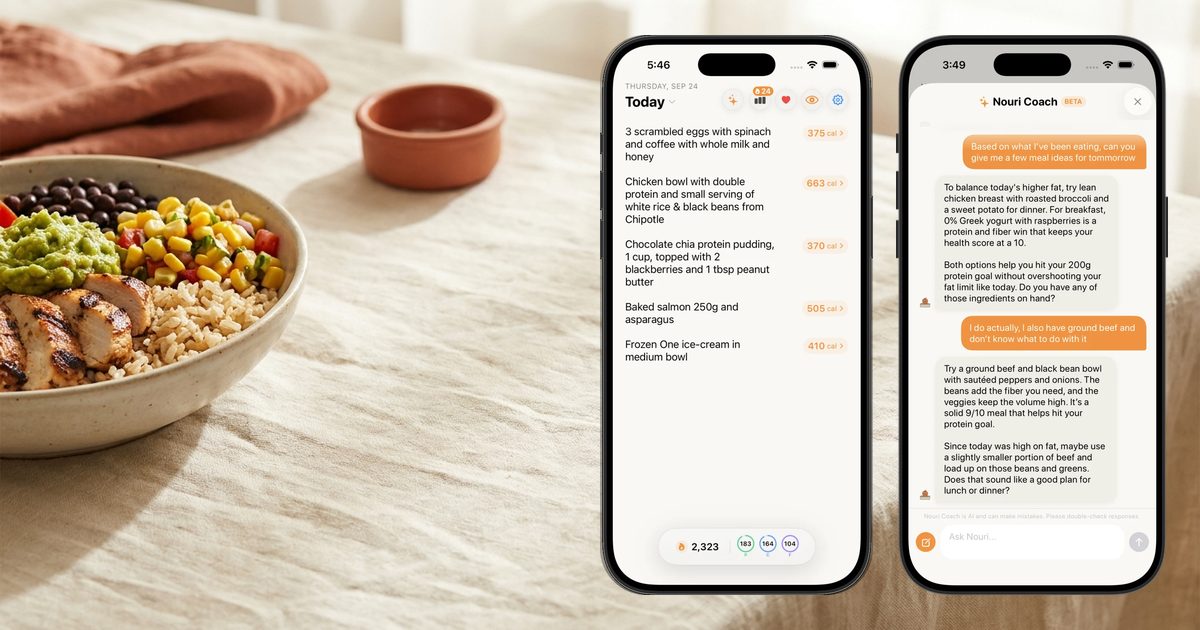
Nouri keeps the part people love about ChatGPT and adds the part it is missing. You log the way you would describe a meal to a friend: type it like a note, say it, snap a photo, or ask Siri from the lock screen. "Hey Siri, track food in Nouri," one sentence, and a calories and macros card appears with what you have left for the day, without opening the app. Photos become a sentence first, so you can read what Nouri saw and correct it before anything is counted.
Every meal comes back instantly with calories and macros per item, the reasoning behind each number, and a confidence rating. If something looks off, add context like "cooked in butter" and recalculate. That is the prompt template above, built into the app, except the result is saved as data: your daily target, protein goal, fiber, sugar, and sodium, a per-meal vitamin scorecard, and a Health Score for each meal. Nouri writes your nutrition to Apple Health and reads calories burned, workouts, and steps. Nouri Coach answers questions about your own eating, the way you might ask ChatGPT, but grounded in what you actually logged.
We also test our numbers in public: Nouri scored 92.1/100 in our 100-meal accuracy benchmark (MyFitnessPal 77.0). Then there are Nouri Reports. Most calorie apps give you numbers. Nouri gives you answers: your first report after 3 logged days, then every Sunday with 4 or more logged days, with averages against your targets, days on target, wins, slips, and one clear focus for next week. Nouri is iPhone (iOS only), and you can try it free.
Common mistakes when counting calories with ChatGPT
- Leaving out the fat. Oil and butter are where meals hide calories. Say them every time.
- Trusting photo estimates for big plates. Both 2025 photo studies found underestimation that grew with portion size. Add a sentence to every photo.
- Keeping the log only in chat history. Memory is selective. Save the daily total somewhere you control.
- Asking for a new estimate of the same meal every day. Lock in numbers for repeat meals instead of regenerating them.
- Skipping the hard days. A rough log of a messy day beats a blank one. See How to Stick to Calorie Tracking.
FAQ
Is ChatGPT accurate for counting calories?
It depends on the input. A 2024 study found 97 percent of its single-food energy values within 40 percent of USDA data, which is a loose bar. For meal photos, a 2025 study measured a 35.8 percent average calorie error, with larger portions underestimated more.
Can ChatGPT track my calories for the whole day?
It can keep a running total inside one conversation if you ask it to. It does not maintain a structured daily log, target, or history for you, and OpenAI says memory does not retain every detail from every conversation. Save each day's total outside the chat.
Does ChatGPT remember what I ate yesterday?
Sometimes. With memory on, ChatGPT can reference past chats, but it decides what is relevant rather than storing every meal. A "Food log" project improves this, but it still is not a food diary you can browse.
Can ChatGPT read my Apple Health data?
With the Health feature, eligible U.S. users 18 and older can connect Apple Health on iPhone, and ChatGPT can use that data in answers. It cannot write anything back, so meals you describe in ChatGPT do not appear in Apple Health.
Is it safe to lose weight using ChatGPT for calories?
Plenty of people use it for rough estimates, and consistency matters more than precision. Treat its numbers as estimates, include cooking fats and portions, and talk to a doctor or dietitian if you have a medical condition. ChatGPT itself is not a medical tool.
Can ChatGPT count calories from a photo?
Yes, it can estimate from a photo, and it is good at identifying foods: 93 percent precision in one 2025 study. It is weaker at portion size, especially for medium and large meals, so add a sentence about portions and cooking method.
What is the best prompt for counting calories in ChatGPT?
Ask for one line per item with the portion it assumed, explicit assumptions about oil and sauces, a running total against your target, and no silent changes to earlier entries. The full template is above.
Why does ChatGPT give different calories for the same food?
It generates each answer rather than looking up one fixed entry, so wording and context change the result. Lock in numbers for meals you eat often and reuse them.
Is ChatGPT better than MyFitnessPal for counting calories?
They solve different problems. ChatGPT is faster to talk to; a tracker keeps a structured log, targets, and history. Nouri scored 92.1/100 in our 100-meal accuracy benchmark (MyFitnessPal 77.0); we did not test ChatGPT.
Can ChatGPT make me a meal plan for a calorie target?
Yes, and this is one of its strengths. In a 2024 study, its daily meal plans stayed within the calorie limit, and every meal's stated calories were within 30 percent of USDA values. Double-check the totals, then log what you actually eat.
What is the easiest way to track calories if I like the ChatGPT style?
Use a tracker that accepts plain sentences. In Nouri you type or say the meal the way you would in a chat, and it saves calories, macros, and per-item reasoning to your day automatically, with your target, Apple Health sync, and a weekly report.
Bottom line
ChatGPT is a good calorie estimator and a poor calorie tracker. It names foods well, explains itself when asked, and plans meals nicely, but the research shows sizable misses on portions, and it keeps no structured log, targets, or trends for you. If you use it, use the template and save your daily totals elsewhere. If you want the same chat-style logging with the tracker built in, Nouri does that. For the bigger picture on estimate quality, read Why Calorie Tracking Apps Are Inaccurate and Fast or Accurate Calorie Tracking.
Sources
- Haman M, Školník M, Lošťák M. "AI dietician: Unveiling the accuracy of ChatGPT's nutritional estimations." Nutrition, 2024. pubmed.ncbi.nlm.nih.gov/38194819 (checked October 13, 2026)
- O'Hara C et al. "An Evaluation of ChatGPT for Nutrient Content Estimation from Meal Photographs." Nutrients, 2025. pubmed.ncbi.nlm.nih.gov/40004936 (checked October 13, 2026)
- Fridolfsson J et al. "Performance Evaluation of 3 Large Language Models for Nutritional Content Estimation from Food Images." Current Developments in Nutrition, 2025. pubmed.ncbi.nlm.nih.gov/41081011, Table 1 in the full text at PMC12513282 (checked October 13, 2026)
- Rodríguez-Jiménez M et al. "Image-Based Dietary Energy and Macronutrients Estimation with ChatGPT-5." Nutrients, 2025. pubmed.ncbi.nlm.nih.gov/41305663 (checked October 13, 2026)
- Ponzo V et al. "Comparison of the Accuracy, Completeness, Reproducibility, and Consistency of Different AI Chatbots in Providing Nutritional Advice." J Clin Med, 2024. pubmed.ncbi.nlm.nih.gov/39768733 (checked October 13, 2026)
- OpenAI, Memory in ChatGPT, help.openai.com/en/articles/8590148-memory-in-chatgpt (checked October 13, 2026)
- OpenAI, Projects in ChatGPT, help.openai.com/en/articles/10169521-projects-in-chatgpt (checked October 13, 2026)
- OpenAI, Health in ChatGPT, help.openai.com/en/articles/20001036-health-in-chatgpt (checked October 13, 2026)
- Cronometer, "Why You Shouldn't Rely on ChatGPT Alone to Track Your Nutrition," cronometer.com/blog/why-you-shouldnt-rely-on-chatgpt-alone-to-track-your-nutrition (checked October 13, 2026)
- USDA FoodData Central: chicken breast, roasted, FDC 171477; white rice, cooked, FDC 168878; olive oil, FDC 171413 (checked October 13, 2026)
Keep reading
All articlesAre AI Calorie Apps Accurate? What the 2026 Research Actually Shows
A 2026 study found an AI photo app underestimated intake by 25%. What the research says about AI calorie apps, and why a photo can't see the oil.
GuidesIn a Calorie Deficit But Not Losing Weight? 9 Reasons and the Fix for Each
In an NEJM study, people reporting under 1,200 calories underreported intake by 47%. 9 reasons the scale won't move, with a fix for each.
GuidesHow Many Calories Do You Need While Breastfeeding? (CDC vs ACOG, Explained)
The CDC says 330 to 400 extra calories a day while breastfeeding; ACOG says 450 to 500. Why they differ and how to find your own number.
Guides'Mom Calories': What Eating Your Kids' Leftovers Really Adds Up To
3 nuggets, some crusts, cheese crackers and juice sips add up to about 297 calories a day, or 2,079 a week. The guilt-free tally, with USDA numbers.