

Fast or Accurate? Why Nouri Refuses to Pick
Most calorie apps make you choose fast or accurate. In our 100-food test, Nouri scored 92.1/100 vs MyFitnessPal's 77.0. Here is how we built for both.
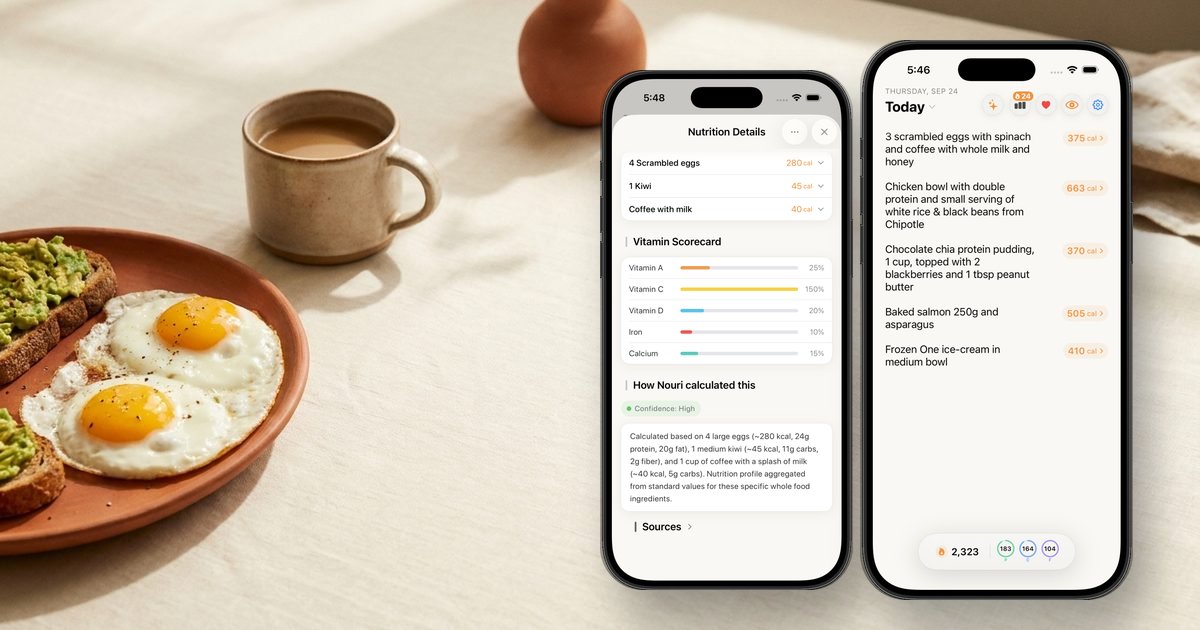
Most calorie apps make you choose. Fast apps give you a number from a photo in seconds but can be off and often do not show how they got it. Accurate apps make you search, weigh, and pick entries, so people quit. Nouri is built for both: one sentence in, a fast number out, with its reasoning shown. In our own 100-food test, Nouri averaged 92.1/100.
The trade-off every calorie app makes
Calorie apps tend to fall into two camps, and each one is honest about only half of the problem.
The fast camp. Snap a photo, get a number, done. It feels like magic, and for a clearly laid out plate it can be very good. The catch is what the camera cannot see: the oil in the pan, the dressing under the lettuce, the second scoop of rice hiding under the chicken. Worse, a fast app often hands you a single total without showing how it got there, so you have no way to tell a good estimate from a bad one.
The accurate camp. Search a food database, choose the right entry out of dozens, set the serving, weigh it if you are serious, and repeat for every ingredient. When you pick the right entry, the numbers are solid. The catch is time. A normal dinner turns into several minutes of searching, and the precision only exists on the days you actually do it.
Both camps fail in the same place: the real world. The fast app misses the hidden calories. The accurate app misses the meals you never logged because it was late and you were tired. We break down why the logging method matters so much in Text vs Voice vs Photo Calorie Tracking.
Why I stopped accepting the trade-off
I used MyFitnessPal first. The numbers were fine, that was never the issue. The issue was that logging a normal dinner took several minutes, and after a long day I simply would not do it. A precise number is worth nothing if you have stopped opening the app by week three.
So I moved to AI photo trackers. They were fast, and I still was not losing weight. When I checked their estimates against what the ingredients actually added up to, the photo numbers kept coming in low. One plate the camera put at around 400 calories worked out closer to 700. The camera could not see the oil, or the portion under the garnish.
That gap is the whole reason Nouri exists. I wanted something fast enough that I would actually use it every day, and honest enough that the number meant something. Not one or the other.
How Nouri does both
Fast: one sentence per meal. There is no database to search and no serving-size picker. You log one of four equal ways, whichever fits the moment:
- Type it like a note: "chicken stir fry with rice, cooked in oil, a beer"
- Say it out loud instead of typing
- Snap a photo, and Nouri turns it into a sentence first, so you can read what it thinks it saw and fix it before anything is counted
- Ask Siri. Nouri has the best Siri logging of any calorie tracking app: say "Hey Siri, track food in Nouri" from the lock screen, answer in one sentence, and a calories and macros card appears right away with what you have left for the day
Calories and macros come back instantly. That is the fast half.
Accurate: reasoning you can check. Every estimate is broken down item by item, so you see what Nouri assumed for each food and portion instead of one unexplained total. If something looks off, add context like "large portion" or "cooked in butter" and recalculate in a few words. Text and voice are the most precise ways in, because you can name exactly what you ate; a photo is very accurate when the food is clearly laid out, and the sentence step lets you correct it when it is not.
Honest: it tells you how sure it is. Nouri also shows how confident it is in an estimate. A high-confidence log means you can move on. A lower rating is your cue to add a detail or double-check. That one signal does what neither camp does well: it tells you which numbers deserve a second look, so you spend your attention only where it matters.
Everything else is built around the log: nutrition totals write to Apple Health and calories burned, workouts, and steps come back in, every meal gets a Health Score, Nouri Coach answers questions about your own eating, and a weekly Nouri Report turns your logs into answers. If this sounds like your last tracker's missing half, try Nouri on the App Store. It is $9.99/month or $39.99/year, with a 3-day free trial, on iPhone (iOS only).
We tested it: 100 foods, same scoring for everyone
Claims about accuracy are cheap, so we ran a test. To be plain about it: we make Nouri, and we ran this benchmark ourselves on October 6, 2026. That is exactly why every input, reference value, and app result is published on our accuracy page, so you can check the raw data instead of trusting us.
The inputs. 100 text inputs in five categories: 25 simple foods, 20 exact amounts, 20 homemade meals, 15 vague real-life inputs, and 20 restaurant items. Reference values came from USDA FoodData Central and each chain's official nutrition data.
The scoring. Every app got the same formula: a weighted error across calories (40%), protein (25%), carbs (20%), and fat (15%), scored from 0 to 100.
The setup. Nouri was tested through the same production server the app uses. MyFitnessPal was tested by searching each input on its website and taking the top result, with the serving set to match the amount asked. Setting the serving for it is generous to MyFitnessPal, since in real use you would have to do that yourself.
| Nouri | MyFitnessPal | |
|---|---|---|
| Average score | 92.1 / 100 | 77.0 / 100 |
| Inputs passed | 95 of 100 | 70 of 100 |
| Chain restaurant items, average | 94 | 89 |
MyFitnessPal does well on chain restaurants. Where it struggled was the top search result itself. "A handful of almonds" returned a Trader Joe's chocolate and cashew trail mix. "200g baked salmon" worked out to 988 calories. "1 oz slice of cheddar cheese" returned a salami and cheese snack pack. None of that is a problem with MyFitnessPal's data when you pick the right entry. It is the cost of the accurate camp: the right answer is in there, and finding it is your job.
Where Nouri missed, and why the confidence rating matters
Nouri missed 5 of 100, and we would rather show them than hide them:
- A whole avocado: 227 calories against a reference of 322
- 200g baked salmon: 342 against 412
- Subway 6-inch turkey: 280 against 480
- A chocolate chip cookie: 170 against 67, because it assumed a bakery-size cookie
- A cup of chicken noodle soup: 130 against 60
The cookie is the most useful one. "A chocolate chip cookie" really is ambiguous, and Nouri showed its assumption in the breakdown, which is exactly the point where adding "small" or "store-bought" fixes it. If you want to see what the reference values look like, we cover them in calories in an avocado, calories in salmon, and Subway calories.
Now the confidence data. Nouri rated its confidence "high" on 98 inputs, and 95 of those passed. It rated two inputs "medium," and both were misses. That is the feature working: on the inputs where it was least sure, it said so. A tracker that flags its own uncertainty lets you double-check the right logs, instead of second-guessing all of them or none of them.
The full input list, every app's answer, and every score are published on our accuracy page.
What this means for how you track
Speed and accuracy are not opposites. They only look that way because most apps put the accuracy in the effort you supply: the searching, the entry picking, the weighing. Move that work into the app, show the reasoning, and flag the uncertain cases, and you can get both.
A few habits get you most of the way in any app:
- Name the amount when you know it. "200g," "1 cup," "two slices" beats "some." Our guide to tracking without weighing food has the everyday portion shortcuts.
- Name the cooking fat. "Cooked in butter" or "with olive oil" is the detail cameras miss most.
- Check the low-confidence logs, skip the rest. Your attention is limited; spend it where the app is unsure.
- Log the big meals especially. A missing dinner can cost more accuracy than a rough estimate. We make that case with research in Why Calorie Tracking Apps Are Inaccurate.
FAQ
What is the best way to track calories accurately?
Weighing food and matching it to a verified database entry is the most precise method, but few people keep it up. For most people the practical answer is logging every meal with specific amounts and cooking fats named, in an app that shows its reasoning so errors are easy to spot.
Are AI calorie tracking apps accurate?
They can be, and it depends heavily on the app and the input. In our own 100-food test, Nouri averaged 92.1/100 from text inputs, and the full data is published on our accuracy page. Photo-only estimates can run low when oil, sauces, or hidden portions are not visible.
Is MyFitnessPal accurate?
Its numbers are only as good as the entry you pick. In our test, taking the top search result and setting the serving correctly, MyFitnessPal averaged 77.0/100, with a strong 89 on chain restaurant items.
What is the fastest calorie tracking app?
The fastest method is describing a meal in one sentence, typed or spoken, because it skips the search and portion forms. Nouri adds Siri logging from the lock screen, so you can log without opening the app at all.
Why do calorie apps give different numbers for the same food?
They assume different portions, recipes, and database entries. "A cookie" could be a small packaged cookie or a large bakery one, and that alone can double the calories. Apps that show their assumptions let you see which one you got.
Can I trust a calorie estimate from a photo?
When the food is clearly laid out, photo estimates can be very accurate. They struggle with what the camera cannot see, like cooking oil or food hidden under other food. Nouri turns a photo into a sentence first, so you can correct those details before anything is counted.
What does a confidence rating mean in a calorie app?
It is the app telling you how sure it is about an estimate. In Nouri, a high rating means you can move on, and a lower one means it is worth adding a detail or double-checking. In our test, both of Nouri's medium-confidence inputs were misses, which is the rating doing its job.
How did you test Nouri's accuracy?
We ran 100 text inputs across five categories against USDA FoodData Central and official chain nutrition data, scoring every app with the same weighted formula. We make Nouri and ran the test ourselves, so we published the raw data on our accuracy page for anyone to check.
Does Nouri show how it calculated calories?
Yes. Every log is broken down item by item with the reasoning shown, and you can add context like "large portion" or "cooked in butter" and recalculate. You never have to accept a single unexplained number.
Is a fast calorie tracker good enough for weight loss?
Yes, if it is consistent and you log every meal. A log that is slightly off but complete shows your trend clearly; a precise log with missing days does not. Our post on the most frictionless calorie tracker goes deeper on why coverage matters.
What is the easiest way to track calories accurately without slowing down?
Use Nouri: type, say, photograph, or Siri-log one sentence per meal, and read the item-by-item breakdown it returns. Glance at how confident it is, add a detail when it is unsure, and move on with your day.
Bottom line
Fast or accurate was always a false choice; it only looked real because apps made you supply the accuracy yourself. Nouri takes one sentence, returns a number in seconds, shows its work, and tells you when to double-check. Do not take our word for it: the inputs, references, and every score are on the accuracy page. And if you are still deciding between apps, our Nouri vs MyFitnessPal comparison lays out the rest of the differences.
Sources
- Nouri accuracy benchmark, run by Nouri (Jacks Labs LLC) on October 6, 2026, with all inputs, references, and scores: nouriapp.co/accuracy (checked October 6, 2026)
- Reference values: USDA FoodData Central, fdc.nal.usda.gov (checked October 6, 2026), and each chain's official nutrition data, listed per item on the accuracy page
- MyFitnessPal results from searching each input on myfitnesspal.com and taking the top result (checked October 6, 2026)
- Founder experience with database and photo trackers is Alain's own and is not a benchmark
Keep reading
All articlesIf Apple Made a Calorie Tracking App
Apple does not make a calorie tracking app. Here is what an Apple-built food tracker would get right, and why we built Nouri to that standard.
StoryThe Most Frictionless Calorie Tracker in the World
Friction, not willpower, is why people quit calorie tracking. We count the steps per log, show why Nouri wins, and how its weekly report keeps you going.
GuidesCreatine for Women: What the Research Actually Shows
Women have 70 to 80% lower natural creatine stores than men. What studies in women found on strength, muscle, the scale, gummies, and "bulky."
GuidesDoes Creatine Make You Gain Weight? Water vs Fat, Explained
Creatine loading typically adds 1 to 3 kg (2 to 6.6 lb), mostly water, not fat. What studies show, whether it has calories, and how to read your scale.