

Does Creatine Make You Gain Weight? Water vs Fat, Explained
Creatine loading typically adds 1 to 3 kg (2 to 6.6 lb), mostly water, not fat. What studies show, whether it has calories, and how to read your scale.
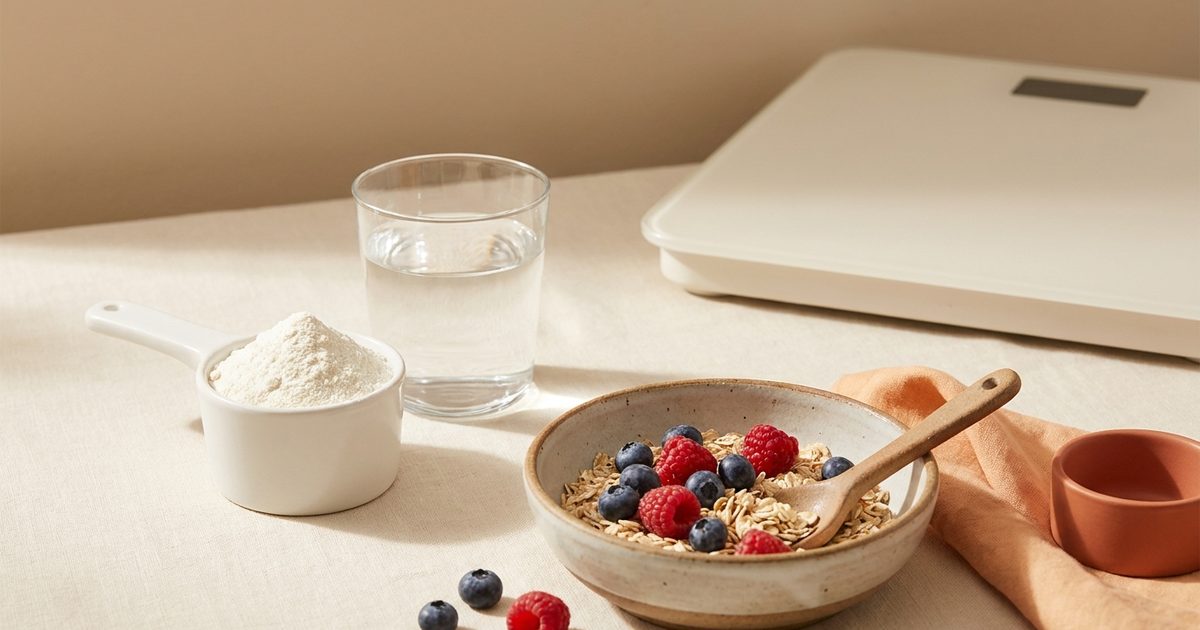
Yes, creatine often raises scale weight, but research says the gain is mostly water and lean mass, not fat. A 2021 research review says a loading phase "typically results in a 1-3 kg increase in body mass," about 2 to 6.6 lb, mostly water. A 2024 meta-analysis of 143 trials found an average gain of 0.86 kg. Read your scale as weekly averages.
The short answer: water and muscle, not fat
A plain note first: this is general information, not medical advice. Talk to your doctor or a registered dietitian before starting any supplement, especially if you have kidney problems, are pregnant, or take medication. Nothing here is a dosing plan, and we do not recommend products.
The pattern people panic about: you start creatine, your food log looks the same, and the scale jumps a pound or two within days. The diet almost certainly did not stop working.
Creatine is a compound your body already makes and stores, mostly in muscle. The International Society of Sports Nutrition (ISSN) position stand, written by Kreider and colleagues in 2017, says about half of the daily need comes from food, mainly meat and fish, and the rest is made in the liver and kidneys. Supplementing raises the amount stored in muscle, and that stored creatine brings water with it.
The same position stand notes that the only consistently reported side effect in the creatine literature "has been weight gain." What matters in a deficit is what that weight is made of, how big it gets, and how fast it arrives.
How much weight, and how fast: what the studies measured
The size of the change depends mostly on how fast muscle creatine rises. Researchers usually compare two approaches: a short "loading" phase of higher intake, or a steady smaller daily amount from the start. The 2021 review by Antonio and colleagues defines loading as 20 to 25 g a day for 5 to 7 days, followed by 3 to 5 g a day. These are study protocols, not a recommendation.
| Source and population | What was measured | Result |
|---|---|---|
| Antonio et al. 2021, review of human studies | Body mass after loading (20 g/day for 5 to 7 days) | "Typically" a 1 to 3 kg increase, "mostly attributable to net body water retention" |
| Kreider et al. 2017, ISSN position stand | Early loading studies | Short-term fluid retention of "about 0.5 to 1.0 L," roughly proportional to the weight gained |
| Pashayee-Khamene et al. 2024, meta-analysis of 143 randomized trials | Body mass and fat-free mass vs placebo | Body mass +0.86 kg, fat-free mass +0.82 kg, body fat percentage down 0.28 points |
| Volek et al. 1999, 19 resistance-trained men, 12 weeks | Body mass and fat-free mass | Body mass up 6.3% with creatine vs 3.6% with placebo; fat-free mass up 6.3% vs 3.1% |
| Branch 2003, meta-analysis of 100 studies | Body composition effect size | Larger after loading-only regimens (0.26) than maintenance regimens (0.04) |
For scale: 1 to 3 kg is about 2.2 to 6.6 lb, and 0.86 kg is about 1.9 lb. A liter of water weighs about a kilogram, so the ISSN's 0.5 to 1.0 L of retained fluid lines up with roughly 1 to 2 lb on the scale.
Speed is the other half. Hultman and colleagues studied 31 men in 1996 and found muscle creatine rose about 20% after 6 days at 20 g a day. A group taking 3 g a day reached a similar 20% rise, but more gradually, over 28 days. In plain terms, loading tends to produce a fast bump in week one, while a smaller daily amount spreads the change over about a month.
The Antonio review notes that the steady daily approach "would be a viable option" for people who want to avoid the weight gain that "can sometimes occur" during loading. Whether that matters for you is a conversation for your doctor or dietitian.
Why creatine pulls water into muscle
Antonio and colleagues describe creatine as "an osmotically active substance": it is carried into muscle by a sodium-dependent transporter, and water follows it to keep the inside of the cell balanced. The ISSN position stand compares it to carbohydrate, which also holds a small amount of water when stored.
Where that water goes matters for the "bloated" worry. In a 2003 study by Powers and colleagues, 16 men and 16 women who resistance trained took creatine or a placebo for 28 days. The creatine group gained body mass and total body water, but the authors found that "fluid distribution was not changed." The 2021 review summarizes the wider evidence the same way: short-term water gains are "primarily attributed to increases in intracellular volume," meaning water inside muscle cells.
The review adds that several 5 to 10 week training studies found no increase in total body water, concluding creatine "may not lead to water retention" over the long run. The early shift is real, mostly inside muscle, and not a permanent puffy layer.
Does creatine make you gain fat?
No, according to the trials reviewed so far. The 2021 review states it directly: "creatine supplementation does not increase fat mass across a variety of populations." It cites randomized trials from one week to two years, including young adults, older adults, female athletes, and postmenopausal women.
Two meta-analyses add numbers. Pashayee-Khamene and colleagues pooled 143 randomized trials in 2024 and found body fat percentage went slightly down, by 0.28 percentage points, while fat-free mass rose 0.82 kg. Candow and colleagues pooled 12 studies with 266 adults under 50 in 2023: creatine plus resistance training produced "a very small" drop in body fat percentage (1.19 points) with no difference in absolute fat mass (0.18 kg, not significant). A 2026 meta-analysis of 63 resistance training studies by Wang and colleagues reached the same shape of result: more lean mass, a slight drop in body fat percentage, no significant effect on fat mass.
Put together: weight goes up a little, fat mass stays flat, so body fat percentage dips, even though the scale alone looks worse. Fat gain still happens the usual way, eating above your TDEE for weeks.
One honest caveat: many of these review authors are ISSN members, and several disclose ties to companies that make creatine. Their conclusions are consistent with the independent meta-analyses above, but it is worth knowing.
Does creatine have calories?
Creatine is not a macronutrient. Food calories on U.S. labels come from protein, carbohydrate, and fat, calculated with the standard 4, 4, and 9 calories per gram under 21 CFR 101.9. Creatine is none of those.
Its role is different from food's. The ISSN position stand explains that creatine's main job is to combine with phosphate to form phosphocreatine, which helps regenerate ATP during hard efforts, and that about 1 to 2% of muscle creatine is broken down each day into creatinine and excreted in urine. The 2021 review adds that about 99% of ingested creatine monohydrate is either taken up by tissue or excreted in urine.
We could not find a primary source that assigns creatine itself a calorie value, so we will not invent one. For scale only: even if you counted a 5 g serving like protein at 4 calories per gram, it would be 20 calories. The bigger calorie question is whatever you mix it into. A juice, smoothie, or shake can carry far more than the creatine ever could, so log the drink.
Creatine and weight loss: what it means during a deficit
Most creatine trials pair it with training, not a calorie deficit, so direct evidence on dieting is thin. If you start creatine during a deficit, a 1 to 3 kg water and lean mass shift can hide a week or two of real fat loss on the scale. Your deficit did not stop working; the water arrived on top of it.
That is also why creatine is not a weight-loss supplement. The small drops in body fat percentage in the meta-analyses come mostly from more lean mass, not from burning extra fat. Your weight trend is still driven by calories in against calories out. If you want to sanity-check your target, run the calorie deficit calculator and the daily calorie needs tool, and keep protein up with the protein intake calculator and our list of high-protein foods.
If you are a woman wondering whether any of this changes for you, Branch's 2003 meta-analysis found no difference in body composition effects between men and women, and the Powers study included both. We cover the female-specific research in creatine for women.
How to read your scale while calorie tracking
Daily weight bounces with water, salt, and food volume, creatine or not. Compare weekly averages instead: weigh in at the same time each morning, average the week, and compare one average to the next.
Here is an illustrative example (made-up numbers, not from a study) of someone eating in a steady deficit who starts creatine at the beginning of Week B:
| Week | Daily weigh-ins (lb) | Weekly average | Change |
|---|---|---|---|
| A, before creatine | 181.2, 180.6, 181.0, 180.4, 180.8, 180.2, 180.5 | 180.67 | |
| B, starts creatine | 180.9, 181.6, 182.3, 182.0, 182.8, 182.4, 182.6 | 182.09 | +1.42 |
| C | 182.2, 182.5, 181.9, 182.3, 181.8, 182.1, 181.7 | 182.07 | -0.02 |
| D | 181.6, 181.2, 181.5, 180.9, 181.3, 180.8, 181.1 | 181.20 | -0.87 |
The worked math for Week A: 181.2 + 180.6 + 181.0 + 180.4 + 180.8 + 180.2 + 180.5 = 1,264.7, divided by 7 = 180.67.
Daily, Week A's low of 180.2 to Week B's high of 182.8 looks like a 2.6 lb disaster. The averages tell a calmer story: a 1.42 lb step up in the week creatine started, a flat week, then the downward trend resuming at 0.87 lb. The step is the water shift. The slope is the diet.
Judge the deficit on the slope after the step, and give it two or three weeks before changing anything. Keep logging food through the jump: an honest log rules out eating as the cause. Scales get dramatic. A food log that takes one sentence in Nouri is how you stay calm about it.
Logging it in Nouri
When I built Nouri, the goal was a tracker fast enough that I actually use it and honest enough that the number means something. I quit my first tracker because logging a normal dinner took minutes, and accuracy does not matter if you stop opening the app by week three. A surprise scale jump is exactly the kind of moment that makes people quit, so the log has to be easy enough to keep going through it.
In Nouri, you log a meal four equal ways: type it like a note, say it, snap a photo (Nouri turns it into a sentence first so you can fix it), or ask Siri from the lock screen. Nouri has the best Siri logging of any calorie tracking app: say "Hey Siri, track food in Nouri," describe the meal in one sentence, and a calories and macros card appears with what is left for the day. Calories and macros come back instantly, with per-item reasoning you can check, and you can add context like "large portion" to recalculate. You can type anything into a log, including "creatine in water" or the shake you mix it into, the same way you would log any food.
Nouri connects to Apple Health both ways: it writes your nutrition totals in and reads calories burned, workouts, and steps. That shows training and intake held steady while the scale moved.
Then the weekly Nouri Report does the trend reading for you. Most calorie apps give you numbers. Nouri gives you answers. Each report shows your average calories and macros against your targets, days on target judged by your goal, wins, slips, one clear focus, and Apple Health calories burned against calories eaten plus your workouts. Your first report arrives after 3 logged days in your first week, then every Sunday evening when you log 4 or more days. Reports are part of Nouri Premium. Nouri is for iPhone (iOS only), and you can try it free.
Common mistakes when the scale jumps
Cutting calories harder in week one. The jump is water, so slashing intake to "fix" it just makes the diet harder to stick to. Check your target against your TDEE instead.
Stopping food logging out of frustration. An honest log is what proves the jump is not from food. Our guide to sticking with calorie tracking covers how to keep going on bad weeks.
Forgetting the mixer. Creatine powder is not the calorie story; the juice or shake can be. Our list of common logging mistakes shows how fast drinks add up.
Changing several things at once. Start creatine, a new training plan, and a new calorie target together and you cannot tell what moved the scale.
FAQ
Does creatine make you gain weight?
Often, yes, at least at first. A 2021 review says loading typically adds 1 to 3 kg, mostly water, and a 2024 meta-analysis of 143 trials found an average gain of 0.86 kg versus placebo, with body fat percentage slightly down.
Is creatine weight gain water or fat?
Mostly water and lean mass, not fat. The 2021 review by Antonio and colleagues found no increase in fat mass across trials lasting from one week to two years, and meta-analyses show fat-free mass rising while body fat percentage dips slightly.
How much water weight does creatine cause?
The ISSN position stand reports early loading studies found about 0.5 to 1.0 liter of fluid retention, roughly 1 to 2 lb. The 2021 review puts total body mass gain during loading at 1 to 3 kg. Individual responses vary.
How fast does creatine water weight show up?
With a loading protocol, within the first week: Hultman's 1996 study found muscle creatine rose about 20% in 6 days at 20 g a day. With 3 g a day, the same rise took about 28 days, so any change is more gradual.
Does creatine water weight go away?
The 2021 review says several 5 to 10 week training studies found no increase in total body water, and that over longer periods creatine does not seem to change body water relative to muscle mass. The ISSN position stand also says muscle creatine returns to baseline about 4 to 6 weeks after stopping.
Does creatine cause bloating?
The water gain is mostly inside muscle cells, according to the 2021 review, and Powers' 2003 study found fluid distribution did not change. If you have digestive symptoms, talk to your doctor.
Does creatine have calories?
Creatine is not a protein, carb, or fat. We found no primary source giving it a calorie value; log the drink you mix it into.
Can I take creatine while trying to lose weight?
That is a question for your doctor or dietitian, and we do not give supplement advice. What the research shows is that creatine does not increase fat mass, but it can add a water and lean mass bump that hides fat loss on the scale for a week or two.
Does creatine affect women's weight the same way?
Branch's 2003 meta-analysis found no difference in body composition effects between men and women, and Powers' 2003 study included 16 women. Our creatine for women guide covers the female-specific research in more detail.
Should I weigh myself every day on creatine?
Daily weigh-ins are fine if you judge progress by the weekly average. Give the trend two or three weeks after starting before changing your calorie target.
What is the easiest way to track calories while starting creatine?
Make logging so quick that a scale jump never makes you quit. In Nouri, you type, say, snap, or Siri a meal in one sentence, and the weekly Nouri Report shows average intake, days on target, and Apple Health workouts side by side.
Creatine usually nudges the scale up through water and lean mass, and the trials do not show it adding fat. Keep logging, read weekly averages, and let a steady log in Nouri show you the diet is still working. For the bigger picture, start with TDEE explained and how to track calories without weighing food.
Sources
- Kreider RB et al., "International Society of Sports Nutrition position stand: safety and efficacy of creatine supplementation in exercise, sport, and medicine," J Int Soc Sports Nutr, 2017 (full text: weight gain as the only consistently reported side effect, 0.5 to 1.0 L fluid retention, dietary sources, creatinine excretion, 4 to 6 weeks to baseline), pubmed.ncbi.nlm.nih.gov/28615996 and pmc.ncbi.nlm.nih.gov/articles/PMC5469049 (checked October 6, 2026)
- Antonio J et al., "Common questions and misconceptions about creatine supplementation: what does the scientific evidence really show?," J Int Soc Sports Nutr, 2021 (full text: 1 to 3 kg during loading, water retention, fat mass, loading definitions, about 99% uptake or excretion), pubmed.ncbi.nlm.nih.gov/33557850 and pmc.ncbi.nlm.nih.gov/articles/PMC7871530 (checked October 6, 2026)
- Pashayee-Khamene F et al., "Creatine supplementation protocols with or without training interventions on body composition: a GRADE-assessed systematic review and dose-response meta-analysis," J Int Soc Sports Nutr, 2024, pubmed.ncbi.nlm.nih.gov/39042054 (checked October 6, 2026)
- Candow DG et al., "Resistance Exercise and Creatine Supplementation on Fat Mass in Adults < 50 Years of Age: A Systematic Review and Meta-Analysis," Nutrients, 2023, pubmed.ncbi.nlm.nih.gov/37892421 (checked October 6, 2026)
- Wang H et al., "Resistance training combined with creatine supplementation: a three-level meta-analysis," J Int Soc Sports Nutr, 2026, pubmed.ncbi.nlm.nih.gov/42765482 (checked October 6, 2026)
- Powers ME et al., "Creatine Supplementation Increases Total Body Water Without Altering Fluid Distribution," J Athl Train, 2003, pubmed.ncbi.nlm.nih.gov/12937471 (checked October 6, 2026)
- Hultman E et al., "Muscle creatine loading in men," J Appl Physiol, 1996, pubmed.ncbi.nlm.nih.gov/8828669 (checked October 6, 2026)
- Volek JS et al., "Performance and muscle fiber adaptations to creatine supplementation and heavy resistance training," Med Sci Sports Exerc, 1999, pubmed.ncbi.nlm.nih.gov/10449017 (checked October 6, 2026)
- Branch JD, "Effect of creatine supplementation on body composition and performance: a meta-analysis," Int J Sport Nutr Exerc Metab, 2003, pubmed.ncbi.nlm.nih.gov/12945830 (checked October 6, 2026)
- Calorie conversion factors (4/4/9 for protein, carbohydrate, fat): 21 CFR 101.9(c)(1), law.cornell.edu/cfr/text/21/101.9 (checked October 6, 2026)
Keep reading
All articlesCreatine for Women: What the Research Actually Shows
Women have 70 to 80% lower natural creatine stores than men. What studies in women found on strength, muscle, the scale, gummies, and "bulky."
GuidesBPC-157: What the Research Actually Shows (and What It Doesn't)
A 2025 review of BPC-157 research found 36 studies: 35 preclinical, 1 clinical. What the evidence shows, its FDA status, and what to ask a doctor.
GuidesComing Off Ozempic or Wegovy: How to Keep the Weight Off
One year after stopping semaglutide in the STEP 1 extension, people regained two-thirds of the weight they lost. What helps, from the evidence.
GuidesHow Many Calories Should I Eat on Ozempic or Zepbound?
There is no official calorie number on the labels. How to estimate a starting target, why under 1,200 (women) or 1,800 (men) needs a closer look.