

What Is TDEE? Formula, Examples, and a Free TDEE Calculator
TDEE is the calories you burn in a day, usually 1,600 to 3,000 for adults. The exact formula, activity multipliers, worked examples, and a free calculator.

TDEE, total daily energy expenditure, is the calories your body burns in a day, the number every calorie target is built on. For most adults it lands between roughly 1,600 and 3,000, lower for small, sedentary people and higher for large, active ones. It is a Mifflin-St Jeor resting burn times an activity factor from 1.2 to 1.9; our free TDEE calculator runs it instantly.
Once you know your TDEE, the goal weight date calculator turns it into a date: how long until you reach your goal at your deficit.
What is inside your daily burn
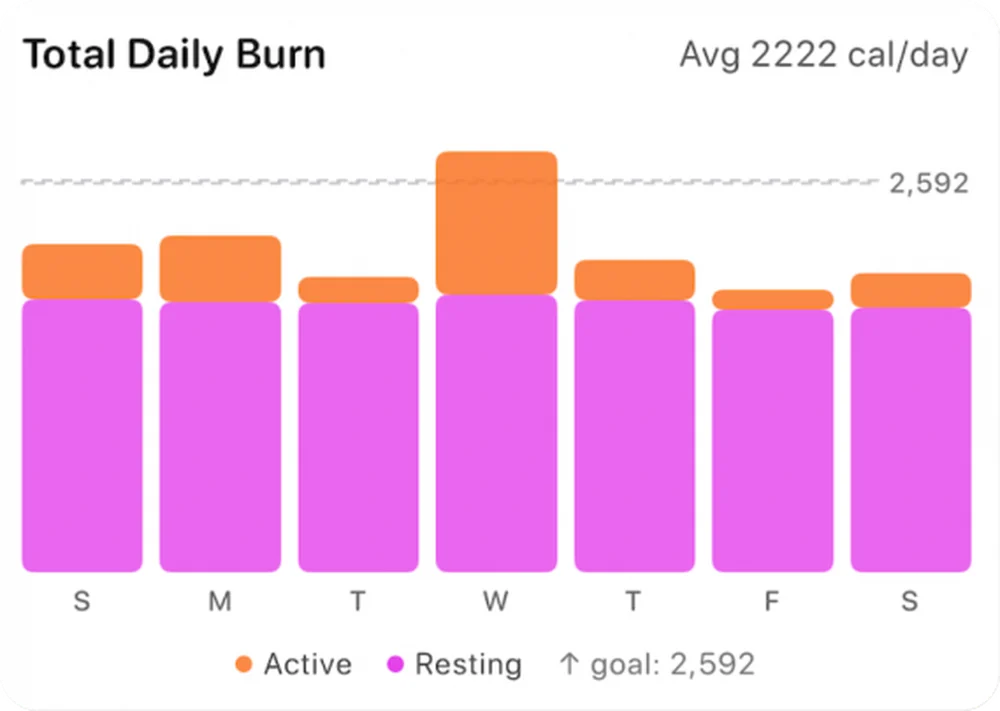
Resting metabolism is the energy of simply being alive: organs, brain, temperature, cell turnover. For most people it is the largest share of the total. It scales with body size, which is why the formula's biggest input is weight.
Activity covers workouts, but also, and often more importantly, everything else that moves you: walking, standing, stairs, fidgeting, a physical job. This non-exercise movement varies more between people than gym time does, and it is the reason two same-sized friends can maintain on very different intakes. It is also the component you estimate when you pick an activity level, and the place where most calculator error enters.
Digestion costs energy too: processing food burns a modest share of what you eat. You do not need to model it separately; the activity multipliers absorb it.
The exact formula Nouri runs
This section is firsthand: it is the actual calculation in Nouri's backend when you finish onboarding, not a generic approximation. Virtually every calculator estimates TDEE the same way: a resting burn multiplied by an activity factor. Resting burn comes from the Mifflin-St Jeor equation, published in the American Journal of Clinical Nutrition in 1990 and still the standard for healthy adults:
- Women: 10 x weight (kg) + 6.25 x height (cm) - 5 x age - 161
- Men: 10 x weight (kg) + 6.25 x height (cm) - 5 x age + 5
Nouri then multiplies by these activity factors:
| Activity level (as asked in onboarding) | Multiplier |
|---|---|
| Sedentary | 1.2 |
| Lightly active | 1.375 |
| Moderately active | 1.55 |
| Very active | 1.725 |
| Extremely active | 1.9 |
TDEE is rounded, then adjusted for your goal exactly like this:
| Goal | Adjustment |
|---|---|
| Lose weight | TDEE - 500 |
| Maintain | TDEE + 0 |
| Gain weight | TDEE + 300 |
Two more implementation details worth knowing because they affect your number: if you skip the activity question, Nouri assumes moderately active (1.55), and the final calorie target is never set below 1,200 regardless of what the arithmetic produces, as a safety floor.
Two worked examples
Example 1. A 30-year-old woman, 165 cm, 70 kg, lightly active, goal: lose.
- Resting: 10 x 70 + 6.25 x 165 - 5 x 30 - 161 = 700 + 1,031.25 - 150 - 161 = 1,420 calories
- TDEE: 1,420.25 x 1.375 = 1,952.8, rounded to 1,953 calories
- Target: 1,953 - 500 = 1,453 calories per day
Example 2. A 42-year-old man, 180 cm, 95 kg, moderately active, goal: maintain.
- Resting: 10 x 95 + 6.25 x 180 - 5 x 42 + 5 = 950 + 1,125 - 210 + 5 = 1,870 calories
- TDEE: 1,870 x 1.55 = 2,898.5, rounded to 2,899 calories
- Target: maintain, so about 2,900 calories per day
Same formula, same multipliers, and the two people are nearly 1,500 calories apart. This is why copying someone else's calorie target is meaningless.
How the number moves across profiles (all computed with the same formula, moderately active, maintain):
| Profile | Resting | TDEE (x1.55) |
|---|---|---|
| Woman, 25, 160 cm, 60 kg | 1,314 | 2,037 |
| Woman, 40, 165 cm, 75 kg | 1,420 | 2,201 |
| Man, 25, 175 cm, 70 kg | 1,674 | 2,594 |
| Man, 50, 183 cm, 100 kg | 1,899 | 2,943 |
Why your real TDEE is found, not calculated
The formula is a population average and your activity level is a self-rating, which makes the computed TDEE a good starting hypothesis and nothing more. Your actual number is discoverable with the tools you already have: eat a consistent, honestly logged intake for two to three weeks and watch the scale trend. A flat trend means you found maintenance, your true TDEE, more precisely than any equation. Steady loss means your intake sits below TDEE by roughly the gap your rate of loss implies. Steady gain means the reverse.
The failure mode of this experiment is dishonest data, and the classic evidence is worth knowing: in a New England Journal of Medicine study of people convinced their metabolisms were broken, measured energy expenditure was normal, while the subjects were underreporting food intake by an average of 47 percent and overreporting exercise by 51 percent. Their TDEEs were fine; their logs were not. If your trend contradicts your log, audit the log first, starting with the usual missing items.
There is one more moving part: TDEE is not constant. Lose ten kilograms and the weight term in the formula shrinks; get a desk job and the multiplier that used to fit no longer does. Recompute when your body or routine changes meaningfully, and treat the trend as the ongoing referee.
Tracking against your TDEE, practically
Knowing the number only pays off if intake gets logged against it, which is where most people's system breaks. A comparison of the common approaches, with facts from each product's official site or App Store listing, checked September 26, 2026:
| App | How you log | Target setting | Platforms | Price |
|---|---|---|---|---|
| Nouri | Type, voice, photo, or Siri from the lock screen | Computes the exact formula above at onboarding; weekly Nouri Reports show your days on target | iPhone (iOS only) | $9.99/month or $39.99/year, 3-day free trial on the yearly plan |
| MyFitnessPal | Database search, barcode scan | Calorie and macro goals | iOS, Android, web | Free tier; $9.99/mo or $49.99/yr; 7-day trial |
| Cronometer | Database search, barcode; photo and voice on paid tier | Calorie, macro, and micronutrient targets | iOS, Android, web | Free tier; Gold $10.99/mo or $59.99/yr |
| Cal AI | Photo first, barcode, describe | Plan built from lifestyle questions | iOS, Android | Subscription after 3-day trial; App Store lists Unlimited purchases $2.99 to $29.99 |
I treat my own computed target as a hypothesis and let the logs arbitrate, and that only works because logging in Nouri is cheap: I type a meal like a note or say it to Siri, and calories and macros come back instantly with the reasoning shown per item, so the data exists at week's end. However you log, the loop is the same: number, honest data, two-week verdict, adjust.
A Nouri Report is where that verdict shows up. Every Sunday evening, for any week with 4 or more logged days, it puts your Apple Health calories burned next to the calories you ate and counts your days on target, judged by your goal. Reports do not recalculate your TDEE; they show how your real week compares to the estimate, so you know whether to change it. Read the burn as context, not extra food: your multiplier already counts exercise.
Common TDEE mistakes
Overrating your activity level. The multiplier question is where most error enters: exercising three times a week does not make a desk-bound life "very active." When in doubt, pick the lower level; the trend will correct you upward far more pleasantly than downward.
Treating the calculator number as truth. It is the average for people shaped like you, not a measurement of you. Two weeks of logs beats it every time.
Recomputing constantly. Day-to-day TDEE wobble is real but unactionable. Recompute on meaningful change (several kilograms, new routine), otherwise leave the target alone and steer by trend.
Stacking device burns on top of the multiplier. Your activity factor already includes exercise. Adding a watch's workout calories on top double-counts the same movement, and device burn numbers skew high anyway.
Ignoring the floor. If the arithmetic pushes below 1,200, Nouri clamps it there deliberately. Very low targets are a medical conversation, not an app setting.
FAQ
What is TDEE?
Total daily energy expenditure: all the calories your body burns in a day, combining resting metabolism, activity, and digestion. It is the reference point every calorie target is set against.
How do I calculate my TDEE?
Compute resting burn with Mifflin-St Jeor (women: 10 x kg + 6.25 x cm - 5 x age - 161; men: same + 5 instead of - 161), then multiply by an activity factor from 1.2 to 1.9. The two worked examples above show every step.
What is a normal TDEE for a woman?
Commonly in the 1,800 to 2,200 range for moderately active women of average size, as the profile table shows, but the spread is wide: size, age, and activity move it by hundreds of calories in either direction.
What is a normal TDEE for a man?
Often 2,400 to 2,900 for moderately active men of average-to-large size, per the same table. The formula, not the averages, is what applies to you.
Is TDEE the same as BMR?
No. BMR (or resting burn) is what you burn at rest; TDEE is BMR multiplied up to include movement and digestion. Nouri computes both and shows the target built from TDEE.
How accurate are TDEE calculators?
Good enough to start, not good enough to trust forever: the equation is a population average and the activity level is a guess. Two to three weeks of honest logging against a stable intake reveals your true number.
Why am I not losing weight eating under my TDEE?
Either the TDEE estimate is high (activity overrated), the intake log is incomplete (the NEJM study above found 47 percent underreporting in exactly this situation), or it has been less than two weeks and water is masking the trend. In that order of likelihood.
Does TDEE change as I lose weight?
Yes. Weight is the formula's largest input, so the number drifts down as you shrink. Recompute after meaningful loss, or simply keep steering by your logged trend, which adjusts automatically.
Do I need to eat back exercise calories on top of TDEE?
No, your activity multiplier already includes your exercise. Eating back device-reported burns on top of a TDEE-based target double-counts movement and commonly erases the deficit.
What activity multiplier should I choose?
Match it to your whole life, not your gym schedule: sedentary 1.2 through extremely active 1.9, as in the table above. If torn between two, take the lower; Nouri defaults to 1.55 when the question is skipped.
Does Nouri calculate my TDEE?
Yes, automatically when you finish onboarding, using exactly what this post shows: Mifflin-St Jeor for resting burn, the 1.2 to 1.9 multiplier table, minus 500 for a loss goal or plus 300 for gain, with a 1,200-calorie floor. You can check it by hand with the worked examples.
What is a Nouri Report?
A personal weekly report built from your logs: Health Score with "Why this score?", average calories and macros against your targets, days on target judged by your goal, wins, slips, and one clear focus. It also shows Apple Health calories burned against calories eaten, your real week next to your TDEE estimate. Your first arrives after 3 logged days in your first week, then every Sunday evening when you log 4 or more days.
Bottom line
TDEE is estimated in two multiplications: Mifflin-St Jeor for your resting burn, times an activity factor, and Nouri runs precisely that formula, with a 500-calorie cut for loss goals and a 1,200 floor, the moment you finish onboarding. Compute your own number with the worked examples, then remember the real rule: the formula starts the conversation and your logged two-week trend ends it. Nouri handles both halves: the math at onboarding, then logging by note, voice, photo, or Siri, and a weekly Nouri Report that shows how your real week compares to the estimate. From here, Calorie Counting 101 turns the number into a plan and How to Track Macros splits it into targets worth training on.
Sources
- Mifflin MD, St Jeor ST et al., "A new predictive equation for resting energy expenditure in healthy individuals," American Journal of Clinical Nutrition, 1990, pubmed.ncbi.nlm.nih.gov/2305711 (checked September 26, 2026)
- Lichtman SW et al., "Discrepancy between self-reported and actual caloric intake and exercise in obese subjects," New England Journal of Medicine, 1992, pubmed.ncbi.nlm.nih.gov/1454084 (checked September 26, 2026)
- Nouri's target computation (formula, multipliers, goal adjustments, default, and floor): Nouri's own onboarding calculation, stated firsthand
- App pricing: myfitnesspal.com/premium, cronometer.com/gold, calai.app and its App Store listing (all checked September 26, 2026)
Keep reading
All articlesAre AI Calorie Apps Accurate? What the 2026 Research Actually Shows
A 2026 study found an AI photo app underestimated intake by 25%. What the research says about AI calorie apps, and why a photo can't see the oil.
GuidesIn a Calorie Deficit But Not Losing Weight? 9 Reasons and the Fix for Each
In an NEJM study, people reporting under 1,200 calories underreported intake by 47%. 9 reasons the scale won't move, with a fix for each.
GuidesHow Many Calories Do You Need While Breastfeeding? (CDC vs ACOG, Explained)
The CDC says 330 to 400 extra calories a day while breastfeeding; ACOG says 450 to 500. Why they differ and how to find your own number.
Guides'Mom Calories': What Eating Your Kids' Leftovers Really Adds Up To
3 nuggets, some crusts, cheese crackers and juice sips add up to about 297 calories a day, or 2,079 a week. The guilt-free tally, with USDA numbers.