
25 Low-Calorie Swaps That Actually Taste Good (With Calories Saved)
25 food swaps with USDA calories, from bagel to English muffin (143 saved) to measured oil (159 saved). Five easy ones add up to 2,299 calories a week.
The best low-calorie swaps keep the food you love and trade the hidden calories. By USDA FoodData Central data, these 25 swaps save 40 to 201 calories each. The biggest wins: fries to a baked potato (201 saved), apple pie to a warm cinnamon apple (201), salami to deli turkey (182). Five easy daily swaps add up to about 2,299 calories a week.
Swapping is the opposite of a diet. Nothing gets banned, nobody eats sad lettuce, and you can still have the bagel on Saturday. You just stop paying full price for calories you would not miss.
How we picked (and counted) these swaps
Every number comes from USDA FoodData Central, with the FDC ID for each food in the Sources. Portions are the ones real people actually eat: a medium bagel, a 12 oz can, a cup of rice, 2 tablespoons of dressing. Calories per portion are worked out from USDA's per-100g values and USDA's own portion weights, then rounded. Calories saved is the original minus the swap, checked with a script.
A swap only made the list if it passes three tests:
- It still tastes good. If the swap makes you sad, you will quit it by Thursday.
- It does the same job. Mustard does what mayo does on a sandwich. Rice cakes do not do what a burger does.
- It actually saves calories. Plenty of "healthy" swaps fail this one. They have their own section below.
Low-calorie breakfast swaps
| # | Instead of | Calories | Try | Calories | Saved |
|---|---|---|---|---|---|
| 1 | Medium plain bagel (105g) | 277 | Whole-wheat English muffin (66g) | 134 | 143 |
| 2 | Cream cheese, 2 tbsp (29g) | 102 | Low-fat cream cheese, 2 tbsp (30g) | 62 | 40 |
| 3 | Granola, 1/2 cup (61g) | 298 | Oatmeal cooked with water, 1 cup (234g) | 166 | 132 |
| 4 | 3 large eggs (150g) | 215 | 1 egg + 3 egg whites (149g) | 123 | 92 |
| 5 | Pork sausage, 2 links (46g) | 150 | Turkey sausage, same weight (46g) | 90 | 60 |
The bagel is the sneaky one. A medium plain bagel weighs 105g, roughly the bread in a whole sandwich, before anything goes on it. The English muffin keeps the toasty, buttery-pocket experience at about half the calories.
Granola wears a health halo, but USDA's granola is 489 calories per 100g, which puts it closer to cookies than to cereal. Half a cup is 298 calories. A full cup of oatmeal is 166, because cooked oats are mostly water, so you get a much bigger bowl. Want the crunch? Sprinkle a spoonful of granola on top instead of making it the base.
Egg note: the eggs are counted plain. Cook them in a tablespoon of butter and you add about 102 calories to either side, which is its own swap waiting to happen.
Low-calorie lunch swaps
| # | Instead of | Calories | Try | Calories | Saved |
|---|---|---|---|---|---|
| 6 | Mayo on a sandwich, 1 tbsp (13.8g) | 94 | Yellow mustard, 1 tbsp (15g) | 9 | 85 |
| 7 | Flour tortilla, 10 inch (72g) | 220 | 2 corn tortillas (48g) | 105 | 115 |
| 8 | Ranch dressing, 2 tbsp (30g) | 129 | Italian dressing, 2 tbsp (29.4g) | 71 | 58 |
| 9 | Hard salami, 6 slices (60g) | 244 | Deli turkey breast, about 2 oz (57g) | 62 | 182 |
| 10 | Medium fast-food fries (117g) | 365 | Medium baked russet potato (173g) | 164 | 201 |
Swap 6 is the best value per second of effort on this list. Mustard is a flavor, mayo is mostly oil. Same sandwich, 85 calories lighter, and honestly a better pickle pairing.
Swap 10 is the biggest single save, and you still eat a potato. The baked russet is heavier than the fries (173g against 117g) and has less than half the calories, because deep frying is the expensive part, not the potato. Top it with salsa and you are in business.
Low-calorie snack swaps
| # | Instead of | Calories | Try | Calories | Saved |
|---|---|---|---|---|---|
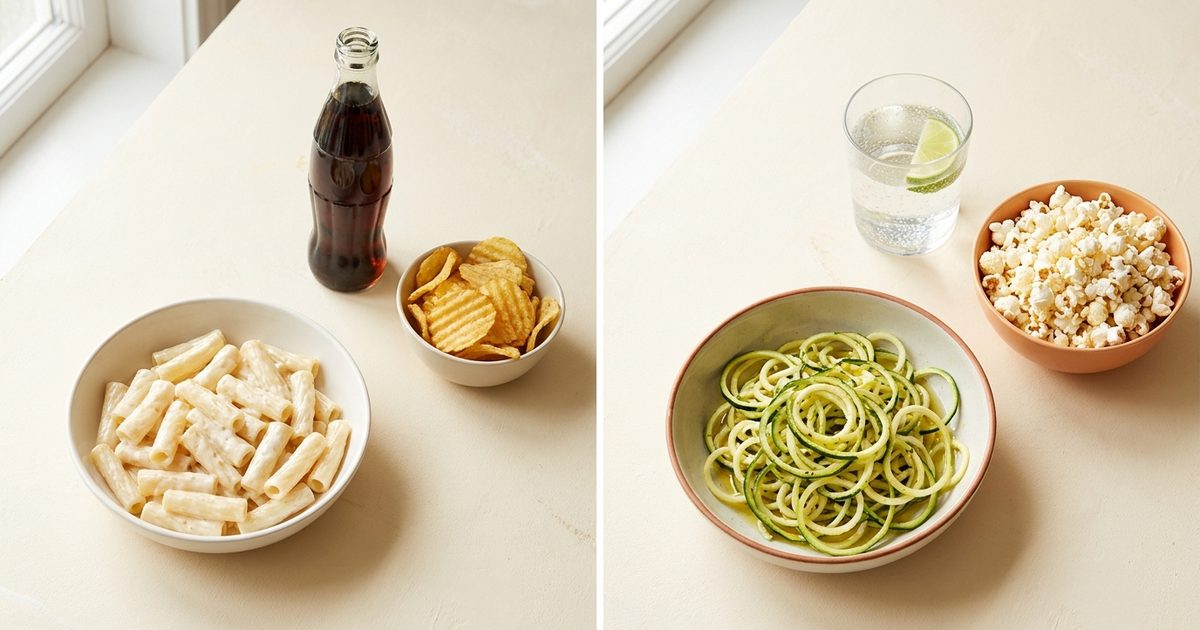
| 11 | Potato chips, 1 oz (28g) | 149 | Air-popped popcorn, 3 cups (24g) | 93 | 56 |
| 12 | Cheddar, 1 oz (28.35g) | 114 | Part-skim mozzarella, 1 oz (28.35g) | 72 | 42 |
| 13 | Low-fat fruit yogurt, 8 oz (227g) | 238 | Nonfat Greek yogurt (170g) + 1/2 cup blueberries (74g) | 142 | 96 |
Popcorn is the snack swap for people who eat chips by the handful. One ounce of chips is about 22 chips, which is a snack for a very disciplined squirrel. Three cups of popcorn is a bowl.
The yogurt swap also flips the ingredient list: instead of fruit-flavored yogurt, you get actual fruit on plain Greek yogurt. For more snack ideas that fill you up, see our high protein snacks and volume eating foods guides.
Low-calorie drink swaps
| # | Instead of | Calories | Try | Calories | Saved |
|---|---|---|---|---|---|
| 14 | Cola, 12 oz can | 155 | Diet cola, 12 oz can | 7 | 148 |
| 15 | Orange juice, 1 cup (248g) | 112 | 1 medium orange (131g) | 62 | 50 |
| 16 | Whole milk in a latte, 1 cup | 149 | Skim milk, 1 cup | 83 | 66 |
| 17 | Heavy cream in coffee, 2 tbsp (30g) | 102 | Half-and-half, 2 tbsp (30g) | 39 | 63 |
| 18 | Regular beer, 12 oz | 153 | Light beer, 12 oz | 103 | 50 |
Drinks are where swaps shine, because you rarely feel full from a drink in the first place. A daily can of cola is 155 calories you probably would not notice missing. The orange swap is half the calories, and you have to peel it, which is the closest thing to a free workout this list offers. Going out? Our guide to tracking alcohol calories breaks down the rest of the bar.
Low-calorie dinner swaps
| # | Instead of | Calories | Try | Calories | Saved |
|---|---|---|---|---|---|
| 19 | Ground beef 80/20, 3 oz cooked (85g) | 231 | Ground beef 93/7, 3 oz cooked (85g) | 178 | 53 |
| 20 | Chicken thigh with skin, 3 oz cooked (85g) | 197 | Skinless chicken breast, 3 oz cooked (85g) | 140 | 57 |
| 21 | Spaghetti, 2 cups cooked (248g) | 392 | 1 cup spaghetti + 1 cup spaghetti squash | 238 | 154 |
| 22 | White rice, 1 cup cooked (158g) | 205 | 1/2 cup rice + 1/2 cup riced cauliflower | 116 | 89 |
| 23 | Free-poured olive oil, 2 tbsp (27g) | 239 | Measured olive oil, 2 tsp (9g) | 80 | 159 |
Swaps 21 and 22 are the half-and-half trick: keep half the original, replace the other half with a vegetable that has the same texture. Your fork does not notice. Your plate stays the same size.
Swap 23 is not even a food change. It is a measuring spoon. Olive oil is 884 calories per 100g, and the difference between a "glug" and 2 teaspoons is 159 calories. Keep the olive oil. Lose the glug.
Low-calorie dessert swaps
| # | Instead of | Calories | Try | Calories | Saved |
|---|---|---|---|---|---|
| 24 | Vanilla ice cream, 1 cup (132g) | 273 | 1/2 cup ice cream + 1 cup strawberries | 183 | 90 |
| 25 | Apple pie, 1/8 of a 9 inch pie (125g) | 296 | Medium apple, warmed with cinnamon (182g) | 95 | 201 |
Dessert stays. That is the rule. Swap 24 keeps the real ice cream and makes the bowl bigger with fruit. Swap 25 keeps the warm-apple-and-cinnamon thing, minus the crust doing most of the calorie work. The apple is counted raw; warming it with cinnamon adds almost nothing.
Swaps that are NOT worth it (for calories)
Some swaps have great PR and no calorie savings. Using the same USDA data:
| "Healthy" swap | Calories | Original | Calories | Verdict |
|---|---|---|---|---|
| Olive oil instead of butter, 1 tbsp | 119 | Butter, 1 tbsp | 102 | Olive oil is 17 higher |
| Coconut oil instead of butter, 1 tbsp | 121 | Butter, 1 tbsp | 102 | 19 higher |
| Honey instead of sugar, 1 tbsp | 64 | Sugar, 1 tbsp (12.6g) | 49 | 15 higher |
| Reduced-fat peanut butter, 2 tbsp (36g) | 187 | Regular, 2 tbsp (32g) | 191 | Saves 4 |
| Light vanilla ice cream, 1/2 cup (76g) | 137 | Regular, 1/2 cup (66g) | 137 | A tie |
| Brown rice instead of white, 1 cup | 248 | White rice, 1 cup | 205 | Brown is 43 higher per cup |
| Dark chocolate instead of milk, 1 oz | 170 | Milk chocolate, 1 oz | 152 | 18 higher |
| Raisins, 1/4 cup (36g) | 108 | Grapes, 1 cup (151g) | 104 | Same calories, 4x less food |
A few notes before anyone gets upset. Olive oil, brown rice, and dark chocolate are great foods. Pick them for flavor, fiber, or because you like them, just not because you think they save calories. Brown rice is actually slightly lower per gram (123 vs 130 per 100g), but USDA's cup of brown rice weighs more, so a cup lands higher.
The light ice cream result is the funniest one. USDA's half cup of light vanilla weighs 76g against 66g for regular, so it is denser, and the calories end up identical. Reduced-fat peanut butter trims the fat but not the calories: it lands 4 calories lower. That is not a swap, that is a rounding error.
How much do a few swaps add up per week?
Here is a realistic week. Not all 25 swaps, just five boring ones you do on autopilot.
| Swap | Saved each time | Times per week | Saved per week |
|---|---|---|---|
| Cola to diet cola | 148 | 5 | 740 |
| Whole to skim milk in your latte | 66 | 5 | 330 |
| Mayo to mustard on lunch | 85 | 5 | 425 |
| Measured oil at dinner | 159 | 4 | 636 |
| Chips to popcorn | 56 | 3 | 168 |
| Total | 2,299 |
That is 2,299 calories a week, about 328 a day on average, and 9,196 over four weeks. Zero meals skipped, zero foods banned.
One honest caveat. Weight does not respond to calories like a bank account. An NIH-led modeling study in The Lancet found that body weight responds slowly to a lasting change in calorie intake, with a half time of about a year. So treat this math as direction, not a scale prediction. If you want to plan a target, the calorie deficit calculator and goal weight date calculator help, and TDEE Explained covers where your daily number comes from.
If food or weight has been a hard topic for you, or you have a history of disordered eating, please work with a doctor or registered dietitian instead of tracking on your own. Swaps should make eating easier, never more stressful.
Why small swaps work when diets don't
Swaps beat diets for the same reason sticking to calorie tracking beats a perfect week followed by quitting: they ask almost nothing of you. You were going to have a sandwich anyway. Now it has mustard.
They also stack quietly. Nobody notices a latte made with skim milk, but the week notices. And because nothing is off-limits, there is no "I already ruined today" spiral. The bagel on Saturday is not a failure. It is a bagel.
The trap is assuming swaps alone do the job. If your portions are drifting or your weekends look nothing like your weekdays, swaps get eaten by the gap. That is where tracking earns its keep, and where most people find their biggest surprise. Our common food tracking mistakes post covers the usual suspects.
How to track swaps in Nouri
I used MyFitnessPal first, and the numbers were never the problem. Adding a normal dinner took several minutes, and after a long day I just would not do it. Then I tried AI photo trackers. Fast, but I was not losing weight. When I checked their estimates against what the ingredients actually added up to, a plate the camera called around 400 calories worked out closer to 700. The camera cannot see the oil in the pan. That is swap 23 in a nutshell, and it is why I built Nouri.
In the freshly redesigned Nouri, you type what you ate like a note, "turkey sandwich with mustard and a diet coke," or say it, snap a photo, or ask Siri from the lock screen with "Hey Siri, track food in Nouri." Nouri shows its reasoning and a confidence rating for each item, so you can see exactly where the calories are. Made it with skim milk instead of whole? Add that context and it recalculates.
That is the fun part of swaps: you see the number move. Then every Sunday, once you have tracked 4 or more days, your Nouri Report shows your week, wins and slips included, with one clear focus for next week. Most calorie apps give you numbers. Nouri gives you answers.
Nouri is iPhone (iOS only), at $9.99/month or $39.99/year, with a 3-day free trial on the yearly plan. Go see what your favorite swap actually saves.
FAQ
What are the easiest low-calorie food swaps?
The easiest swaps change one ingredient, not the whole meal. Mayo to mustard saves 85 calories, regular to diet cola saves 148, and measuring 2 teaspoons of oil instead of free-pouring 2 tablespoons saves 159, all by USDA data.
What food swap saves the most calories?
On this list, fast-food fries to a baked potato and apple pie to a warm cinnamon apple tie at 201 calories saved. Hard salami to deli turkey is next at 182, then measured olive oil at 159.
What are healthy food swaps for weight loss?
Swaps that keep the same job and cut fat or sugar: ground beef 93/7 instead of 80/20, nonfat Greek yogurt with berries instead of fruit yogurt, and half rice with half riced cauliflower. They work best alongside a calorie target you can actually stick to.
Do small calorie swaps really add up?
Yes. Five everyday swaps in our example save 2,299 calories a week, about 328 a day. Weight responds slowly and your body adapts as you lose, so think of it as steady direction rather than a promised result.
What is a good low-calorie breakfast swap?
A whole-wheat English muffin instead of a medium bagel saves 143 calories, and a cup of oatmeal instead of half a cup of granola saves 132. Using 1 egg plus 3 egg whites instead of 3 eggs saves 92.
Is olive oil lower in calories than butter?
No. A tablespoon of olive oil is 119 calories and a tablespoon of butter is 102, per USDA. Olive oil is a fine choice for cooking and flavor, but it does not save calories.
Is honey lower in calories than sugar?
No. A tablespoon of honey is 64 calories and a tablespoon of sugar is about 49, because honey is denser. Many people use a little less honey because it is sweeter, but spoon for spoon it is higher.
Is brown rice lower in calories than white rice?
Per gram, brown rice is slightly lower (123 vs 130 per 100g). Per USDA cup, brown rice comes in higher, 248 vs 205, because a cup of it weighs more. Choose it for fiber, not calories.
Is light ice cream lower in calories?
Not always. USDA's half cup of light vanilla ice cream is 137 calories, the same as regular, because the light version is denser. Check the label by weight, or keep the real stuff and add fruit.
What drink swaps help you lose weight?
Regular to diet cola saves 148 calories per can, whole to skim milk in a latte saves 66 per cup, heavy cream to half-and-half in coffee saves 63 per 2 tablespoons, and regular to light beer saves 50 per 12 oz.
What is the easiest way to track calories when making food swaps?
Describe the meal in one sentence and let Nouri do the math. Type, say, snap, or ask Siri, check the per-item reasoning, and add "with skim milk" or "measured oil" to see the swap recalculate right away.
Pick two swaps from this list, the ones that sound least painful, and run them for a week. Then track it with Nouri to see what changed, and if you want a filling plate to go with them, volume eating and high protein foods are the natural next reads. Heading into the cold months? See why you gain weight in winter.
Sources
- USDA FoodData Central (SR Legacy), all food values (checked Oct 23, 2026). Breakfast: bagel, plain (FDC 174899), English muffin, whole-wheat (FDC 172762), cream cheese (FDC 173418), cream cheese, low fat (FDC 169079), granola (FDC 171646), oatmeal, cooked with water (FDC 173905), egg, whole (FDC 171287), egg white (FDC 172183), pork sausage, pan-fried (FDC 174578), turkey sausage, cooked (FDC 173871)
- Lunch: mayonnaise (FDC 171009), yellow mustard (FDC 172234), flour tortilla (FDC 175037), corn tortilla (FDC 175036), ranch dressing (FDC 173592), Italian dressing (FDC 171019), hard salami (FDC 172938), deli turkey breast (FDC 174572), fast-food french fries (FDC 170698), russet potato, baked (FDC 170030)
- Snacks: potato chips (FDC 169677), popcorn, air-popped (FDC 167959), cheddar (FDC 173414), mozzarella, part skim (FDC 170847), fruit yogurt, low fat (FDC 171286), Greek yogurt, plain nonfat (FDC 170894), blueberries (FDC 171711)
- Drinks: cola (FDC 174852), diet cola (FDC 175099), orange juice (FDC 169098), orange (FDC 169097), whole milk (FDC 171265), skim milk (FDC 171269), heavy cream (FDC 170859), half-and-half (FDC 171255), regular beer (FDC 168746), light beer (FDC 168749)
- Dinner: ground beef 80/20 (FDC 171799), ground beef 93/7 (FDC 174755), chicken thigh with skin (FDC 173625), chicken breast (FDC 171477), pasta, cooked (FDC 169737), spaghetti squash (FDC 169299), white rice (FDC 168878), cauliflower (FDC 169986), olive oil (FDC 171413)
- Dessert: vanilla ice cream (FDC 167575), strawberries (FDC 167762), apple pie (FDC 175011), apple (FDC 171688)
- Not-worth-it comparisons: butter (FDC 173410), coconut oil (FDC 171412), honey (FDC 169640), sugar (FDC 169655), peanut butter (FDC 172470), peanut butter, reduced fat (FDC 172458), vanilla ice cream, light (FDC 167572), brown rice (FDC 169704), dark chocolate, 70-85% (FDC 170273), milk chocolate (FDC 167587), raisins (FDC 168165), grapes (FDC 174683)
- Portions are USDA's own household measures or multiples of them (1 tbsp mustard = 3 USDA teaspoons; 1 tbsp sugar = 3 USDA teaspoons; 2 links of pork sausage = 2 USDA links; 3 cups popcorn = 3 USDA cups; 6 slices salami = 6 USDA slices; half portions are half of USDA's cup weights). The turkey sausage serving uses the same weight as the pork sausage it replaces. Raisins are a quarter of USDA's unpacked cup weight. Calories per portion are calculated from USDA per-100g values and rounded to the nearest calorie; savings are original minus swap.
- Hall KD, Sacks G, Chandramohan D, et al. "Quantification of the effect of energy imbalance on bodyweight." The Lancet, 2011, pubmed.ncbi.nlm.nih.gov/21872751 (checked Oct 23, 2026)
Keep reading
All articlesAre AI Calorie Apps Accurate? What the 2026 Research Actually Shows
A 2026 study found an AI photo app underestimated intake by 25%. What the research says about AI calorie apps, and why a photo can't see the oil.
GuidesIn a Calorie Deficit But Not Losing Weight? 9 Reasons and the Fix for Each
In an NEJM study, people reporting under 1,200 calories underreported intake by 47%. 9 reasons the scale won't move, with a fix for each.
GuidesHow Many Calories Do You Need While Breastfeeding? (CDC vs ACOG, Explained)
The CDC says 330 to 400 extra calories a day while breastfeeding; ACOG says 450 to 500. Why they differ and how to find your own number.
Guides'Mom Calories': What Eating Your Kids' Leftovers Really Adds Up To
3 nuggets, some crusts, cheese crackers and juice sips add up to about 297 calories a day, or 2,079 a week. The guilt-free tally, with USDA numbers.