
Volume Eating: 50 Low Calorie Foods With the Most Food per Calorie
Iceberg lettuce and celery give you 714g of food per 100 calories. 50 low calorie foods ranked with USDA data, plus a 500-calorie plate that weighs 1.2kg.
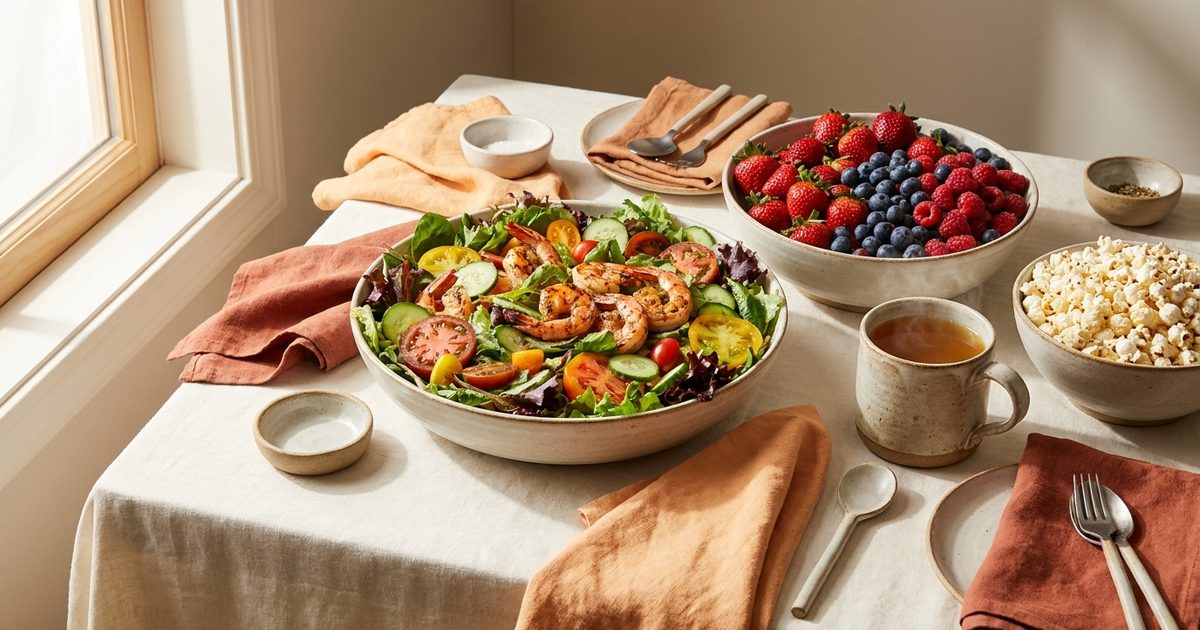
Volume eating means filling your plate with foods that have few calories per gram, so you get the most food for your calories. By USDA FoodData Central data, iceberg lettuce and celery have 14 calories per 100g, so 100 calories buys 714g of either. The same 100 calories buys 61g of chicken breast and 11g of olive oil.
What volume eating is
Volume eating is the third sibling in the "maxxing" family, after fibermaxxing and proteinmaxxing. The idea is simple: your stomach notices how much food you ate, not just how many calories it held. So you build meals from foods that are heavy and filling but light in calories, and you get a bigger plate for the same number.
The measure behind it is calorie density, also called energy density: calories per gram of food. Water-rich foods like vegetables, fruit, broth, and lean protein sit at the low end. Fat-rich and dry foods like oil, nuts, cheese, granola, and dried fruit sit at the high end. Nothing is banned. Volume eating just means knowing which foods buy you a big plate and which buy you a few bites.
What the research says about calorie density
Most of the research on this comes from Barbara Rolls and her colleagues at Penn State. Three studies, each checked at the source:
- The review. In a 2009 review in Physiology & Behavior, Rolls writes that "people tend to eat a consistent weight of food," so "when the ED of the available foods is reduced, energy intake is reduced." ED is energy density. The same review says several clinical trials found that adding water-rich foods like fruits and vegetables was associated with substantial weight loss, even when patients were not told to restrict calories.
- The salad study. In a 2004 study, 42 women ate a required first-course salad before a pasta lunch. Compared with no salad, the low-energy-dense salads cut total meal calories by 7% for the small portion and 12% for the large one. High-energy-dense salads, made with more dressing and cheese, raised meal calories by 8% and 17%.
- The year-long trial. In a 2007 trial, 97 women with obesity were counseled either to cut fat or to cut fat and eat more water-rich foods, especially fruit and vegetables. Neither group got a calorie goal. After a year, completers in the fruit-and-vegetable group lost 7.9 kg against 6.4 kg, ate a greater weight of food, and reported less hunger.
The salad study and the trial were both in women, and the review itself notes that the mechanisms are not yet well understood. But the direction is consistent: when the food on the plate weighs more per calorie, people tend to eat fewer calories, and in the year-long trial they also reported less hunger.
The two numbers that matter
Every food below gets two numbers, both from USDA FoodData Central:
- Calories per 100g. The calorie density. Lower means more food for the same calories.
- Grams per 100 calories. How much food 100 calories buys you, worked out as 10,000 divided by calories per 100g. Higher is better for volume.
A cucumber at 15 calories per 100g gives you 667g for 100 calories, about two whole cucumbers. Chicken breast at 165 gives you 61g. Olive oil at 884 gives you 11g, a little under one tablespoon.
50 volume eating foods, ranked by calories per 100g
Every number below is from USDA FoodData Central (SR Legacy), at USDA's own portion weights. Calories and protein per portion are calculated from USDA's per-100g figures. Calories per 100g does not depend on portion size, so it is the fairest way to compare a cup of lettuce with a chicken breast. Foods with the same value are listed side by side. Popcorn sits at the bottom on purpose; the section after the table explains why.
| Rank | Food | Portion | Calories | Cal per 100g | Grams per 100 cal | Protein |
|---|---|---|---|---|---|---|
| 1 | Vegetable broth | 1 cup (221g) | 11 | 5 | 2000g | 0.5g |
| 2 | Chicken broth | 1 cup (249g) | 15 | 6 | 1667g | 1.6g |
| 3 | Iceberg lettuce | 1 cup shredded (72g) | 10 | 14 | 714g | 0.6g |
| 4 | Celery | 1 cup chopped (101g) | 14 | 14 | 714g | 0.7g |
| 5 | Cucumber, with peel | 1 cucumber (301g) | 45 | 15 | 667g | 2.0g |
| 6 | Radishes | 1 cup slices (116g) | 19 | 16 | 625g | 0.8g |
| 7 | Romaine lettuce | 1 cup shredded (47g) | 8 | 17 | 588g | 0.6g |
| 8 | Zucchini | 1 medium (196g) | 33 | 17 | 588g | 2.4g |
| 9 | Cherry tomatoes | 1 cup (149g) | 27 | 18 | 556g | 1.3g |
| 10 | Green bell pepper | 1 medium (119g) | 24 | 20 | 500g | 1.0g |
| 11 | White mushrooms | 1 cup pieces (70g) | 15 | 22 | 455g | 2.2g |
| 12 | Asparagus, boiled | 1/2 cup (90g) | 20 | 22 | 455g | 2.2g |
| 13 | Spinach, raw | 1 cup (30g) | 7 | 23 | 435g | 0.9g |
| 14 | Cabbage | 1 cup chopped (89g) | 22 | 25 | 400g | 1.1g |
| 15 | Cauliflower | 1 cup chopped (107g) | 27 | 25 | 400g | 2.1g |
| 16 | Spaghetti squash, cooked | 1 cup (155g) | 42 | 27 | 370g | 1.0g |
| 17 | Watermelon | 1 cup diced (152g) | 46 | 30 | 333g | 0.9g |
| 18 | Green beans | 1 cup (100g) | 31 | 31 | 323g | 1.8g |
| 19 | Strawberries | 1 cup halves (152g) | 49 | 32 | 312g | 1.0g |
| 20 | Chicken and vegetable soup, canned | 1 cup (255g) | 84 | 33 | 303g | 5.0g |
| 21 | Broccoli, raw | 1 cup chopped (91g) | 31 | 34 | 294g | 2.6g |
| 22 | Cantaloupe | 1 cup cubes (160g) | 54 | 34 | 294g | 1.3g |
| 23 | Skim milk | 1 cup (245g) | 83 | 34 | 294g | 8.3g |
| 24 | Kale, raw | 1 cup (21g) | 7 | 35 | 286g | 0.6g |
| 25 | Chunky vegetable soup, canned | 1 cup (230g) | 90 | 39 | 256g | 2.6g |
| 26 | Peach | 1 medium (150g) | 58 | 39 | 256g | 1.4g |
| 27 | Carrots | 1 cup chopped (128g) | 52 | 41 | 244g | 1.2g |
| 28 | Grapefruit, pink | 1/2 fruit (123g) | 52 | 42 | 238g | 0.9g |
| 29 | Blackberries | 1 cup (144g) | 62 | 43 | 233g | 2.0g |
| 30 | Orange | 1 fruit (131g) | 62 | 47 | 213g | 1.2g |
| 31 | Pineapple | 1 cup chunks (165g) | 82 | 50 | 200g | 0.9g |
| 32 | Raspberries | 1 cup (123g) | 64 | 52 | 192g | 1.5g |
| 33 | Apple, with skin | 1 medium (182g) | 95 | 52 | 192g | 0.5g |
| 34 | Egg whites | 3 large (99g) | 51 | 52 | 192g | 10.8g |
| 35 | Blueberries | 1 cup (148g) | 84 | 57 | 175g | 1.1g |
| 36 | Greek yogurt, plain nonfat | 1 container (170g) | 100 | 59 | 169g | 17.3g |
| 37 | Grapes | 1 cup (151g) | 104 | 69 | 145g | 1.1g |
| 38 | Oatmeal, cooked with water | 1 cup (234g) | 166 | 71 | 141g | 5.9g |
| 39 | Cottage cheese, 1% | 1/2 cup (113g) | 81 | 72 | 139g | 14.0g |
| 40 | Potato, boiled, no skin | 1 medium (167g) | 144 | 86 | 116g | 2.9g |
| 41 | Banana | 1 medium (118g) | 105 | 89 | 112g | 1.3g |
| 42 | Sweet potato, baked | 1 medium (114g) | 103 | 90 | 111g | 2.3g |
| 43 | Russet potato, baked | 1 medium (173g) | 164 | 95 | 105g | 4.5g |
| 44 | Shrimp, cooked | 3 oz (85g) | 84 | 99 | 101g | 20.4g |
| 45 | Cod, cooked | 3 oz (85g) | 89 | 105 | 95g | 19.4g |
| 46 | Lentils, boiled | 1 cup (198g) | 230 | 116 | 86g | 17.9g |
| 47 | Tilapia, cooked | 1 fillet (87g) | 111 | 128 | 78g | 22.8g |
| 48 | Black beans, boiled | 1 cup (172g) | 227 | 132 | 76g | 15.2g |
| 49 | Chicken breast, roasted | 1/2 breast (86g) | 142 | 165 | 61g | 26.7g |
| 50 | Popcorn, air-popped | 3 cups (24g) | 93 | 387 | 26g | 3.1g |
The calorie-dense traps
These are not bad foods. They are foods where a normal portion is small and the calories add up fast, so they need measuring rather than pouring. Same columns, same database, ranked from most to least calorie-dense:
| Food | Portion | Calories | Cal per 100g | Grams per 100 cal | Protein |
|---|---|---|---|---|---|
| Olive oil | 1 tbsp (13.5g) | 119 | 884 | 11g | 0.0g |
| Butter | 1 tbsp (14.2g) | 102 | 717 | 14g | 0.1g |
| Mayonnaise | 1 tbsp (13.8g) | 94 | 680 | 15g | 0.1g |
| Walnuts | 1 oz, 14 halves (28.35g) | 185 | 654 | 15g | 4.3g |
| Peanut butter | 2 tbsp (32g) | 191 | 598 | 17g | 7.1g |
| Dark chocolate, 70-85% | 1 oz (28.35g) | 170 | 598 | 17g | 2.2g |
| Almonds | 1 oz, 23 almonds (28.35g) | 164 | 579 | 17g | 6.0g |
| Popcorn, oil-popped | 3 cups (24g) | 120 | 500 | 20g | 2.2g |
| Granola | 1/2 cup (61g) | 298 | 489 | 20g | 8.4g |
| Cheddar cheese | 1 slice (28g) | 115 | 410 | 24g | 6.8g |
| Raisins | 1 small box (43g) | 129 | 299 | 33g | 1.4g |
The gap is the point. A tablespoon of olive oil is 119 calories, more than a whole cucumber and a cup of strawberries combined (45 + 49 = 94). An ounce of almonds is 164 calories, the same as a whole baked russet potato. Half a cup of granola is 298 calories, which is more than a cup of oatmeal and a cup of blueberries combined (166 + 84 = 250).
What the ranking actually tells you
Watery vegetables are the volume kings. Lettuce, celery, cucumber, radishes, zucchini, tomatoes, and peppers all sit at 14 to 20 calories per 100g. A whole 301g cucumber is 45 calories. You will rarely eat 100 calories of these in one sitting, which is exactly why they make a plate bigger without moving your total.
Broth leads the table, with a footnote. Vegetable and chicken broth are 5 and 6 calories per 100g, but nobody eats 2 kilos of broth. Their real use is as a start to a meal, or as the base of a soup with vegetables and protein in it. Canned chicken and vegetable soup still lands at 33 calories per 100g.
Fruit is the sweet end of the list. Watermelon, strawberries, cantaloupe, and peaches are 30 to 39 calories per 100g. Berries, apples, and oranges sit around 43 to 57. Grapes and bananas are denser, at 69 and 89, but still far below anything in the trap table. Our apple and banana guides cover every size.
Potatoes and oats are the volume starches. A cup of oatmeal cooked with water is 71 calories per 100g, and a boiled potato is 86, because both hold a lot of water. Compare that with 387 for air-popped popcorn and 489 for granola. The potato and oatmeal guides break down each prep.
Lean protein is where volume meets fullness. Egg whites, nonfat Greek yogurt, and 1% cottage cheese are 52 to 72 calories per 100g, and shrimp and cod are about 100. Chicken breast is denser, at 165, but it brings 26.7g of protein per half breast. A volume-eating plate still needs protein, and the high protein foods ranking shows which ones cost the fewest calories.
Popcorn is a volume food by the cup, not by the gram. Air-popped popcorn is 387 calories per 100g, so it ranks last by weight. But it is mostly air: USDA weighs a cup at just 8g, so 3 cups are 93 calories. That is why it is a staple high-volume snack. Oil-popped popcorn is 120 calories for the same 3 cups.
Same 500 calories, two plates
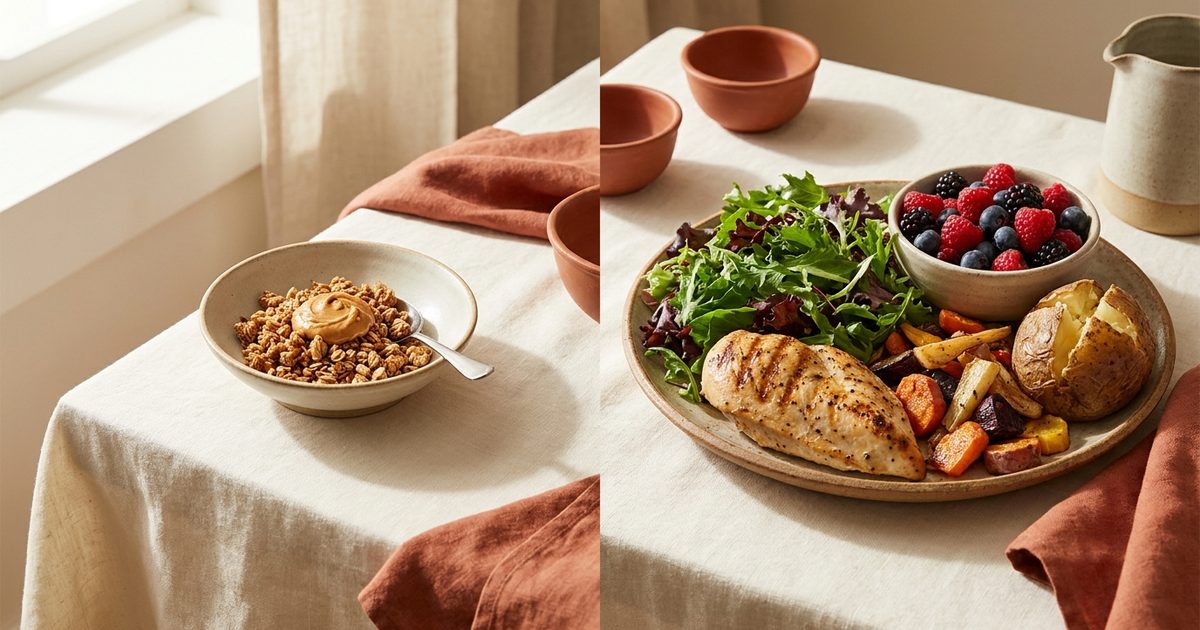
Here is the whole idea in one comparison. Two plates, built only from the tables above, within 11 calories of each other:
| Calorie-dense plate | Volume plate | |
|---|---|---|
| Foods | Granola, 1/2 cup + peanut butter, 2 tbsp | Chicken breast, 1/2 breast + boiled potato, 1 medium + green beans, 1 cup + romaine, 2 cups + cherry tomatoes, 1 cup + strawberries, 1 cup + watermelon, 1 cup + cucumber, 1 whole |
| Calories | 298 + 191 = 489 | 142 + 144 + 31 + 16 + 27 + 49 + 46 + 45 = 500 |
| Weight | 61 + 32 = 93g | 86 + 167 + 100 + 94 + 149 + 152 + 152 + 301 = 1,201g |
| Protein | 8.4 + 7.1 = 15.5g | 26.7 + 2.9 + 1.8 + 1.2 + 1.3 + 1.0 + 0.9 + 2.0 = 37.8g |
The volume plate weighs 1,201g against 93g, about 12.9 times as much food, for 11 more calories. It also has more than twice the protein. The calorie-dense plate is a big bowl of granola with peanut butter on top. The volume plate is a full dinner, a side salad, and dessert.
One honest caveat: the volume plate has no dressing and no butter on the potato. A tablespoon of olive oil would add 119 calories, and that is the most common way volume plates quietly stop being volume plates. Measure the fat, and pile on everything else.
A sample high-volume day: 1,381 calories, 2.7kg of food
Here is one realistic day built from the tables, plus half a cup of jarred marinara from the same USDA database. It includes a tablespoon of olive oil, because real salads have dressing.
| Meal | Foods | Calories | Protein | Weight |
|---|---|---|---|---|
| Breakfast | Egg whites, 3 large (51) + oatmeal, 1 cup (166) + strawberries, 1 cup (49) | 266 | 17.7g | 485g |
| Lunch | Chicken and vegetable soup, 1 cup (84) + romaine, 3 cups (24) + cucumber, 1 whole (45) + cherry tomatoes, 1 cup (27) + chicken breast, 1/2 breast (142) + olive oil, 1 tbsp (119) | 441 | 36.7g | 946g |
| Snack | Greek yogurt, 1 container (100) + blueberries, 1 cup (84) | 184 | 18.4g | 318g |
| Dinner | Shrimp, 6 oz (168) + spaghetti squash, 2 cups (84) + marinara, 1/2 cup (66) + zucchini, 1 medium (33) | 351 | 47.0g | 808g |
| Evening | Air-popped popcorn, 3 cups (93) + watermelon, 1 cup (46) | 139 | 4.0g | 176g |
| Total | 1,381 | 123.8g | 2,733g |
The calorie math: 266 + 441 + 184 + 351 + 139 = 1,381. The protein: 17.7 + 36.7 + 18.4 + 47.0 + 4.0 = 123.8g. The weight: 485 + 946 + 318 + 808 + 176 = 2,733g, about 2.7 kilos of food. Shrimp, 6 oz, is two 3 oz portions (84 + 84), and spaghetti squash, 2 cups, is two 1-cup portions (42 + 42).
Look at lunch. The olive oil is 13.5g of a 946g meal, about 1.4% of the weight, but 119 of its 441 calories, about 27%. Volume eating does not mean no fat. It means you know where the calories in a big plate are actually coming from. If you want a target to build a day like this around, TDEE Explained and Calorie Counting 101 walk through it.
How to log big plates in Nouri
Volume eating creates a logging problem: the plates have a lot of things on them. The volume plate above has eight components. In a database app that is eight searches and eight portion pickers. I used MyFitnessPal first, and the numbers were never the issue. A normal dinner took several minutes to log, and after a long day I simply would not do it. A volume-eating dinner is that problem on purpose.
In Nouri you describe the plate the way you would tell a friend: "half a chicken breast, a boiled potato, a cup of green beans, a big romaine salad with cherry tomatoes and a cucumber, then strawberries and watermelon." Nouri returns calories and macros right away and shows its reasoning for each item, so you can see that the cucumber was counted whole and the salad had no dressing. If it did have dressing, add "with a tablespoon of olive oil" and it recalculates.
There are four equal ways to log: type it like a note, say it out loud, snap a photo, or ask Siri from the lock screen with "Hey Siri, track food in Nouri" and one sentence. With a photo, Nouri turns the picture into a sentence first, so you can correct it before anything is counted. That step matters for volume plates, because a camera sees a pile of greens and cannot see the oil that went into the pan. Text and voice are the most precise when the fat is hidden. Nouri is iPhone (iOS only), and you can try it free.
Nouri also tracks fiber, sugar, and sodium with their own daily goals, next to your calories and macros. Fiber is a volume eater's ally: the vegetables, fruit, and beans that fill the plate are the same foods that fill your fiber goal. The sample day above carries about 32g of fiber, past the 28g Daily Value covered in our high fiber foods guide.
Then the week ties it together. Your Nouri Report arrives every Sunday evening once you have logged four or more days, with your average calories and macros against your targets, days on target judged by your goal, your wins and slips, and one clear focus for the next week. If big salads kept turning into 600-calorie salads, that is where you will see it.
FAQ
What is volume eating?
Volume eating is choosing foods with few calories per gram so you can eat larger portions for the same calories. Watery vegetables, fruit, broth-based soups, potatoes, oats, and lean protein are the core foods. Calorie-dense foods like oil, nuts, and cheese still fit, in measured amounts.
What are the best low calorie foods for volume eating?
By USDA data, iceberg lettuce and celery have 14 calories per 100g, cucumber 15, radishes 16, and romaine and zucchini 17. For filling meals, add potatoes, oatmeal, egg whites, nonfat Greek yogurt, shrimp, and cod, which bring more substance and protein.
What foods give you the most food for the fewest calories?
Per gram, broth and watery vegetables: 100 calories buys about 714g of iceberg lettuce or celery and 667g of cucumber. Among fruits, watermelon gives 333g and strawberries 312g per 100 calories.
Does volume eating work for weight loss?
Research by Barbara Rolls and colleagues found that lowering a diet's energy density can reduce calorie intake while controlling hunger. In a year-long trial, women counseled to cut fat and eat more water-rich foods lost 7.9 kg against 6.4 kg for those who only cut fat. You still need a calorie target; volume eating just makes it easier to stay under it.
What is calorie density?
Calorie density, or energy density, is the number of calories in a given weight of food, usually shown as calories per 100g. Water and fiber lower it, and fat raises it the most. Olive oil is 884 calories per 100g, while celery is 14.
Is popcorn a good volume food?
Air-popped popcorn is, if you measure it in cups. It is 387 calories per 100g, but a cup weighs only 8g, so 3 cups are 93 calories, per USDA. Oil-popped popcorn is 120 calories for the same 3 cups.
Are potatoes good for volume eating?
Yes. A medium boiled potato is 144 calories at 86 calories per 100g, and a medium baked russet is 164 at 95 per 100g. The calories in a loaded potato usually come from the butter, sour cream, and cheese: a tablespoon of butter adds 102.
Is soup good for volume eating?
Broth-based soups are. Chicken broth is 6 calories per 100g and canned chicken and vegetable soup is 33, so a cup of the soup is 84 calories. Cream, cheese, and oil raise a soup's calorie density, so check the label on creamy ones.
What are high volume low calorie snacks?
From our table: 3 cups of air-popped popcorn (93 calories), a cup of watermelon (46), a cup of strawberries (49), a whole cucumber (45), or a container of nonfat Greek yogurt (100) with a cup of blueberries (84). Most nuts, granola, and dried fruit are the opposite: small portions with a lot of calories.
Are nuts bad for volume eating?
Not bad, just dense. An ounce of almonds is 164 calories and 2 tablespoons of peanut butter is 191, so 100 calories buys only about 17g of either. Measure them, and use them as a topping rather than the base of a meal.
How do I make meals more filling without more calories?
Swap part of a dense food for a watery one: half the pasta, plus spaghetti squash or zucchini, or a big romaine salad before the main course. In the Penn State salad study, a large low-energy-dense first-course salad cut total lunch calories by 12%. Keep a protein source on the plate, and measure the oil.
What is the easiest way to track calories when volume eating?
Describe the whole plate in one sentence, typed, spoken, snapped, or through Siri, and let Nouri split it into items with calories, macros, and fiber. It shows each item's reasoning, so you can check that the dressing was counted and adjust it in a few words.
Pile the plate with watery vegetables, fruit, and lean protein, then measure the oil, nuts, and cheese. When the plates get big, Nouri turns one sentence into the whole log, and How to Track Calories Without Weighing Food helps you eyeball the portions. For the rest of the family, see Proteinmaxxing: 50 High Protein Foods and Fibermaxxing: 50 High Fiber Foods.
Sources
- Rolls BJ. "The relationship between dietary energy density and energy intake." Physiology & Behavior, 2009, pubmed.ncbi.nlm.nih.gov/19303887 (checked October 5, 2026)
- Rolls BJ, Roe LS, Meengs JS. "Salad and satiety: energy density and portion size of a first-course salad affect energy intake at lunch." Journal of the American Dietetic Association, 2004, pubmed.ncbi.nlm.nih.gov/15389416 (checked October 5, 2026)
- Ello-Martin JA, Roe LS, Ledikwe JH, Beach AM, Rolls BJ. "Dietary energy density in the treatment of obesity: a year-long trial comparing 2 weight-loss diets." American Journal of Clinical Nutrition, 2007, pubmed.ncbi.nlm.nih.gov/17556681 (checked October 5, 2026)
- U.S. Food and Drug Administration, Daily Value on the Nutrition and Supplement Facts Labels (Dietary Fiber, 28g), fda.gov (checked October 5, 2026)
- USDA FoodData Central, SR Legacy (checked October 5, 2026). Vegetables: cucumber, with peel (FDC 168409), iceberg lettuce (FDC 169248), celery (FDC 169988), radishes (FDC 169276), romaine lettuce (FDC 169247), zucchini (FDC 169291), cherry tomatoes (FDC 170457), green bell pepper (FDC 170427), white mushrooms (FDC 169251), asparagus, boiled (FDC 168390), spinach, raw (FDC 168462), cabbage (FDC 169975), cauliflower (FDC 169986), spaghetti squash, cooked (FDC 169299), green beans (FDC 169961), broccoli, raw (FDC 170379), kale, raw (FDC 168421), carrots (FDC 170393). Soups and broths: chicken broth (FDC 174536), vegetable broth (FDC 171583), chicken and vegetable soup, canned (FDC 171546), chunky vegetable soup, canned (FDC 171559). Fruits: watermelon (FDC 167765), strawberries (FDC 167762), cantaloupe (FDC 169092), peach (FDC 169928), grapefruit, pink (FDC 174673), blackberries (FDC 173946), orange (FDC 169097), raspberries (FDC 167755), pineapple (FDC 169124), apple, with skin (FDC 171688), blueberries (FDC 171711), grapes (FDC 174683), banana (FDC 173944). Starches: oatmeal, cooked with water (FDC 173905), potato, boiled, no skin (FDC 170440), russet potato, baked (FDC 170030), sweet potato, baked (FDC 168483), popcorn, air-popped (FDC 167959). Protein: egg whites (FDC 172183), Greek yogurt, plain nonfat (FDC 170894), Cottage cheese, 1% (FDC 173417), skim milk (FDC 171269), shrimp, cooked (FDC 175180), cod, cooked (FDC 171956), tilapia, cooked (FDC 175177), chicken breast, roasted (FDC 171477), lentils, boiled (FDC 172421), black beans, boiled (FDC 173735). Calorie-dense comparisons: olive oil (FDC 171413), butter (FDC 173410), mayonnaise (FDC 171009), walnuts (FDC 170187), peanut butter (FDC 172470), almonds (FDC 170567), dark chocolate, 70-85% (FDC 170273), granola (FDC 171646), cheddar cheese (FDC 170899), raisins (FDC 168165), popcorn, oil-popped (FDC 169861). Sample day: marinara sauce (FDC 171192)
- Portion weights are USDA's own household measures (3 egg whites and 3 cups of popcorn are multiples of USDA's single-unit weights; 1/2 cup cottage cheese and 1/2 cup granola are half of USDA's cup weights); per-portion values calculated from USDA per-100g figures times those weights
Keep reading
All articlesThe Cheapest Protein: 24 Foods Ranked by Cost per 25g of Protein
Dried beans are the cheapest protein at $0.42 per 25g. We ranked 24 grocery foods by protein per dollar with August 2026 BLS prices and USDA data.
FoodsProteinmaxxing: 50 High Protein Foods Ranked by Protein per 100 Calories
Shrimp leads at 24.2g of protein per 100 calories. 50 high protein foods ranked with USDA data, plus a 194g proteinmaxxing day and real targets.
FoodsHigh Protein Snacks: 40 Snacks Ranked by Protein per Calorie
Shrimp leads at 24.2g of protein per 100 calories. 40 high protein snacks ranked with USDA data, plus 25 to 30g combos under 300 calories.
FoodsHow Many Calories in an Apple? Official USDA Numbers by Size
A medium apple with skin is about 95 calories with 4.4g of fiber, by USDA data. Calories by size, peeled vs unpeeled, applesauce, juice, and dried apple.