

Best Calorie Tracker for Lifting and High Protein in 2026
5 macro trackers for lifters compared. Nouri wins on fast protein tracking; MacroFactor wins on adaptive targets. Sources checked Nov 12.
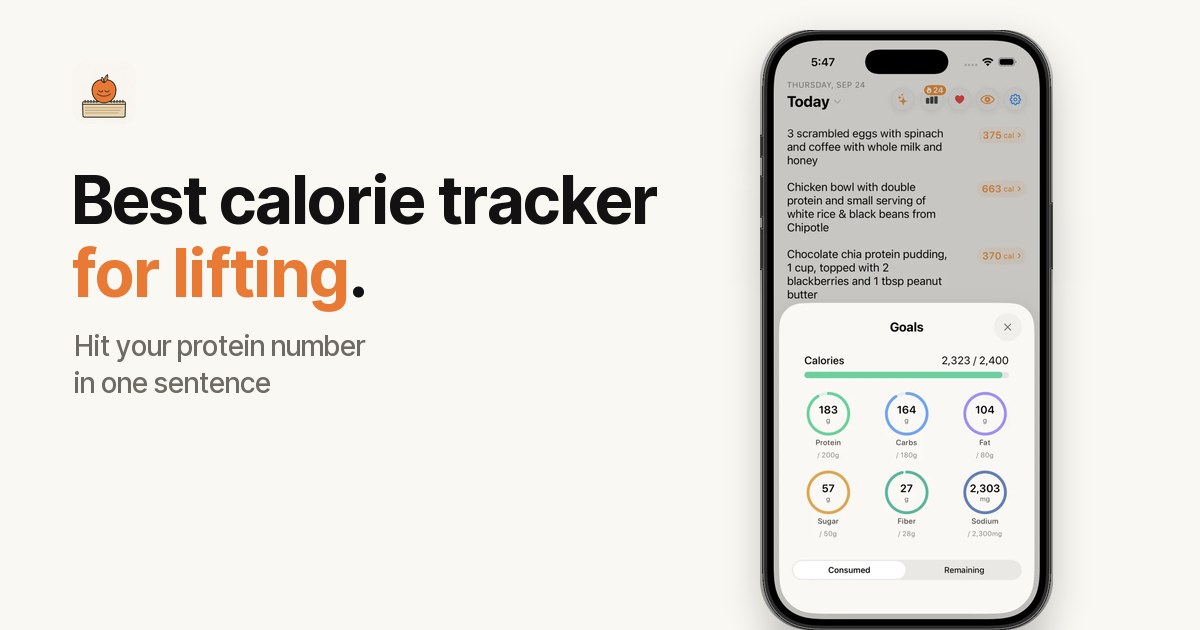
For most lifters who want to hit a protein number without the busywork, the best calorie tracker is Nouri: type "chicken rice bowl and a protein shake" in one line and get calories and macros, with a 1.0 g per pound protein target (1.2 with Prioritize Protein on). We make Nouri. If you want an algorithm that adjusts your targets every week, pick MacroFactor.
The short answer
- Best for gym-goers who want protein tracking without the busywork: Nouri. One sentence per meal, a protein-first target setting, and workouts and calories burned pulled in from Apple Health.
- Best for adaptive coaching and serious lifters: MacroFactor. It estimates your real expenditure from your logs and weight trend and adjusts your macro plan every week. If you want the algorithm to set your numbers, this is the pick.
- Best for micronutrients on a high-protein diet: Cronometer, which lists 95+ vitamins and minerals and a free barcode scanner.
- Best free tier and workout logging in one app: MyFitnessPal, with workout and steps logging free; custom macro goals sit in Premium.
- Best photo-first option: Cal AI, built around snapping your plate, on iPhone and Android.
How we picked
We ranked each app on five things that matter in a training block:
- Protein target you can trust. Does the app give you a gram-based protein goal, and can you push it higher on purpose?
- Speed on repeat meals. Lifters eat the same few meals a lot. How fast is "chicken, rice, broccoli" for the fifth time this week?
- Training data in the same picture. Does the app read workouts and calories burned from Apple Health or a wearable?
- Target management. Do you set your own numbers, or does the app adjust them for you as your weight moves?
- Price and platform. Tiebreakers, because the best tracker is the one you can keep paying for.
Every competitor fact comes from the app's own website or App Store listing, checked November 12, 2026. We did not test any competitor's accuracy, so we make no accuracy claims about them.
Calorie trackers for lifting compared
| App | How you add food | Protein targets | Training data | Adjusts targets for you | Price | Platforms |
|---|---|---|---|---|---|---|
| Nouri | Type a sentence, voice, photo, Siri | 1.0 g/lb default, 1.2 g/lb with Prioritize Protein | Reads workouts, calories burned, steps from Apple Health | No | $9.99/month or $39.99/year, 3-day free trial | iPhone (iOS only) |
| MacroFactor | Search, barcode, label scan, AI photo, describe or speak | Coached, Collaborative, or Manual macro plans | Apple Health, Google Fit; separate MacroFactor Workouts app | Yes, weekly | $11.99/mo, $47.99/half year, $71.99/yr, 7-day trial | iOS, Android |
| Cronometer | Search, barcode (free), photo and voice (Gold) | Custom macro targets; per-day macros on Gold | Apple Health, Apple Watch, Fitbit, Garmin, Oura, Whoop | No | Free; Gold $10.99/mo or $59.99/yr | iOS, Android, web |
| MyFitnessPal | Search; barcode, Meal Scan, Voice Log on Premium | Custom macro goals on Premium | Workout and steps logging, 40+ connected apps and devices | No | Free; Premium $9.99/mo or $49.99/yr, 7-day trial | iOS, Android, web |
| Cal AI | Photo first, barcode, describe | Calories, protein, carbs, fat | Apple Health, Google Fit | Not stated | Not published on its site; 3-day trial | iOS, Android |
Competitor facts from each app's own site and App Store listing, checked November 12, 2026.
How much protein do lifters actually need?
The most cited answer comes from a 2018 meta-analysis in the British Journal of Sports Medicine by Morton and colleagues: 49 randomized trials, 1,863 participants, all doing resistance training for at least six weeks. Protein supplementation increased gains in strength and fat-free mass, and the benefit for fat-free mass plateaued at a total intake of about 1.62 g per kg of body weight per day. The confidence interval ran from 1.03 to 2.20 g/kg, so the authors wrote that it "may be prudent" to recommend about 2.2 g/kg for people trying to maximize muscle gain.
The International Society of Sports Nutrition's position stand lands in the same place: 1.4 to 2.0 g/kg a day is sufficient for most exercising people, and 2.3 to 3.1 g/kg may be needed to hold on to lean mass when resistance-trained people eat in a calorie deficit.
Here is what those numbers mean in pounds, the unit most US lifters think in:
| Guideline | g per kg | g per lb | 180 lb lifter |
|---|---|---|---|
| Morton 2018 plateau estimate | 1.62 | 0.73 | 132 g |
| Morton 2018 upper bound ("maximize") | 2.2 | 1.0 | 180 g |
| ISSN range for most exercisers | 1.4 to 2.0 | 0.64 to 0.91 | 114 to 163 g |
| Nouri default | 2.2 | 1.0 | 180 g |
| Nouri with Prioritize Protein | 2.65 | 1.2 | 216 g |
So Nouri's default of 1.0 g per pound matches Morton's 2.2 g/kg figure, and Prioritize Protein's 1.2 g per pound (2.65 g/kg) sits inside the ISSN range for lifters in a deficit. Hitting roughly the right amount most days beats a perfect number twice a week. Your own target is in the protein intake calculator, and the macro calculator splits the rest.
1. Nouri: protein tracking without the busywork
Nouri works like Apple Notes, but for calories. You type what you ate the way you would text it, "chicken rice bowl and a protein shake," and Nouri splits it into items with calories, protein, carbs, and fat, plus the reasoning behind each number and a confidence rating. If the bowl had double chicken, add that in plain words and recalculate. No database search, no serving-size picker, no adding the shake as a separate entry.
Why lifters like it:
- Prioritize Protein. Your protein target is 1.0 g per pound of body weight by default. Turn on Prioritize Protein and it moves to 1.2 g per pound. Fat is set at 30% of calories and carbs fill the rest.
- Apple Health both ways. Nouri writes your nutrition into Apple Health and reads workouts, calories burned, and steps back, so leg day and dinner sit in the same picture.
- Four ways to add food. Type, voice, a photo (turned into a sentence first so you can fix what it saw), or Siri from the lock screen: "Hey Siri, track food in Nouri," then say the meal. Handy with chalk on your hands.
- Answers, not just totals. A weekly Nouri Report shows average calories and protein against your targets, days on target, and one focus for next week. Fiber, sugar, and sodium goals come standard.
- Published accuracy. Nouri scored 92.1/100 in our 100-meal accuracy benchmark (MyFitnessPal 77.0).
A worked example. A 180 lb lifter with a 2,600-calorie target and Prioritize Protein on:
| Macro | Rule | Grams | Calories |
|---|---|---|---|
| Protein | 180 lb x 1.2 g | 216 g | 864 |
| Fat | 30% of 2,600 | 86.7 g | 780 |
| Carbs | The rest | 239 g | 956 |
| Total | 2,600 |
With Prioritize Protein off, protein is 180 g (720 calories), fat stays at 780, and carbs rise to 275 g.
What Nouri does not do: it does not adjust your targets automatically from your weight trend, it has no barcode scanner, and it has no workout logger of its own (it reads workouts from Apple Health).
Pricing: $9.99/month or $39.99/year, with a 3-day free trial on the yearly plan (get Nouri).
2. MacroFactor: the pick for adaptive coaching
MacroFactor is excellent, and if you want your targets managed for you, pick it. Its site says it "finds your true caloric burn and auto-adjusts your macro plan every week," estimating expenditure from your logged intake and weight trend rather than from a smartwatch. Its listing describes Coached, Collaborative, and Manual plan modes and weekly check-ins. For a lifter running a long bulk or cut who wants the algorithm to catch a slowing trend before they do, that is a real advantage.
Logging is solid too: a verified database, barcode and nutrition-label scanning, AI that lets you "snap a photo or describe your meal," and speech-to-text logging. Training lives in a separate app, MacroFactor Workouts, per its site.
Best for: serious lifters who log every meal and want algorithmic target adjustments.
Consider Nouri instead if: the logging itself is what makes you quit, or you would rather set a protein target once and get a weekly report. Full comparison: Nouri vs MacroFactor.
Pricing: $11.99 a month, $47.99 per half year, or $71.99 a year, with a 7-day trial and no free version. App Store rating 4.8 from 24,000 ratings.
3. Cronometer: protein plus the micronutrients
Cronometer's listing says it tracks "95+ vitamins and minerals" from a curated database of more than 1.1 million verified foods, and its free Basic plan includes a barcode scanner. It syncs with Apple Health and Apple Watch and connects Fitbit, Garmin, Oura, and Whoop to import workouts and energy expenditure. Gold adds photo and voice logging and a Macro Scheduler to "set different macro targets for each day of the week."
Best for: lifters who want to know whether a high-protein diet is still covering iron, magnesium, and the rest.
Pricing: free; Gold is $10.99 a month or $59.99 a year. App Store rating 4.8 from 100,667 ratings. Comparison: Nouri vs Cronometer.
4. MyFitnessPal: the free all-in-one
MyFitnessPal's listing describes a database of 20.5M+ foods, workout and steps logging, an AI Coach, and connections to "40+ fitness trackers, smartwatches & health apps." The catch: its Premium page lists barcode scan, Meal Scan, Voice Log, and "macro tracking with custom goals" as Premium features. Free still covers nutrition, weight, and exercise tracking.
Best for: people who want food and workouts in one free app and are fine searching a database.
Pricing: free; Premium is $9.99 a month or $49.99 a year, with a 7-day trial for first-time users. App Store rating 4.7 from 2,392,518 ratings. Comparison: Nouri vs MyFitnessPal.
5. Cal AI: snap the plate
Cal AI's site says you "snap a photo" and your phone's depth sensor calculates food volume, then it "automatically calculates your calories, protein, carbs, and fat." You can also scan a barcode or describe a meal, and connect Apple Health or Google Fit. Its listing notes that food scanning results require a subscription.
Best for: lifters who eat photographable plates and want AI logging on Android as well as iPhone.
Pricing: not published on its website; a 3-day free trial. App Store rating 4.8 from 375,229 ratings. Comparison: Nouri vs Cal AI.
Bulking vs cutting: what changes in your tracker
Bulking. The challenge is eating enough, consistently, without protein quietly sliding while carbs and fat climb. Track the snacks too. Repeat meals are where typing wins: "same breakfast as yesterday plus a banana" is one line.
Cutting. Protein matters more when calories are lower, which is why the ISSN range goes up for lifters in a deficit. Keep the deficit modest and keep training. Want the target to follow your weight? MacroFactor. Setting your own? Prioritize Protein keeps protein front and center.
Either way, aim for a sustainable target, not a crash. If you have a history of disordered eating, please track with the support of a doctor or dietitian. For food ideas, see 50 high-protein foods ranked by protein per 100 calories, what 200 grams of protein looks like, and the fast food protein index for days you eat out.
What tracking a training day looks like in Nouri
I used MyFitnessPal first. The numbers were fine. Adding a normal dinner took several minutes, and after a long day I just would not do it. A protein target means nothing if half your meals never get tracked.
So Nouri starts with a cursor. One morning I photographed a breakfast plate, and Nouri wrote it back as a sentence before counting anything: "Two poached eggs on avocado toast, bacon, scrambled eggs, and fresh fruit bowl." Four items, 850 calories, 42g protein, 75g carbs, 42g fat. If it had misread the plate, I would have fixed one word. On a training day the rest is the same: type lunch, say the shake to Siri, and the workout shows up from Apple Health on its own.
Who should not pick Nouri
- Android users. Nouri is iPhone only for now. Join the Android waitlist, or pick MacroFactor, Cronometer, MyFitnessPal, or Cal AI.
- People who want targets adjusted for them. Nouri does not run an adaptive algorithm. MacroFactor does.
- Barcode-heavy eaters. If most of your food comes in a wrapper and you love scanning, MacroFactor, Cronometer, MyFitnessPal, and Cal AI all scan barcodes. Nouri does not; you type "one 20g protein bar" instead.
- Micronutrient deep-divers. Cronometer tracks far more vitamins and minerals than Nouri's per-meal scorecard.
- Anyone who wants a free plan. Nouri has a 3-day free trial, not a free tier.
Still comparing the whole field? Start with the best calorie tracker app in 2026, or see the best calorie tracker for Apple Health.
FAQ
What is the best calorie app for the gym?
For most iPhone users who want to hit a protein target without searching databases, Nouri: type the meal in one sentence and it reads your workouts from Apple Health. If you want an algorithm to adjust your targets weekly, MacroFactor is the better pick.
What is the best macro tracker for lifting?
MacroFactor if you want adaptive targets and already log every meal. Nouri if speed is what keeps you consistent, with a 1.0 g per pound protein target that rises to 1.2 with Prioritize Protein.
What is the best app to track protein?
Any app with a gram-based protein goal works if you use it daily. Nouri makes protein the headline with Prioritize Protein, and Cronometer adds deep micronutrient tracking on top.
How much protein do I need to build muscle?
A 2018 meta-analysis of 49 trials found gains in fat-free mass plateaued around 1.62 g per kg per day, with the authors suggesting about 2.2 g/kg for people aiming to maximize gains. That is roughly 0.73 to 1.0 g per pound.
Is 1 gram of protein per pound too much?
For healthy lifters it matches the roughly 2.2 g/kg upper figure from Morton 2018, so it is a generous, research-backed target rather than an extreme one. If you have kidney disease or another medical condition, ask your doctor first.
What is the best calorie tracker for bulking?
One you will use for every meal and snack, since a bulk stalls when meals go untracked. Nouri's one-line typing suits repeat meals, and MacroFactor adjusts your surplus if your weight gain drifts.
What is the best calorie tracker for cutting?
MacroFactor if you want the target to follow your weight trend. Nouri if you want a high protein target, Prioritize Protein's 1.2 g per pound, and a weekly report on how the week went.
Is MacroFactor worth it?
For serious lifters who log consistently and want weekly algorithmic adjustments, yes. It costs $71.99 a year with a 7-day trial and no free version, per its site.
Does MyFitnessPal track macros for free?
The free plan shows calories, carbs, fat, and protein, but its Premium page lists "macro tracking with custom goals" as a Premium feature, at $9.99 a month or $49.99 a year.
Can a calorie app sync my workouts?
Yes. Nouri reads workouts, calories burned, and steps from Apple Health. Cronometer imports workouts from Apple Health and wearables, MyFitnessPal connects 40+ apps and devices, and MacroFactor and Cal AI connect to Apple Health and Google Fit.
What is the easiest way to track protein for lifting?
Open Nouri and type the meal in one line, like "chicken rice bowl and a protein shake," or say it to Siri from the lock screen. Protein, calories, and what you have left appear right away, and Sunday's Nouri Report shows your average protein against your target.
The best tracker for lifting is the one still open in week eight of your program. Try Nouri for protein without the busywork, pick MacroFactor if you want an algorithm in charge of your numbers, and grab your target from the protein intake calculator.
Sources
- Morton RW et al. A systematic review, meta-analysis and meta-regression of the effect of protein supplementation on resistance training-induced gains in muscle mass and strength in healthy adults. Br J Sports Med. 2018;52(6):376-384. PMID 28698222: https://pubmed.ncbi.nlm.nih.gov/28698222/ and full text https://pmc.ncbi.nlm.nih.gov/articles/PMC5867436/ (checked Nov 4, 2026)
- Jäger R et al. International Society of Sports Nutrition Position Stand: protein and exercise. J Int Soc Sports Nutr. 2017;14:20. PMID 28642676: https://pubmed.ncbi.nlm.nih.gov/28642676/ (checked Nov 4, 2026)
- Nouri 100-meal accuracy benchmark: https://nouriapp.co/accuracy (checked Nov 4, 2026)
- MacroFactor website, pricing, and FAQ: https://macrofactor.com/macrofactor/ (checked Nov 12, 2026)
- MacroFactor App Store listing: https://apps.apple.com/us/app/macrofactor-macro-tracker/id1553503471 (checked Nov 12, 2026)
- Cronometer Gold and Basic plans: https://cronometer.com/gold/ (checked Nov 12, 2026)
- Cronometer App Store listing: https://apps.apple.com/us/app/id1145935738 (checked Nov 12, 2026)
- MyFitnessPal Premium: https://www.myfitnesspal.com/premium (checked Nov 12, 2026)
- MyFitnessPal App Store listing: https://apps.apple.com/us/app/id341232718 (checked Nov 12, 2026)
- Cal AI website: https://www.calai.app/ (checked Nov 12, 2026)
- Cal AI App Store listing: https://apps.apple.com/us/app/id6480417616 (checked Nov 12, 2026)
- Ratings and listing text via the iTunes lookup API: https://itunes.apple.com/lookup?id=341232718,1145935738,6480417616,1553503471&country=us (checked Nov 12, 2026)
Keep reading
All articlesBest Calorie Tracker for iPhone and Apple Health in 2026
7 iPhone calorie apps compared on Siri, Apple Health read and write, and Apple Watch. Nouri is our pick at $39.99/year; FoodNoms if you want free.
CompareBest Simple Calorie Tracker App for Beginners in 2026
5 simple calorie apps for beginners, judged on what you must learn and decide per meal. Nouri wins at $39.99/year; Lose It is the free pick.
CompareBest Voice and Siri Calorie Tracker App in 2026
We compared 6 voice calorie trackers. Nouri is our pick: say one sentence to Siri from the lock screen and see calories, macros, and what's left.
CompareBest Notes-Style Calorie Tracking Apps (2026): Nouri vs Amy vs FoodNoms vs Lighter
A notes-style calorie tracker works like Apple Notes for calories. We compare 7 apps; Nouri turns one typed sentence into calories, with a 3-day free trial.