
What 150g, 200g, and 250g of Protein a Day Look Like (Real Food Days)
200g of protein is 800 calories. Real USDA-checked food days for 150g, 200g, and 250g, a 50g serving table, and who actually needs that much.
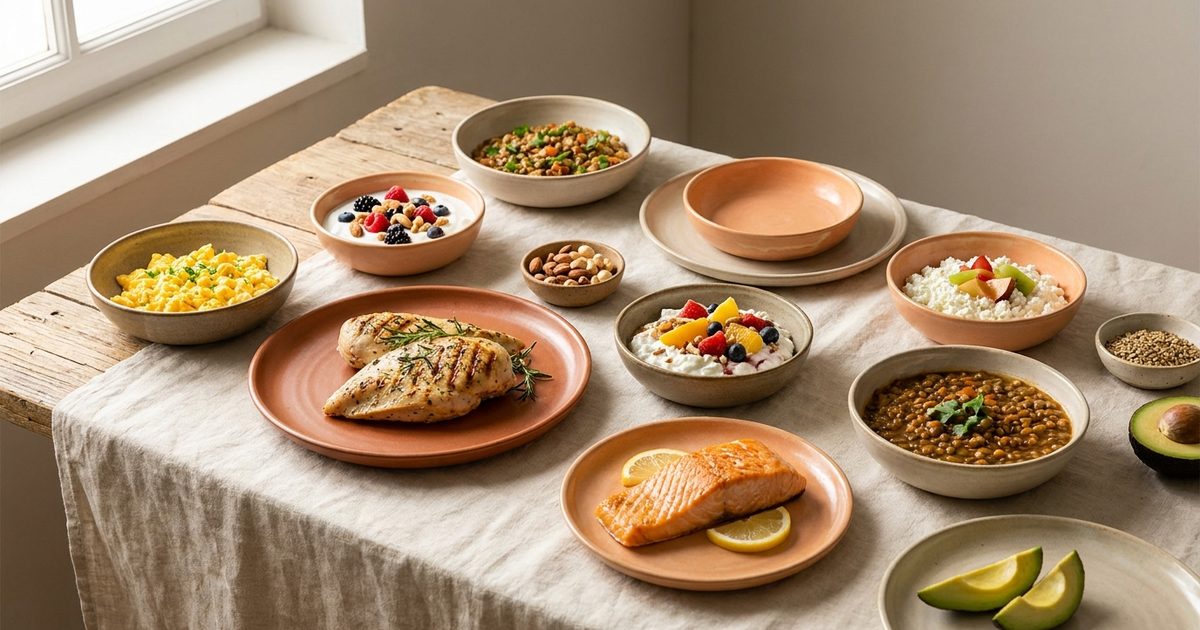
200 grams of protein a day looks like five real meals: eggs and toast, a can of tuna, Greek yogurt, a 6 oz steak, and cottage cheese. Our USDA-built day delivers 202.5g of protein in 1,920 calories, and the protein alone is 800 calories. That is 1 g/lb for a 200 lb person, or 1.2 g/lb at about 167 lb.
Who actually needs 150, 200, or 250 grams of protein
Big protein numbers make sense once you tie them to body weight. Nouri's default protein target is 1.0 gram per pound of body weight, and the Prioritize Protein setting raises it to 1.2 grams per pound. So 200g is simply the default target for a 200 lb person, and the Prioritize Protein target for someone around 167 lb.
The research ranges are lower. The 2025 to 2030 Dietary Guidelines for Americans set a protein serving goal of 1.2 to 1.6 grams per kilogram of body weight. The International Society of Sports Nutrition (ISSN) position stand calls 1.4 to 2.0 g/kg sufficient for most exercising people, and says 2.3 to 3.1 g/kg may be needed to keep lean mass in resistance-trained people who are eating in a calorie deficit. One gram per pound is about 2.2 g/kg, so it sits just above the ISSN's everyday range and just below its cutting range.
Here is what each popular target means in body weight:
| Daily protein | Body weight at 1.0 g/lb (Nouri default) | At 1.2 g/lb (Prioritize Protein) | Where it equals ISSN 2.0 g/kg | Where it fits ISSN 2.3 to 3.1 g/kg (cutting) |
|---|---|---|---|---|
| 140g | 140 lb | 117 lb | 154 lb | 100 to 134 lb |
| 150g | 150 lb | 125 lb | 165 lb | 107 to 144 lb |
| 200g | 200 lb | 167 lb | 220 lb | 142 to 192 lb |
| 220g | 220 lb | 183 lb | 243 lb | 156 to 211 lb |
| 230g | 230 lb | 192 lb | 254 lb | 164 to 220 lb |
| 240g | 240 lb | 200 lb | 265 lb | 171 to 230 lb |
| 250g | 250 lb | 208 lb | 276 lb | 178 to 240 lb |
Read the 200g row as a reality check. For a 200 lb lifter, 200g is the generous 1 g/lb rule. For a 150 lb person who is not training hard, it is nearly double the top of the Dietary Guidelines range (82 to 109g at 68 kg).
Find your own number: the protein intake calculator shows every range for your weight, and the per-weight pages lay it out in one glance: protein for 150 lbs, protein for 200 lbs, and protein for 250 lbs.
The calories in 150g, 200g, and 250g of protein
Protein has 4 calories per gram, so a big protein target takes up a real share of your day before you count any carbs or fat.
| Daily protein | Calories from protein | Share of 2,000 cal | Share of 2,500 cal | Share of 3,000 cal |
|---|---|---|---|---|
| 150g | 600 | 30% | 24% | 20% |
| 200g | 800 | 40% | 32% | 27% |
| 250g | 1,000 | 50% | 40% | 33% |
That is why a 250g target on a 1,800-calorie diet is so hard: protein alone would be 56% of the day. The higher targets fit larger, active people who also eat more.
What 150g of protein looks like
Every food below is from USDA FoodData Central, at USDA's own portion weights. Calories and protein per portion come from USDA's per-100g values, rounded per line.
| Meal | Foods | Calories | Protein |
|---|---|---|---|
| Breakfast | Greek yogurt, 1 container (100) + oatmeal, 1 cup (166) + banana, medium (105) + 1 hard-boiled egg (78) | 449 | 30.8g |
| Lunch | Roasted chicken breast, 1 whole breast, 172g (284) + white rice, 1 cup (205) + broccoli, 1/2 cup (27) | 516 | 59.5g |
| Snack | Cottage cheese 1%, 1/2 cup (81) + apple, medium (95) | 176 | 14.5g |
| Dinner | Sockeye salmon, 1/2 fillet, 155g (242) + baked russet potato, medium (164) + broccoli, 1/2 cup (27) | 433 | 47.5g |
| Total | 1,574 | 152.3g |
The protein math: 17.3 + 5.9 + 1.3 + 6.3 = 30.8 at breakfast, 53.3 + 4.3 + 1.9 = 59.5 at lunch, 14.0 + 0.5 = 14.5 for the snack, and 41.1 + 4.5 + 1.9 = 47.5 at dinner. The day: 30.8 + 59.5 + 14.5 + 47.5 = 152.3g, and 449 + 516 + 176 + 433 = 1,574 calories.
At 150g, two foods do most of the work: one whole chicken breast and half a salmon fillet supply 94.4g, nearly two thirds of the day. The calories leave plenty of room for cooking oil, sauces, and a second snack.
What 200g of protein looks like
The 200g day adds a fifth eating occasion and bigger protein portions. No protein powder.
| Meal | Foods | Calories | Protein |
|---|---|---|---|
| Breakfast | 3 hard-boiled eggs (232) + 3 egg whites (51) + whole-wheat toast, 2 slices (161) + 2% milk, 1 cup (122) | 566 | 45.7g |
| Lunch | Light tuna in water, 1 can, 165g (191) + whole-wheat bread, 2 slices (161) + apple, medium (95) | 447 | 50.5g |
| Snack | Greek yogurt, 1 container (100) + banana, medium (105) | 205 | 18.6g |
| Dinner | Top sirloin, lean, 6 oz (320) + baked russet potato, medium (164) + broccoli, 1 cup (55) | 539 | 59.7g |
| Evening | Cottage cheese 1%, 1 cup (163) | 163 | 28.0g |
| Total | 1,920 | 202.5g |
The protein math: 18.9 + 10.8 + 7.9 + 8.1 = 45.7, then 42.1 + 7.9 + 0.5 = 50.5, then 17.3 + 1.3 = 18.6, then 51.5 + 4.5 + 3.7 = 59.7, plus 28.0 in the evening. The day: 45.7 + 50.5 + 18.6 + 59.7 + 28.0 = 202.5g. Calories: 566 + 447 + 205 + 539 + 163 = 1,920.
A can of tuna and a 6 oz steak carry 93.6g between them, and the eggs, yogurt, and cottage cheese fill in the rest. For a 200 lb person, 1,920 calories is probably below maintenance, so most people would add carbs and fat on top. If you are cutting, it shows 200g fits a modest calorie budget.
For scale, getting 200g from a single food would take about 32 large eggs (2,460 calories), 645g of roasted chicken breast (1,065 calories), or nearly five cans of tuna (910 calories). Mixing foods is the only sane way to do it.
What 250g of protein looks like
At 250g, protein powder starts to earn its place. This day uses one scoop.
| Meal | Foods | Calories | Protein |
|---|---|---|---|
| Breakfast | 4 hard-boiled eggs (310) + 3 egg whites (51) + whole-wheat toast, 2 slices (161) + 2% milk, 1 cup (122) | 644 | 52.0g |
| Lunch | Roasted chicken breast, 1 whole breast (284) + white rice, 1 cup (205) + black beans, 1/2 cup (114) | 603 | 65.2g |
| Snack | Whey protein, 1/3 cup, 32g (113) + 2% milk, 1 cup (122) + banana, medium (105) | 340 | 34.4g |
| Dinner | Ground beef 93/7, 6 oz cooked (355) + quinoa, 1 cup (222) + broccoli, 1 cup (55) | 632 | 60.9g |
| Evening | Greek yogurt, 1 container (100) + cottage cheese 1%, 1/2 cup (81) + almonds, 1 oz (164) | 345 | 37.3g |
| Total | 2,564 | 249.8g |
The protein math: 25.2 + 10.8 + 7.9 + 8.1 = 52.0, then 53.3 + 4.3 + 7.6 = 65.2, then 25.0 + 8.1 + 1.3 = 34.4, then 49.1 + 8.1 + 3.7 = 60.9, then 17.3 + 14.0 + 6.0 = 37.3. The day: 52.0 + 65.2 + 34.4 + 60.9 + 37.3 = 249.8g. Calories: 644 + 603 + 340 + 632 + 345 = 2,564.
No powder? Swap the whey for a full cup of cottage cheese (163 calories, 28.0g). The day becomes 252.8g at 2,614 calories. Five meals of this size is a lot of logging, but "four eggs, three whites, two slices of toast, glass of milk" is one sentence to Nouri.
How many servings equal 50g of protein
This is the quickest way to plan any target: 150g is three of these blocks, 200g is four, and 250g is five.
| Food (USDA) | Amount for 50g protein | In USDA portions | Calories |
|---|---|---|---|
| Shrimp, cooked | 208g | 2.5 × 3 oz | 206 |
| Whey protein powder | 64g | 2 scoops (1/3 cup each) | 225 |
| Light tuna, canned in water | 196g | 1.2 cans | 227 |
| Egg whites | 459g | 13.9 large whites | 239 |
| Turkey breast, roasted | 166g | 2.0 × 3 oz | 244 |
| Chicken breast, roasted | 161g | 1.9 half breasts | 266 |
| Greek yogurt, plain nonfat | 490g | 2.9 containers | 289 |
| Cottage cheese, 1% | 403g | 3.6 half cups | 290 |
| Sockeye salmon, cooked | 189g | 2.2 × 3 oz | 294 |
| Top sirloin, lean | 165g | 1.9 × 3 oz | 310 |
| Ground beef 93/7, cooked | 173g | 2.0 × 3 oz | 362 |
| Firm tofu | 289g | 3.6 quarter blocks | 416 |
| Skim milk | 1,484g | 6.1 cups | 504 |
| Edamame | 420g | 2.7 cups | 508 |
| Eggs, hard-boiled | 397g | 7.9 large eggs | 615 |
| Lentils, boiled | 554g | 2.8 cups | 643 |
| Black beans, boiled | 564g | 3.3 cups | 745 |
| Peanut butter | 225g | 7.0 × 2 tbsp | 1,347 |
| Almonds | 236g | 8.3 oz | 1,366 |
Each row is 50 ÷ the food's protein per 100g × 100. For chicken breast: 50 ÷ 31.0 × 100 = 161g, and 161g × 165 calories per 100g = 266 calories. The calorie column is the story. Poultry, fish, egg whites, whey, and Greek yogurt deliver 50g for 206 to 294 calories. Whole eggs and beans cost two to three times that, and peanut butter and almonds more than 1,300. Our high protein foods ranking sorts 50 foods by this efficiency.
How to split 150g, 200g, or 250g across meals
The ISSN position stand gives a general per-serving recommendation of about 0.25 g per kg of body weight, or an absolute 20 to 40 grams, spread every 3 to 4 hours. The Dietary Guidelines say it more simply: "Prioritize Protein Foods at Every Meal." A big daily target means either bigger servings or more of them.
| Daily target | 3 meals | 4 meals | 5 meals |
|---|---|---|---|
| 150g | 50g each | 37.5g each | 30g each |
| 200g | 67g each | 50g each | 40g each |
| 250g | 83g each | 62.5g each | 50g each |
The 4-meal split for 150g and the 5-meal split for 200g land inside the ISSN's 20 to 40 gram range. At 250g, even five meals average 50g. Real days are uneven: our 200g day runs 45.7, 50.5, 18.6, 59.7, and 28.0. What matters is that no meal is missing protein and the total lands.
A practical rule: anchor each meal with one item from the 50g table, then fill in. Breakfast is where most people fall short, so the 200g and 250g days start with 45.7g and 52.0g.
A cost-friendly 200g day
High protein does not have to mean expensive. This version uses the cheapest foods in our cheapest protein foods ranking: eggs, milk, chicken breast, dried beans, rice, pasta, and bread.
| Meal | Foods | Calories | Protein |
|---|---|---|---|
| Breakfast | 4 hard-boiled eggs (310) + white bread, 2 slices (133) + 2% milk, 1 cup (122) | 565 | 37.7g |
| Lunch | Roasted chicken breast, 1 whole breast (284) + white rice, 1 cup (205) + black beans, 1 cup (227) | 716 | 72.8g |
| Snack | 2 hard-boiled eggs (155) + 2% milk, 2 cups (244) | 399 | 28.7g |
| Dinner | Roasted chicken breast, 1 whole breast (284) + spaghetti, 1 cup (196) + broccoli, 1/2 cup (27) | 507 | 62.4g |
| Total | 2,187 | 201.6g |
The protein math: 25.2 + 4.4 + 8.1 = 37.7, then 53.3 + 4.3 + 15.2 = 72.8, then 12.6 + 16.1 = 28.7, then 53.3 + 7.2 + 1.9 = 62.4. The day: 37.7 + 72.8 + 28.7 + 62.4 = 201.6g. Calories: 565 + 716 + 399 + 507 = 2,187.
What does it cost? Using the cost per 25g of protein from our ranking (BLS average prices for August 2026), the priced foods come to about $6.96 for 199.7g of protein, roughly $0.87 per 25g. Chicken breast is $4.35 of that. Broccoli is not priced, and your store will differ, so treat it as an estimate. The method: grams of protein from each food ÷ 25 × that food's cost per 25g. For example, the six eggs carry 37.8g, so 37.8 ÷ 25 × $0.75 = $1.13.
How Nouri sets and tracks a 200g target
Nouri sets your protein target from your weight: 1.0 gram per pound by default, 1.2 grams per pound with Prioritize Protein turned on. For a 200 lb person that is 200g or 240g. Your calorie target does not move, fat stays at 30% of calories, and carbs absorb the difference.
The target is the easy part. Hitting 200g means logging five meals and about fifteen foods a day. I started with MyFitnessPal, and the numbers were fine. The problem was time: a normal dinner took several minutes of searching and picking portions, and after a long day I skipped it. A day like the ones above would have been fifteen searches.
In Nouri you describe the meal once. Type "can of tuna on two slices of whole-wheat bread and an apple," say it, snap a photo (Nouri turns the photo into a sentence first so you can fix anything it misread), or ask Siri from the lock screen: "Hey Siri, track food in Nouri." The protein for that meal shows up right away with per-item reasoning, and adding "6 oz, not 4" recalculates it. Want to see how the estimates hold up? Nouri scored 92.1/100 in our 100-meal accuracy benchmark (MyFitnessPal 77.0). Nouri is iPhone (iOS only), and you can start with a free trial.
Your protein ring fills as you log, so by mid-afternoon you know whether dinner needs to be the 6 oz steak. Each week your Nouri Report shows your average protein against your target, how many days you landed on target for your goal, and protein equivalents that turn the grams into food you can picture.
Common mistakes with high protein targets
Confusing grams of food with grams of protein. A 6 oz (170g) roasted chicken breast portion is not 170g of protein. It is about 52.7g. Use the 50g table above, or let your tracker do the conversion.
Mixing raw and cooked weights. Meat loses water when it cooks, so 6 oz raw and 6 oz cooked are different amounts of protein. Every number in this post is for cooked or ready-to-eat food. Pick one way and stick to it. How to track calories without weighing food covers simpler ways to estimate.
Leaning on nuts and nut butter. 50g of protein from peanut butter costs 1,347 calories. On a high target, nuts quietly take over your fat budget.
Saving it all for dinner. A 100g dinner is hard to eat and easy to skip. Spread it out: the high protein snacks list has 40 options for the gaps between meals.
Raising protein without adjusting anything else. Adding 50g of protein adds 200 calories. If your calorie target stays the same, those calories have to come out of carbs or fat. How to Track Macros walks through the trade.
FAQ
What does 200 grams of protein look like?
Our USDA-built day reaches 202.5g with eggs and egg whites at breakfast, a can of tuna at lunch, Greek yogurt as a snack, a 6 oz top sirloin at dinner, and a cup of cottage cheese, for 1,920 calories. From one food, 200g would take about 32 large eggs or 645g of roasted chicken breast.
Is 200g of protein a day too much?
It depends on your size. For a 200 lb person, 200g is the 1 g/lb rule, about 2.2 g/kg, slightly above the 1.4 to 2.0 g/kg the ISSN calls sufficient for most exercising people. For a 150 lb person it is far above the Dietary Guidelines range of 82 to 109g. If you have a medical condition, check with your doctor before raising protein a lot.
How many calories is 200 grams of protein?
200 grams of protein is 800 calories, at 4 calories per gram. That is 40% of a 2,000-calorie day or 32% of a 2,500-calorie day. 150g is 600 calories and 250g is 1,000.
Who needs 150 grams of protein a day?
150g is Nouri's default 1 g/lb target for a 150 lb person, or the Prioritize Protein target (1.2 g/lb) for a 125 lb person. By ISSN math it equals 2.0 g/kg at about 165 lb. Our 150g sample day hits 152.3g at 1,574 calories.
How do I eat 140 grams of protein a day?
Take the 150g day above and drop the cottage cheese snack: it lands at 138.3g in 1,493 calories. 140g fits a 140 lb person at 1 g/lb or a 117 lb person with Prioritize Protein on. The protein for 140 lbs page shows every range for that weight.
What does 220, 230, or 240 grams of protein a day look like?
Add a Greek yogurt to the 200g day and you reach 219.8g at 2,020 calories. Remove the 1/2 cup of cottage cheese and the almonds from the 250g day for 229.8g at 2,319 calories, or remove only the egg whites for 239.0g at 2,513 calories. Those targets match 220, 230, and 240 lb at 1 g/lb.
How much protein should I eat per meal to hit 200g?
Five meals of 40g each gets you to 200g, which is the top of the ISSN's general 20 to 40g per-serving range. With four meals you need 50g each. Anchor each meal with one food from the 50g table and fill in from there.
Can you get 200g of protein without protein powder?
Yes. Our 200g day uses no powder: eggs, egg whites, tuna, Greek yogurt, steak, and cottage cheese. Powder helps more around 250g, and even then a cup of cottage cheese can replace the scoop.
What is the cheapest way to get 200 grams of protein?
Eggs, milk, chicken breast, and dried beans. Our cost-friendly day hits 201.6g, and the priced foods come to about $6.96 at August 2026 BLS average prices, roughly $0.87 per 25g. See the cheapest protein foods for all 24 foods ranked.
Is 250 grams of protein too much?
For a 250 lb person it is the 1 g/lb target. For a 180 lb person it is about 3.1 g/kg, the very top of the 2.3 to 3.1 g/kg range the ISSN describes for trained people in a deficit. It is also 1,000 calories of protein, so it only fits a large calorie budget.
How many eggs equal 200 grams of protein?
About 32 large eggs, at 6.3g each by USDA data, which would be 2,460 calories. Egg whites are leaner: 50g of protein takes 13.9 whites for 239 calories. Mixing the two keeps breakfast realistic.
What is the easiest way to track 200 grams of protein a day?
Set your weight in Nouri, turn on Prioritize Protein if you want the higher 1.2 g/lb target, then log each meal in one sentence by typing, talking, taking a photo, or asking Siri. The protein ring tells you how far you are from 200g at any point in the day.
Bottom line
150g, 200g, and 250g of protein are 600, 800, and 1,000 calories, and each one is just 1 g/lb for a 150, 200, or 250 lb person. Spread them over four or five meals built around lean meat, fish, eggs, and dairy and they fit inside a normal day. Check your own target with the protein for 200 lbs page or the full protein intake calculator, let Nouri keep the running total, and on fast food days use our list of fast food orders under 500 calories with 30g+ protein.
Sources
- Dietary Guidelines for Americans, 2025 to 2030 (protein serving goals of 1.2 to 1.6 g/kg/day; "Prioritize Protein Foods at Every Meal"), cdn.realfood.gov/DGA.pdf (checked October 13, 2026)
- Jäger R, Kerksick CM, Campbell BI, et al. "International Society of Sports Nutrition Position Stand: protein and exercise." Journal of the International Society of Sports Nutrition, 2017 (1.4 to 2.0 g/kg/d for most exercising individuals; 2.3 to 3.1 g/kg/d during hypocaloric periods in resistance-trained subjects; 0.25 g/kg or 20 to 40 g per serving, every 3 to 4 hours), pmc.ncbi.nlm.nih.gov/articles/PMC5477153 (checked October 13, 2026)
- USDA FoodData Central, SR Legacy (checked October 13, 2026): chicken breast, roasted (FDC 171477); turkey breast, roasted (FDC 171496); light tuna, canned in water (FDC 171986); shrimp, cooked (FDC 175180); sockeye salmon, cooked (FDC 173692); top sirloin, lean, broiled (FDC 168635); ground beef 93/7, cooked (FDC 174755); egg, hard-boiled (FDC 173424); egg white (FDC 172183); Greek yogurt, plain nonfat (FDC 170894); cottage cheese 1% (FDC 173417); skim milk (FDC 171269); 2% milk (FDC 171267); whey protein powder (FDC 173180); firm tofu (FDC 172475); edamame (FDC 168411); lentils, boiled (FDC 172421); black beans, boiled (FDC 173735); peanut butter (FDC 172470); almonds (FDC 170567); oatmeal, cooked (FDC 173905); white rice, cooked (FDC 168878); quinoa, cooked (FDC 168917); spaghetti, cooked (FDC 169737); whole-wheat bread (FDC 172688); white bread (FDC 174924); russet potato, baked (FDC 170030); broccoli, boiled (FDC 169967); banana (FDC 173944); apple (FDC 171688)
- Portion weights are USDA's own household measures. Multiples are counted from them: 1 whole chicken breast = 2 × USDA's 1/2 breast (86g); 6 oz steak or ground beef = 2 × 3 oz (85g); 1 cup broccoli = 2 × 1/2 cup (78g); 1 cup cottage cheese = 226g, USDA's cup weight; 1 slice white bread = 25g, USDA's slice weight
- Cost per 25g of protein: Nouri, The Cheapest Protein: 24 Foods Ranked by Cost per 25g of Protein, from U.S. Bureau of Labor Statistics average prices for August 2026
Keep reading
All articlesAre AI Calorie Apps Accurate? What the 2026 Research Actually Shows
A 2026 study found an AI photo app underestimated intake by 25%. What the research says about AI calorie apps, and why a photo can't see the oil.
GuidesIn a Calorie Deficit But Not Losing Weight? 9 Reasons and the Fix for Each
In an NEJM study, people reporting under 1,200 calories underreported intake by 47%. 9 reasons the scale won't move, with a fix for each.
GuidesHow Many Calories Do You Need While Breastfeeding? (CDC vs ACOG, Explained)
The CDC says 330 to 400 extra calories a day while breastfeeding; ACOG says 450 to 500. Why they differ and how to find your own number.
Guides'Mom Calories': What Eating Your Kids' Leftovers Really Adds Up To
3 nuggets, some crusts, cheese crackers and juice sips add up to about 297 calories a day, or 2,079 a week. The guilt-free tally, with USDA numbers.