

Turkey Trot Calories Burned: 5K, 10K and Walking, by Pace and Weight
A turkey trot 5K burns about 200 to 480 calories and a 10K about 400 to 960, by pace and weight (120 to 200 lb). Full tables, net vs gross math, pacing tips.
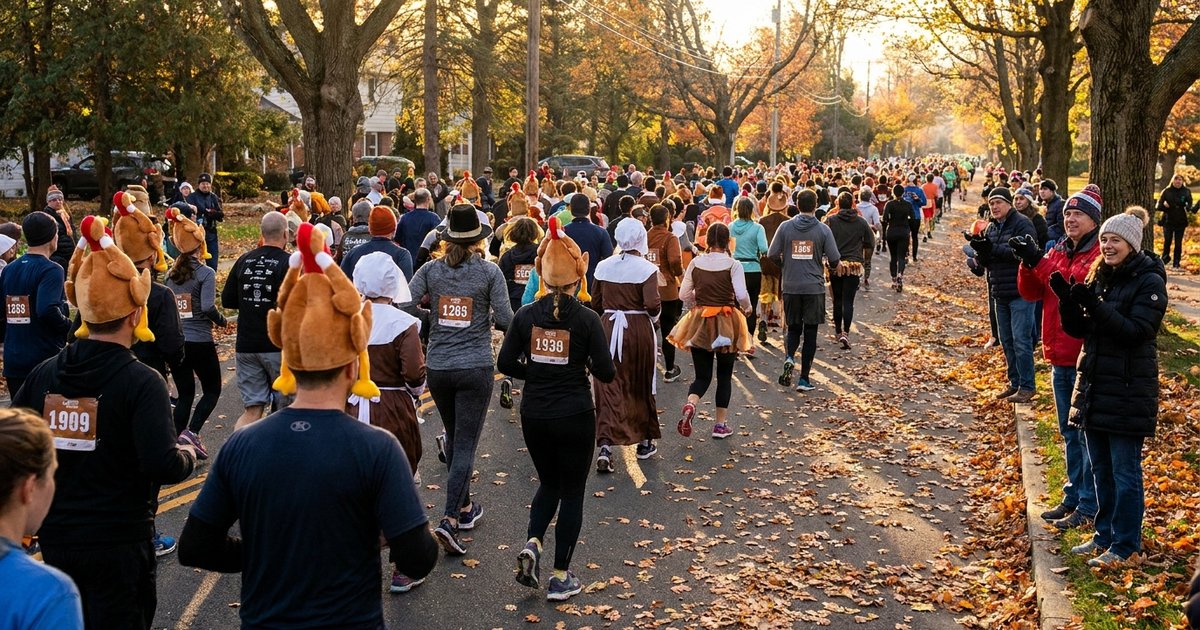
A turkey trot 5K burns about 200 to 480 calories, depending on your pace and body weight (120 to 200 lb), using 2024 Compendium MET values. A 10K roughly doubles that: about 400 to 960. Walkers and runners land closer than you'd think, because walkers are out there longer. Thanksgiving 2026 is Thursday, November 26.
Quick ground rule before the tables: a turkey trot is a tradition, a party in running shoes, and occasionally a man dressed as a pilgrim outsprinting you. It is not a payment plan for dinner. Food is not a debt, and nobody is checking your splits at the table. These numbers are here because they are fun to know.
How do you calculate calories burned in a turkey trot?
Researchers rate activities in METs (metabolic equivalents). By convention, 1 MET is your resting rate, about 1 calorie per kilogram of body weight per hour. Running at 6 mph is 9.3 METs, so it costs roughly 9.3 times what sitting does.
- Gross calories = METs x weight in kg x hours
- Net calories = (METs minus 1) x weight in kg x hours
Every MET value here comes from the 2024 Adult Compendium of Physical Activities, the standard research reference for activity energy costs. We matched each pace to its Compendium code, then worked out the time each pace takes for 5 km (3.107 miles) and 10 km (6.214 miles).
METs are averages from lab studies. Your real number shifts with fitness, stride, hills, wind and selfie stops with the person in the inflatable turkey suit.
How many calories does a 5K turkey trot burn?
Gross calories for the full 5K, by pace and body weight. Times are what that pace takes for 3.107 miles.
| Pace | Speed | Code | METs | 5K time | 120 lb | 140 lb | 160 lb | 180 lb | 200 lb |
|---|---|---|---|---|---|---|---|---|---|
| Easy walk | 2.5 mph (24:00/mi) | 17170 | 3.0 | 1:14:34 | 203 | 237 | 271 | 304 | 338 |
| Moderate walk | 3.0 mph (20:00/mi) | 17190 | 3.8 | 1:02:08 | 214 | 250 | 286 | 321 | 357 |
| Brisk walk | 3.5 mph (17:09/mi) | 17200 | 4.8 | 53:16 | 232 | 271 | 309 | 348 | 387 |
| Easy jog | 4.0 mph (15:00/mi) | 12028 | 6.5 | 46:36 | 275 | 321 | 366 | 412 | 458 |
| Jog | 5.0 mph (12:00/mi) | 12030 | 8.5 | 37:17 | 287 | 335 | 383 | 431 | 479 |
| Run | 6.0 mph (10:00/mi) | 12050 | 9.3 | 31:04 | 262 | 306 | 349 | 393 | 437 |
| Fast run | 7.5 mph (8:00/mi) | 12080 | 11.8 | 24:51 | 266 | 310 | 355 | 399 | 443 |
Weights convert at 0.4536 kg per pound: 120 lb is 54.4 kg, 140 lb is 63.5 kg, 160 lb is 72.6 kg, 180 lb is 81.6 kg and 200 lb is 90.7 kg.
How many calories does a 10K turkey trot burn?
Same paces, double the distance. If your local trot has a 10K option and you picked it on purpose, we salute you.
| Pace | Speed | Code | METs | 10K time | 120 lb | 140 lb | 160 lb | 180 lb | 200 lb |
|---|---|---|---|---|---|---|---|---|---|
| Easy walk | 2.5 mph | 17170 | 3.0 | 2:29:08 | 406 | 474 | 541 | 609 | 676 |
| Moderate walk | 3.0 mph | 17190 | 3.8 | 2:04:16 | 428 | 500 | 571 | 643 | 714 |
| Brisk walk | 3.5 mph | 17200 | 4.8 | 1:46:31 | 464 | 541 | 618 | 696 | 773 |
| Easy jog | 4.0 mph | 12028 | 6.5 | 1:33:12 | 550 | 641 | 733 | 824 | 916 |
| Jog | 5.0 mph | 12030 | 8.5 | 1:14:34 | 575 | 671 | 767 | 862 | 958 |
| Run | 6.0 mph | 12050 | 9.3 | 1:02:08 | 524 | 612 | 699 | 786 | 874 |
| Fast run | 7.5 mph | 12080 | 11.8 | 49:43 | 532 | 621 | 710 | 798 | 887 |
The worked example, step by step
Take a 160 lb (72.6 kg) runner doing the 5K at 6.0 mph. Time is 3.107 miles divided by 6.0 mph = 0.518 hours (31 minutes). Gross calories are 9.3 x 72.6 x 0.518 = 349 calories.
Now a 160 lb walker at 3.0 mph. Time is 3.107 / 3.0 = 1.036 hours (62 minutes). Gross calories are 3.8 x 72.6 x 1.036 = 286 calories. The runner burns more, but only by about 63 calories, because the walker is on the course twice as long.
Why does a 12-minute mile beat a 10-minute mile in the table?
Sharp eye. The 5.0 mph jog (8.5 METs) shows slightly more calories per 5K than the 6.0 mph run (9.3 METs). That is not a secret fat-burning zone. Each Compendium code comes from its own set of studies, and the MET values do not rise in a perfectly smooth line with speed. Over a whole race, the differences between jogging and running paces are small enough to sit inside normal person-to-person variation.
Two honest notes:
- Code 12028 covers 4.0 to 4.2 mph. We used 4.0 mph (a 15:00 mile) for the time. The Compendium's own label also says "13 min/mile," which works out faster than its listed speed range, so treat that row as a rough middle ground.
- The big picture is the useful bit. Once you are jogging or running, a 5K costs roughly 1 calorie per kilogram per kilometer, whatever the pace. Walking lands a little lower, about 0.8 per kilogram per kilometer at a moderate pace.
Net vs gross calories: which number is real?
Both are real. They answer different questions.
Gross is everything your body burned during the race, including the energy it would have used anyway just keeping you alive. Net subtracts that resting baseline (1 MET for the same amount of time), so it shows only the extra the trot added. Most watches and treadmills show something closer to gross, unless they label it "active calories."
Here is the gap for a 160 lb (72.6 kg) person:
| Pace | 5K gross | 5K net | 10K gross | 10K net |
|---|---|---|---|---|
| Moderate walk, 3.0 mph | 286 | 210 | 571 | 421 |
| Brisk walk, 3.5 mph | 309 | 245 | 618 | 490 |
| Jog, 5.0 mph | 383 | 338 | 767 | 676 |
| Run, 6.0 mph | 349 | 312 | 699 | 624 |
The math for the 3.0 mph walk: resting cost is 1.0 x 72.6 x 1.036 = 75 calories, so net is 286 minus 75 = 210 (or directly, 2.8 x 72.6 x 1.036). For the 6.0 mph run, resting is only 38 calories because the run is short, so net is 312.
Notice the net gap is bigger for walkers. A slower race means more of the clock was "resting cost" you would have spent anyway. Neither number makes anyone's race count more. A 1 MET baseline is also a convention: real resting burn varies from person to person.
How many steps is a 5K?
For walkers, about 6,500 to 7,900 steps, depending on pace. Here is how we got there, with every assumption on the table.
The CADENCE-Adults study measured 76 adults aged 21 to 40 walking on a treadmill and counted their steps. Average cadence was 105.8 steps per minute at 2.5 mph, 113.6 at 3.0 mph and 121.5 at 3.5 mph. Multiply by the time each pace takes to cover 5 km:
| Walking pace | Cadence (steps/min) | 5K time (min) | 5K steps | 10K steps |
|---|---|---|---|---|
| 2.5 mph | 105.8 | 74.6 | about 7,900 | about 15,800 |
| 3.0 mph | 113.6 | 62.1 | about 7,100 | about 14,100 |
| 3.5 mph | 121.5 | 53.3 | about 6,500 | about 12,900 |
Faster walkers take fewer steps because each one is longer (about 0.63 m per step at 2.5 mph vs 0.77 m at 3.5 mph, worked out from the same study's numbers). Assumptions: a flat course, steady pace, and a body similar to the study's average. Taller people take fewer, longer steps. Runners take fewer steps again, but that study only covered walking, so we will not invent a running number. Want your own walking number? Try the steps to calories calculator.
Does a turkey trot count as exercise?
Yes, and neatly. The CDC says adults need 150 minutes of moderate activity a week, or 75 minutes of vigorous activity (it names jogging and running as vigorous examples).
- A 5K walk at 3.0 mph (3.8 METs, moderate) takes 62 minutes: about 41% of the weekly moderate target.
- A 5K run at 6.0 mph takes 31 minutes: about 41% of the weekly vigorous target.
Same share, either way. The universe is telling you walking counts. If you want more walking ideas for the rest of the year, see how to lose weight walking.
How should you pace a turkey trot?
Turkey trots are crowded, chaotic and mostly joyful. A few tips that keep it that way:
- Start slower than you want to. The first half mile is a human traffic jam. Settle in and pass people later if you feel good.
- Seed yourself honestly. Walkers and stroller pushers near the back, racers near the front. Everyone gets a better morning.
- Run-walk is a real strategy. Jog a few minutes, walk one, repeat. The Compendium even has a code for a jog/walk combination (12010, 6.0 METs).
- Aim for a negative split. Run the second half a little faster than the first.
- Test your costume first. Wear it on a short practice run. Feathers, tails and inflatable wattles chafe in surprising places, and a costume that slides down your face at mile two is a hazard, not a bit.
- Dress for the finish, not the start. You warm up fast. A throwaway layer or a costume that vents is your friend on a cold morning.
- Bringing a stroller? Pushing a jogging stroller outdoors at 5 mph is 10.0 METs (code 12593), up from 8.5 for jogging at the same speed solo.
What should you eat before a morning turkey trot?
Keep it simple, familiar and boring in the best way. Race morning is not the day to try the new protein bar from the expo table.
- Eat something you already know sits well. Toast with jam or peanut butter, a banana, oatmeal, a bagel or a granola bar are common picks. Easy carbs and not too much fat or fiber right before tend to feel best for most people.
- Give it time. A small snack is usually fine closer to the start, and a bigger breakfast does better with more time to settle.
- Drink water, and have your usual coffee if that's your routine. Race day is not the day to quit caffeine or discover it.
- Then go have a great Thanksgiving. Eat the pie because it's pie. The pie is a carb source and we respect it.
If your stomach is sensitive, or you have a medical condition that affects how you eat or exercise, check with your doctor before race day. And if you have a history of disordered eating, please work with a doctor or registered dietitian before tracking food or exercise. Calorie numbers should make your day more interesting, never smaller.
Why I track the breakfast, not the burn
When I started tracking, I used MyFitnessPal. The numbers were fine. Typing in a normal dinner just took several minutes, and after a long day I would skip it. Then I tried AI photo trackers. Fast, but when I checked a few plates ingredient by ingredient, one the camera called about 400 calories was closer to 700.
That 300-calorie miss is in the same range as an entire 5K for a lot of people in the tables above. Which is my point: the race number is fun, but the food number is the one you actually use every day, and it only helps if it's honest and fast enough that you'll do it.
That's why I built Nouri. On race morning you can type or say "toast with peanut butter and half a banana" and you're done. You can snap a photo, which Nouri turns into a sentence first so you can read what it thinks it saw, or tell Siri from the lock screen with gloves still on: "Hey Siri, track food in Nouri." Each item comes with reasoning and a confidence rating, and if you forgot the honey, you add it in a few words and it recalculates. It syncs with Apple Health both ways, so the trot your watch recorded and your breakfast sit in the same place. If Thanksgiving is the next thing you want numbers for, the Thanksgiving calorie calculator is built for exactly that plate.
What else is in the Thanksgiving cluster?
Want the food side of the day too?
- Thanksgiving dinner calories, dish by dish
- Turkey calories by cut, white vs dark meat
- Thanksgiving pie calories, every classic slice
- High-protein Thanksgiving, dishes ranked by protein
- Thanksgiving leftovers calories and Friendsgiving calories
- What a gym girl eats on Thanksgiving and Thanksgiving on a cut, bulk or maintenance
- The macro calculator if you want targets for the week
And the day after, our Black Friday calories burned guide runs the same MET math on mall walking and carrying bags.
FAQ
How many calories does a 5K turkey trot burn?
About 200 to 480 calories, depending on pace and body weight. A 160 lb person burns about 286 walking at 3.0 mph and about 349 running at 6.0 mph, using 2024 Compendium MET values.
How many calories do you burn walking a 5K?
About 203 to 387 calories for people from 120 to 200 lb, at paces from 2.5 to 3.5 mph. At 160 lb, a moderate 3.0 mph walk is about 286 calories and takes about 62 minutes.
How many calories does a 10K burn?
About 400 to 960 calories, depending on pace and weight. A 160 lb runner at 6.0 mph burns about 699 in just over an hour, and a 160 lb walker at 3.0 mph burns about 571 in about two hours.
Does running burn more calories than walking the same distance?
Yes, but less than most people expect. Running costs roughly 1 calorie per kilogram per kilometer, and moderate walking about 0.8. The walker spends more time on the course, which narrows the gap.
How many steps is a 5K walk?
About 6,500 to 7,900 steps, based on CADENCE-Adults cadences of 105.8 to 121.5 steps per minute at 2.5 to 3.5 mph. Faster walkers take fewer, longer steps, and taller people take fewer steps too.
How long does it take to walk a 5K?
About 53 minutes at a brisk 3.5 mph, 62 minutes at 3.0 mph and 75 minutes at an easy 2.5 mph. Crowded turkey trot starts usually add a few minutes.
What is the difference between net and gross calories burned?
Gross is everything you burned during the activity. Net subtracts what you would have burned resting for the same time (1 MET), so it shows only the extra. For a 160 lb walker doing a 5K at 3.0 mph, gross is about 286 and net about 210.
How accurate are calorie burn numbers from a watch?
Every device and formula estimates, because nobody is measuring your oxygen use mid-race. Check whether your watch shows total or "active" calories, since active is closer to net. Treat it as a ballpark.
Is a turkey trot a good first race?
For a lot of people, yes. Most are relaxed, walkers are welcome, costumes are encouraged and the finish line usually has a family photo waiting. Start slow, seed yourself near the back and enjoy it.
What should I eat before a morning 5K?
Something small, familiar and easy to digest, like toast, a banana, oatmeal or a granola bar, with time to settle before the start. Drink water and keep your usual coffee routine. Skip anything new on race day.
Should I run a turkey trot to burn off Thanksgiving dinner?
Run it because it's fun. Thanksgiving dinner doesn't need to be burned off or paid back, and your body uses that food for plenty besides racing. Enjoy both parts of the day.
What is the easiest way to track food on Thanksgiving race day?
Use an app that takes one sentence. Nouri lets you type, say, snap or Siri your breakfast and your plate, then shows per-item reasoning you can fix in a few words. It scored 92.1/100 in our 100-meal accuracy benchmark (MyFitnessPal 77.0).
A turkey trot 5K burns about 200 to 480 calories and a 10K about 400 to 960, and none of it is owed to anyone. Wear the costume, start slow, and if you want the food side of the day to feel effortless, track it in Nouri. For the rest of the day, start with Thanksgiving dinner calories and high-protein Thanksgiving.
Sources
- Herrmann SD, Willis EA, Ainsworth BE, et al., "2024 Adult Compendium of Physical Activities: A third update of the energy costs of human activities," Journal of Sport and Health Science, 2024, pacompendium.com (checked Nov 7, 2026)
- 2024 Adult Compendium, Running (codes 12010, 12028, 12030, 12050, 12080, 12593), pacompendium.com/running (checked Nov 7, 2026)
- 2024 Adult Compendium, Walking (codes 17170, 17190, 17200), pacompendium.com/walking (checked Nov 7, 2026)
- Tudor-Locke C, et al., "Walking cadence (steps/min) and intensity in 21-40 year olds: CADENCE-adults," International Journal of Behavioral Nutrition and Physical Activity, 2019, Table 2, pmc.ncbi.nlm.nih.gov/articles/PMC6337834 (checked Nov 7, 2026)
- CDC, "Adult Activity: An Overview," cdc.gov/physical-activity-basics/guidelines/adults.html (checked Nov 7, 2026)
Keep reading
All articlesDoes Calorie Counting Work for Weight Loss? What 30 Years of Research Says
Yes, for many people. In 39 trials, more digital tracking went with more weight loss 74% of the time. Why it works, where it fails, and who should skip it.
GuidesHow to Lose Weight Walking: Is 10,000 Steps a Day Enough? (The Real Math)
10,000 steps burns about 280 to 370 extra calories at 150 to 200 lb. Walking alone works slowly; add a small food deficit and it's about 2.5x faster.
GuidesThe Best Weight Loss Tools, Ranked by Evidence (What Actually Helps in 2027)
13 weight loss tools ranked by research. Tracking what you eat is #1, a bathroom scale is #2, and waist trainers and detox teas flop. Starter kit: $48.85.
GuidesHow Many Calories Do You Burn Shopping on Black Friday? (Mall Walking, Carrying Bags, Standing in Line)
A 4-hour Black Friday trip burns about 580 to 870 calories (60 to 90 kg), plus 7,000 to 9,500 steps. Minute-by-minute MET math and the Cyber Monday couch.