
The Best Weight Loss Tools, Ranked by Evidence (What Actually Helps in 2027)
13 weight loss tools ranked by research. Tracking what you eat is #1, a bathroom scale is #2, and waist trainers and detox teas flop. Starter kit: $48.85.
The weight loss tool with the strongest evidence is a food tracker: in a review of 39 trials, more tracking was linked to more weight loss 74% of the time. Next come a bathroom scale (daily weighers lost 6.1 kg more in one trial), strength training, and a step counter. Fat burners, detox teas, and waist trainers flop. A starter kit costs under $50.
Tools don't lose weight. They make the habits that do (eating a bit less than you burn, moving more, sleeping enough) easier to see and repeat. So we ranked each on two things: how strong the research is, and how easy it is to keep using in week six, when January's motivation is gone.
The ranking at a glance
| Rank | Tool | Evidence | Cost (US) | Effort | Best for |
|---|---|---|---|---|---|
| 1 | Food and calorie tracking app | Strong | Free tiers exist; Nouri starts with a 3-day free trial | Low to medium | Everyone trying to lose weight |
| 2 | Bathroom scale (regular weigh-ins) | Strong | From $19.88 | Very low | Seeing your real trend, keeping weight off |
| 3 | Strength training (bands or weights) | Strong, paired with eating less | From $14.98 | Medium | Keeping muscle while you lose fat |
| 4 | Step counter (your phone) | Moderate | $0 | Low | Moving more without a gym |
| 5 | Sleep (the habit, not the tracker) | Emerging | $0 | Medium | Short sleepers |
| 6 | Portion control plate or containers | Limited (one good trial) | Use what you own | Low | People who hate numbers |
| 7 | Food scale | Indirect | From $11.99 | Medium | Calibrating your portion guesses |
| 8 | Water bottle | Modest | $0 | Very low | Swapping out sugary drinks |
| 9 | Smart scale extras (body fat %) | Weak for the extras | From $22.99 | Very low | Auto-sync fans |
| Medical | GLP-1 medication | Strong, doctor-supervised | Prescription | Medical | People who qualify, with a doctor |
| Skip | Fat burner supplements | None good, FDA warnings | Wasted | n/a | Nobody |
| Skip | Detox teas and cleanses | None good | Wasted | n/a | Nobody |
| Skip | Waist trainers | No trials found | Wasted | n/a | Nobody, for fat loss |
Prices are US list prices on brand stores, checked Nov 1, 2026. "Strong" means systematic reviews or several randomized trials point the same way.
What is the best tool for weight loss?
A way to track what you eat. A 2011 systematic review called self-monitoring "the centerpiece of behavioral weight loss intervention programs," and the evidence has stacked up since:
- Burke and colleagues (2011): across 22 studies of tracking food, exercise, or weight, "a significant association between self-monitoring and weight loss was consistently found." The authors rated study quality weak (mostly white, female samples and self-reported data), but the direction was consistent.
- Patel and colleagues (2021): 39 randomized trials of digital self-monitoring. More tracking was linked to weight loss in 74% of cases, and people tracked more often digitally than on paper in 21 of 34 comparisons (less often in just 2).
- Harvey and colleagues (2019), "Log Often, Lose More": in a 24-week program, people who lost 10% or more of their weight opened their food diary 2.7 times a day, versus 1.7 for everyone else.
The Harvey detail most people miss: tracking took 23.2 minutes a day in month one and 14.6 by month six, and minutes spent didn't predict success. How often people checked in did. Quick and frequent beats long and careful.
Government advice agrees. The CDC's steps for losing weight say to "write down or use an app" to track what you eat and drink for a few days, and NIDDK lists tracking tools "such as cellphones, activity counters, and online journals" as a feature of a safe weight loss program. For the deeper dive, see does calorie counting work.
Why a food tracker ranks #1 (and why people quit)
It's the only tool here that shows the number that matters most: what you ate. Steps, sleep, and water nudge that number. The tracker shows it.
It also fixes our biggest blind spot. In a 1992 NEJM study, people who said they couldn't lose weight on under 1,200 calories were underreporting what they ate by 47% on average and overreporting exercise by 51%. Their metabolisms were normal; their estimates weren't. It was a small group of 10, but the lesson has aged well: memory is a bad food scale.
The catch is that tracking only works while you do it. I learned that before I built Nouri. I used MyFitnessPal first, and the numbers were fine. But adding a normal dinner took several minutes, and after a long day I just wouldn't do it. Then I tried AI photo trackers: fast, but when I checked them against what the ingredients added up to, a plate the camera called around 400 calories worked out closer to 700. The camera can't see the oil in the pan. The tracker that wins is quick enough to open three times a day and honest enough that the number means something.
Our pick for the tracker: Nouri (we make it)
Full disclosure: we make Nouri, so weigh this section accordingly.
How it works: add a meal four equal ways: type it like a note ("chicken burrito bowl, extra rice, chips"), say it, snap a photo, or use Siri. A photo becomes a sentence first, so you can read what Nouri saw and fix it before anything counts. Nouri has the best Siri logging of any calorie tracking app: from the lock screen, say "Hey Siri, track food in Nouri," describe the meal in one sentence, and a calories and macros card appears right away with what you have left today, without opening the app.
Why it fits the research: every estimate shows its reasoning item by item with a confidence rating, and you can add context ("cooked in butter") and recalculate. In our own 100-meal accuracy benchmark, Nouri scored 92.1/100 (MyFitnessPal 77.0), with all the data public.
It connects your other tools: Nouri writes nutrition to Apple Health and reads your steps, workouts, and calories burned from it. Your first Nouri Report arrives after 3 tracked days, then every Sunday you track 4 or more, with days on target, wins, slips, and one focus for the week. Most calorie apps give you numbers. Nouri gives you answers.
Honest weaknesses: iPhone only (Android waitlist), no barcode scanner, no free version beyond the 3-day free trial, and targets come from a published formula rather than an adaptive algorithm.
Fair alternatives: MyFitnessPal and Cronometer both offer free versions; MacroFactor adjusts your targets for you and has a free trial. We compare eight apps in best calorie tracker app. Pick the one you'll still open on a tired Tuesday.
Do smart scales help with weight loss?
Yes, mostly because of the scale part. Weighing yourself regularly is one of the best-studied habits in weight loss.
- Zheng and colleagues (2015): across 17 studies, regular self-weighing was linked to more weight loss "and not with adverse psychological outcomes" such as depression or anxiety.
- Steinberg and colleagues (2015): people with a connected scale who weighed daily lost 6.1 kg (13.4 lb) more over 6 months than those weighing about 5.4 days a week. Only 47 people, so hold the exact number loosely.
- Wing and colleagues (2006, NEJM): among 314 people who had already lost weight, 45.7% in a daily-weighing program regained 2.3 kg (5 lb) or more over 18 months, versus 72.4% of a newsletter-only group.
The "smart" part mainly adds auto-syncing, one less step. Body fat percentage readings are rough estimates that shift with hydration, and the research above tested body weight, not body fat. Weigh at the same time each morning and judge the weekly average; water and salt move the daily number. See what 12 weeks of weight loss looks like for how bumpy a normal trend is.
Do resistance bands and strength training help you lose weight?
They help you lose the right weight. A 2022 meta-analysis of 114 trials (4,184 people with overweight or obesity) found that resistance training plus eating less cut body fat by 5.3 kg (11.7 lb) compared with no intervention, while lean mass held steady.
That matters because eating less can cost you muscle, and lifting tells your body to keep it. The CDC recommends 2 days of muscle-strengthening activity a week, plus 150 minutes of moderate activity. A set of flat bands, squats, wall push-ups, and rows covers the basics. Bands won't burn arm or belly fat specifically (spot reduction is a myth; see how to lose belly fat), and protein helps: try the protein intake calculator.
Do step counters and pedometers help you lose weight?
They help you move more, which helps a little with weight.
- Bravata and colleagues (2007, JAMA): across 26 studies, pedometer users in randomized trials walked 2,491 more steps a day than controls, and BMI dropped 0.38. Having a step goal mattered.
- Richardson and colleagues (2008): pedometer walking programs without diet changes averaged 1.27 kg (2.8 lb) of weight loss, about 0.05 kg a week.
A reality check on fancy wearables: in the 2016 IDEA trial (JAMA), young adults who added an activity tracker to a weight loss program lost less over 24 months (3.5 kg vs 5.9 kg). Your phone already counts steps for free. Turn them into calories with the steps to calories calculator, or read how to lose weight walking.
Does sleep tracking help with weight loss?
The sleep helps. The tracker is unproven. In a 2022 randomized trial in JAMA Internal Medicine, 80 adults with overweight who usually slept under 6.5 hours got one sleep-hygiene counseling session. They slept about 1.2 hours more a night and ate about 270 fewer calories a day than controls, with no diet instructions, and lost weight relative to them.
We found no trial showing a sleep app or ring causes weight loss by itself. If yours nudges you to bed earlier, great. The CDC recommends 7 or more hours for adults 18 to 60.
Do portion control plates and meal prep containers work?
One good trial says yes, modestly. In 2007, 130 people with obesity and type 2 diabetes used a portion control plate daily for 6 months or got usual dietary teaching. The plate group lost 1.8% of body weight versus 0.1%, and more could reduce diabetes medication. It's one specific group, so we rank it "limited," but pre-portioned containers and a smaller plate are a good fit if counting feels like too much right now.
Do food scales help with weight loss?
Indirectly. We couldn't find a trial testing a food scale on its own. The case for one comes from the underreporting research above: people misjudge portions, especially oils, nut butters, cereal, pasta, and cheese.
Use it as a calibration tool, not a lifelong ritual. Weigh your usual portions of your 5 to 10 most common foods for a week or two. Once you know what your normal bowl of pasta weighs, type "100 g dry pasta" from memory. More in how to track calories without weighing food.
Does drinking water help you lose weight?
A little. Two small 12-week trials tested 500 ml (about 17 oz) of water before meals. In 48 adults aged 55 to 75 on a reduced-calorie diet, the water group lost about 2 kg (4.4 lb) more (Dennis, 2010). In 84 adults with obesity, the water group lost 1.3 kg (2.9 lb) more, though the difference lost statistical significance after adjustment (Parretti, 2015). A water bottle earns its spot because it's free and makes swapping soda or sweet coffee easier. Nothing in a bottle burns fat.
What about Ozempic and other GLP-1 medications?
They're prescription medicines, not gadgets, but the evidence is strong, so they belong in an honest ranking. They're for people who meet medical criteria, used under a doctor's care alongside diet and activity changes.
- STEP 1 (2021, NEJM): semaglutide plus lifestyle changes led to an average 14.9% drop in body weight over 68 weeks, versus 2.4% with placebo.
- SURMOUNT-1 (2022, NEJM): tirzepatide led to average losses of 15.0% to 20.9% over 72 weeks, versus 3.1% with placebo.
Nausea and diarrhea were the most common side effects. The FDA warns that unapproved and compounded versions "do not undergo FDA's review for safety, effectiveness and quality," and advises a prescription from your doctor filled at a state-licensed pharmacy. Already on one? Protein matters more: see protein on GLP-1.
Do fat burners, detox teas, and waist trainers work?
No. These sell the hardest and have the least to show for it.
Fat burners. The FDA says many weight loss products, "such as diet pills; fat-burning pills; and weight loss supplements, pills and teas," are "likely to be contaminated with dangerous hidden ingredients." Its tainted-products list was updated as recently as October 27, 2026, and covers "only a small fraction" of contaminated products, so not being listed doesn't make one safe.
Detox teas and cleanses. The NIH's NCCIH cites a 2015 review finding "no compelling research to support the use of 'detox' diets for weight management," and a 2017 review finding detox diets tend to lead to weight gain once normal eating resumes. Detox programs can include laxatives, which can cause diarrhea, and the FDA and FTC have taken action against several detox and cleanse sellers. The quick scale drop is water and gut contents, not fat.
Waist trainers. We found no clinical trials showing they reduce body fat. They change how your waist looks while you wear one, not what's underneath.
The weight loss starter kit under $50
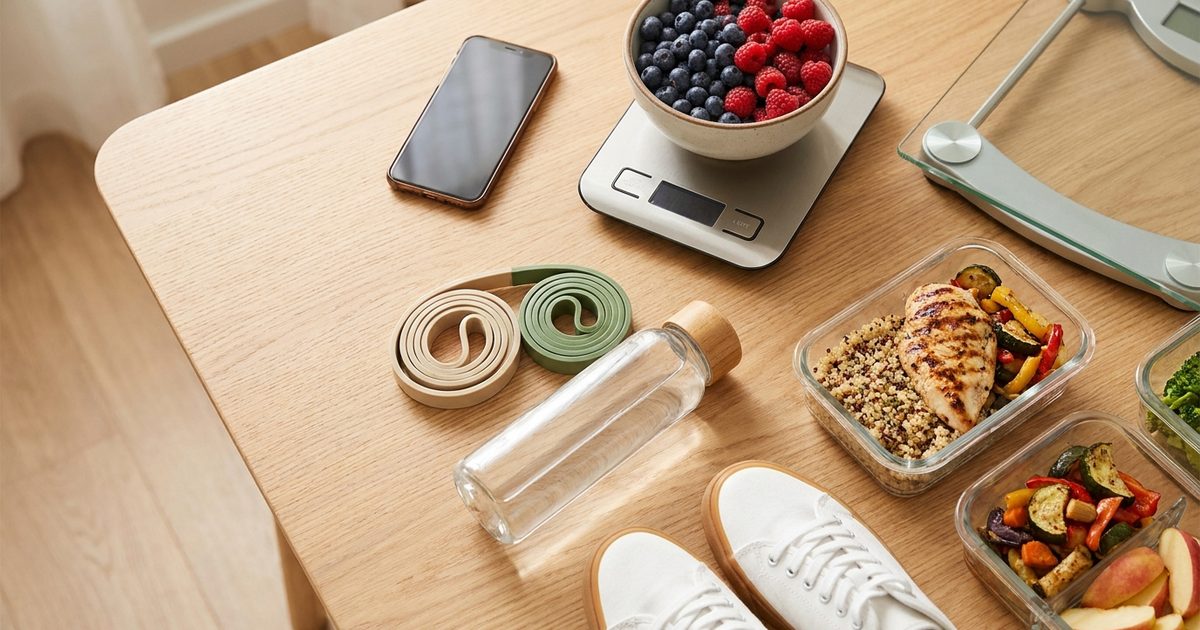
Everything with strong evidence, nothing with hype. These are cheap models from brand stores so you can see real prices; we have no affiliation, and any basic version works the same.
| Tool | Example (brand store, Nov 1, 2026) | Price |
|---|---|---|
| Food tracker | Free version, or Nouri (3-day free trial) | $0 to start |
| Bathroom scale | Etekcity EB4074C Digital Body Weight Scale | $19.88 |
| Strength bands | Gaiam Flat Bands (3-Pack) | $14.98 |
| Kitchen scale | Etekcity EK6015 Digital Kitchen Scale | $13.99 |
| Step counter | The phone in your pocket | $0 |
| Water bottle | The one in your cupboard | $0 |
| Total hardware | $48.85 |
Want auto-sync? Etekcity's ESB-591 smart scale was $22.99 and the Wyze Scale X $38.98 on their own stores. Prices change; in Australia and Canada, any basic digital scale and band set does the same job.
Your first two weeks:
- Track every meal and drink for 7 days, messy ones included. Change nothing yet.
- Weigh each morning and look only at the 7-day average.
- Weigh your 5 most common portions once.
- Note your average daily steps.
- In week two, pick one change: a modest target from the calorie deficit calculator, a step goal 1,000 to 2,000 above your average, or two band sessions.
The CDC notes that people who lose about 1 to 2 pounds a week, at a gradual, steady pace, are more likely to keep it off. Check a realistic timeline with the goal weight date calculator.
When weight loss tools can backfire
Tracking and weighing help most people, and the Zheng review found regular weighing wasn't linked to depression or anxiety. But if food numbers, the scale, or step counts start to feel compulsive, or you have a history of disordered eating, please work with a doctor or registered dietitian first, and it's fine to skip these tools entirely. Support: NEDA or the 988 Lifeline (US), Butterfly Foundation 1800 33 4673 (Australia), NEDIC 1-866-633-4220 (Canada).
Weight is also only one measure. Better sleep, strength, energy, and blood pressure are wins the scale doesn't show. For a personal calorie or weight target, especially with a health condition, talk to your doctor or a registered dietitian.
Common mistakes with weight loss tools
- Buying gadgets instead of building a habit. In the IDEA trial, a device didn't beat a basic program. Start free and cheap.
- Judging the scale daily. A salty dinner adds water overnight. Use the weekly average, and read calorie deficit but not losing weight if the trend stalls.
- Tracking weekdays only. Saturday counts too: see weekend calories and weight loss.
- Quitting the tracker because it's tedious. Make it faster instead with shorter entries, voice, or Siri. More in how to stick to calorie tracking.
FAQ
What are the best weight loss tools that actually work?
A food tracking app, a bathroom scale used regularly, and strength training have the strongest research, followed by a step counter. Fat burners, detox teas, and waist trainers have no good evidence.
Is a food scale necessary for weight loss?
No, but it helps you calibrate. Weigh your usual portions for a week or two and your later estimates get much better, even without the scale.
Are smart scales worth it?
Yes, if auto-syncing makes you weigh more consistently. The weight reading is what research supports; body fat percentages are rough estimates that shift with hydration.
Is weighing yourself every day good or bad?
For most people losing weight, research links daily weighing with more weight loss and better maintenance, and a 2015 review found no link with depression or anxiety. Judge the weekly average, and weigh less often if it makes you anxious.
Do pedometers help you lose weight?
They help you walk about 2,491 more steps a day in trials. Weight loss from walking alone is modest, about 1.27 kg on average in one meta-analysis, so pair steps with tracking food.
Do fitness trackers help you lose weight?
Not much on their own. In the 24-month IDEA trial, adding a wearable to a weight loss program led to less weight loss than the program alone.
Does drinking water help you lose weight?
Slightly. Two small 12-week trials found 500 ml of water before meals led to 1.3 to 2 kg more weight loss, and it helps most when it replaces sugary drinks.
Do resistance bands help you lose weight?
They help you lose fat while keeping muscle, especially combined with eating a bit less. A 2022 meta-analysis of 114 trials found that combination cut about 5.3 kg of fat versus no intervention.
Do waist trainers work for weight loss?
No. We found no clinical trials showing waist trainers reduce body fat; they only change how your waist looks while you wear one.
Do fat burners and detox teas work?
No good evidence supports either. The FDA warns many weight loss pills, supplements, and teas contain hidden drug ingredients, so talk to a health care professional before trying any.
Is Ozempic a weight loss tool?
GLP-1 medications are prescription treatments with strong evidence, about 15% average weight loss over 68 weeks in the STEP 1 trial. They're only for people who meet medical criteria, under a doctor's care.
What is the easiest way to track calories for weight loss?
Use a tracker that takes seconds, because quick, frequent check-ins beat long, careful ones. With Nouri you type, say, snap, or tell Siri what you ate ("Hey Siri, track food in Nouri") and get calories and macros right away with the reasoning shown, plus a weekly Nouri Report on what to change next.
The best weight loss tool isn't the most expensive one; it's the one you'll still use in week six. Start with a tracker, a $20 scale, and your phone's step count, and add Nouri if you want tracking to take ten seconds. Then set a realistic target with the calorie deficit calculator and check where you stand with the BMI calculator or the weight loss percentage calculator.
Sources
Research (PubMed, checked Nov 1, 2026):
- Burke LE, et al. Self-monitoring in weight loss: a systematic review of the literature. J Am Diet Assoc. 2011. https://pubmed.ncbi.nlm.nih.gov/21185970/
- Patel ML, et al. Self-Monitoring via Digital Health in Weight Loss Interventions: A Systematic Review Among Adults with Overweight or Obesity. Obesity. 2021. https://pubmed.ncbi.nlm.nih.gov/33624440/
- Harvey J, et al. Log Often, Lose More: Electronic Dietary Self-Monitoring for Weight Loss. Obesity. 2019. https://pubmed.ncbi.nlm.nih.gov/30801989/
- Lichtman SW, et al. Discrepancy between self-reported and actual caloric intake and exercise in obese subjects. N Engl J Med. 1992. https://pubmed.ncbi.nlm.nih.gov/1454084/
- Zheng Y, et al. Self-weighing in weight management: a systematic literature review. Obesity. 2015. https://pubmed.ncbi.nlm.nih.gov/25521523/
- Steinberg DM, et al. Weighing every day matters. J Acad Nutr Diet. 2015. https://pubmed.ncbi.nlm.nih.gov/25683820/
- Wing RR, et al. A self-regulation program for maintenance of weight loss. N Engl J Med. 2006. https://pubmed.ncbi.nlm.nih.gov/17035649/
- Lopez P, et al. Resistance training effectiveness on body composition and body weight outcomes in individuals with overweight and obesity across the lifespan. Obes Rev. 2022. https://pubmed.ncbi.nlm.nih.gov/35191588/
- Bravata DM, et al. Using pedometers to increase physical activity and improve health: a systematic review. JAMA. 2007. https://pubmed.ncbi.nlm.nih.gov/18029834/
- Richardson CR, et al. A meta-analysis of pedometer-based walking interventions and weight loss. Ann Fam Med. 2008. https://pubmed.ncbi.nlm.nih.gov/18195317/
- Jakicic JM, et al. Effect of Wearable Technology Combined With a Lifestyle Intervention on Long-term Weight Loss: The IDEA Randomized Clinical Trial. JAMA. 2016. https://pubmed.ncbi.nlm.nih.gov/27654602/
- Tasali E, et al. Effect of Sleep Extension on Objectively Assessed Energy Intake Among Adults With Overweight in Real-life Settings. JAMA Intern Med. 2022. https://pubmed.ncbi.nlm.nih.gov/35129580/
- Pedersen SD, et al. Portion control plate for weight loss in obese patients with type 2 diabetes mellitus. Arch Intern Med. 2007. https://pubmed.ncbi.nlm.nih.gov/17592101/
- Dennis EA, et al. Water consumption increases weight loss during a hypocaloric diet intervention in middle-aged and older adults. Obesity. 2010. https://pubmed.ncbi.nlm.nih.gov/19661958/
- Parretti HM, et al. Efficacy of water preloading before main meals as a strategy for weight loss in primary care patients with obesity: RCT. Obesity. 2015. https://pubmed.ncbi.nlm.nih.gov/26237305/
- Wilding JPH, et al. Once-Weekly Semaglutide in Adults with Overweight or Obesity (STEP 1). N Engl J Med. 2021. https://pubmed.ncbi.nlm.nih.gov/33567185/
- Jastreboff AM, et al. Tirzepatide Once Weekly for the Treatment of Obesity (SURMOUNT-1). N Engl J Med. 2022. https://pubmed.ncbi.nlm.nih.gov/35658024/
Government guidance (checked Nov 1, 2026):
- CDC, Steps for Losing Weight: https://www.cdc.gov/healthy-weight-growth/losing-weight/index.html
- CDC, Physical Activity Guidelines for Adults: https://www.cdc.gov/physical-activity-basics/guidelines/adults.html
- CDC, About Sleep: https://www.cdc.gov/sleep/about/index.html
- NIDDK, Choosing a Safe and Successful Weight-loss Program: https://www.niddk.nih.gov/health-information/weight-management/choosing-a-safe-successful-weight-loss-program
- FDA, Weight Loss Product Notifications: https://www.fda.gov/drugs/medication-health-fraud/tainted-weight-loss-products
- FDA, Concerns with Unapproved GLP-1 Drugs Used for Weight Loss: https://www.fda.gov/drugs/postmarket-drug-safety-information-patients-and-providers/fdas-concerns-unapproved-glp-1-drugs-used-weight-loss
- NCCIH, "Detoxes" and "Cleanses": What You Need To Know: https://www.nccih.nih.gov/health/detoxes-and-cleanses-what-you-need-to-know
Product prices and app facts (official sites, checked Nov 1, 2026):
- Etekcity EK6015 Digital Kitchen Scale ($13.99): https://www.etekcity.com/products/digital-kitchen-scale-ek6015
- Etekcity EK8060 Digital Kitchen Scale ($11.99): https://www.etekcity.com/products/digital-kitchen-scale-ek8060
- Etekcity EB4074C Digital Body Weight Scale ($19.88): https://www.etekcity.com/products/digital-body-weight-scale-eb4074c
- Etekcity ESB-591 Smart Body Weight Scale ($22.99): https://www.etekcity.com/products/esb-591-smart-body-weight-scale
- Wyze Scale X ($38.98): https://www.wyze.com/products/wyze-scale-x
- Gaiam Flat Bands 3-Pack ($14.98): https://www.gaiam.com/products/flat-bands-3-pack-1
- MyFitnessPal (free version): https://www.myfitnesspal.com/
- Cronometer (free version): https://cronometer.com/
- MacroFactor (free trial): https://macrofactor.com/
Keep reading
All articlesTurkey Trot Calories Burned: 5K, 10K and Walking, by Pace and Weight
A turkey trot 5K burns about 200 to 480 calories and a 10K about 400 to 960, by pace and weight (120 to 200 lb). Full tables, net vs gross math, pacing tips.
GuidesDoes Calorie Counting Work for Weight Loss? What 30 Years of Research Says
Yes, for many people. In 39 trials, more digital tracking went with more weight loss 74% of the time. Why it works, where it fails, and who should skip it.
GuidesHow to Lose Weight Walking: Is 10,000 Steps a Day Enough? (The Real Math)
10,000 steps burns about 280 to 370 extra calories at 150 to 200 lb. Walking alone works slowly; add a small food deficit and it's about 2.5x faster.
GuidesHow Many Calories Do You Burn Shopping on Black Friday? (Mall Walking, Carrying Bags, Standing in Line)
A 4-hour Black Friday trip burns about 580 to 870 calories (60 to 90 kg), plus 7,000 to 9,500 steps. Minute-by-minute MET math and the Cyber Monday couch.