
Lowest-Calorie Alcoholic Drinks, Ranked: Beer, Seltzers, Wine and Cocktails
A vodka soda is 97 calories and a light beer 103, per USDA. 14 common drinks ranked per standard serve, plus Aussie and Canadian sizes and smart bar orders.
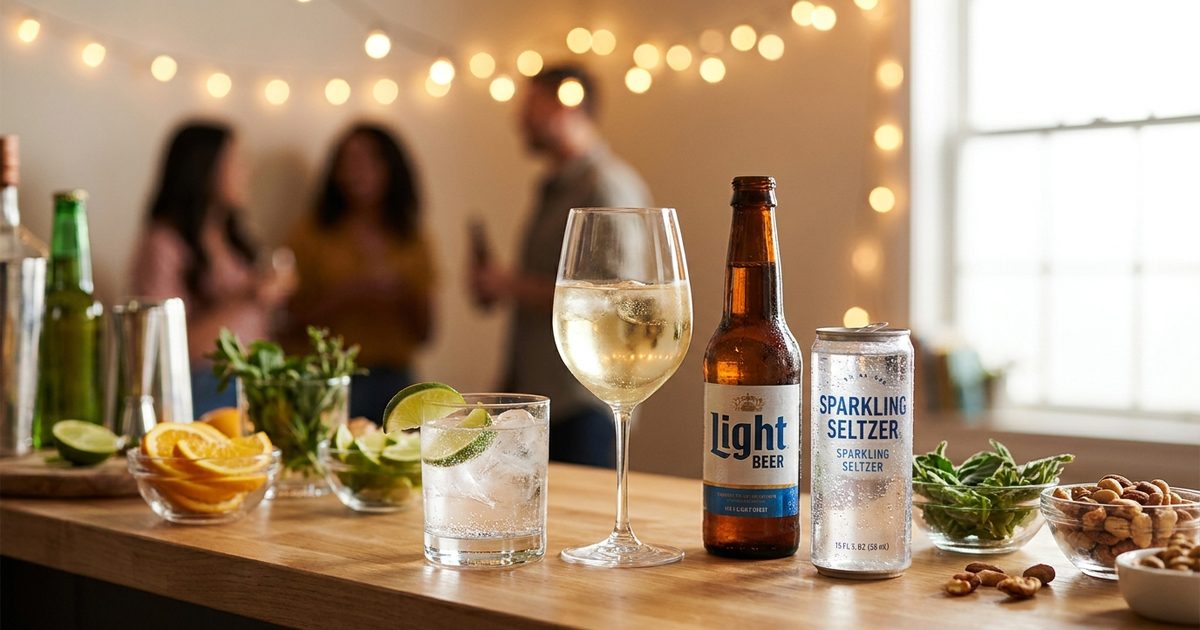
The lowest-calorie alcoholic drinks are a white wine spritzer (about 72 calories), a spirit with soda water (97), a hard seltzer (100), and a light beer (103), using USDA data and brands' own labels. The mixer decides everything: the same vodka shot is 97 calories with soda water and 174 as a rum and cola. Here is the full ranking.
What is the lowest-calorie alcoholic drink?
A wine spritzer wins on paper, because half the glass is soda water. Among "normal" drinks, a straight spirit with soda water is the floor: 97 calories for a 1.5 oz shot of 80-proof gin, rum, vodka, or whiskey, and zero from the club soda. Hard seltzers and light beer sit right behind it at 100 to 103.
Everything above that is either more alcohol (a bigger pour, a stronger beer) or a sugary mixer. Both are fixable at the bar with one word.
This post is about choosing the drink. If you want the system for actually tracking a night out, rounds and all, read How to Track Alcohol Calories.
The ranking: 14 drinks per standard serve
Generic drinks use USDA FoodData Central (FDC IDs in Sources). Mixed drinks are a 1.5 oz shot plus the listed mixer, added up from USDA values. Seltzers are from each brand's own nutrition page. kJ = kcal x 4.184, for the Aussies.
| Rank | Drink | Serve | Calories | kJ | Source |
|---|---|---|---|---|---|
| 1 | White wine spritzer | 3 fl oz white wine + soda water | 72 | 303 | USDA |
| 2 | Spirit with soda water (vodka, gin, rum, whiskey) | 1.5 fl oz + soda | 97 | 406 | USDA |
| 3 | Straight shot, 80 proof | 1.5 fl oz | 97 | 406 | USDA |
| 4 | Vodka and diet cola | 1.5 fl oz + 6 fl oz diet cola | 99 | 413 | USDA |
| 5 | White Claw Hard Seltzer, Black Cherry | 12 oz can | 100 | 418 | White Claw |
| 6 | Truly Hard Seltzer | 1 can | 100 | 418 | Truly |
| 7 | Light beer | 12 fl oz | 103 | 430 | USDA |
| 8 | White wine | 5 fl oz | 121 | 504 | USDA |
| 9 | Red wine | 5 fl oz | 125 | 523 | USDA |
| 10 | Gin and tonic | 1.5 fl oz + 4 fl oz tonic | 139 | 579 | USDA |
| 11 | Regular beer | 12 fl oz | 153 | 640 | USDA |
| 12 | Vodka and orange juice | 1.5 fl oz + 4 fl oz OJ | 153 | 639 | USDA |
| 13 | Whiskey and ginger ale | 1.5 fl oz + 6 fl oz ginger ale | 159 | 666 | USDA |
| 14 | Rum and cola | 1.5 fl oz + 6 fl oz regular cola | 174 | 730 | USDA |
Three things jump out:
- Tonic water is not soda water. It has about 42 calories per 4 fl oz, so a G&T costs 41 more than a gin soda. Same glass, same lime, different bubbles.
- Wine is honest, pours are not. 5 fl oz of red is 125 calories. A generous restaurant glass is often more, and the calories scale with the pour.
- The heaviest drink here is mostly soft drink. In a rum and cola, the cola brings 77 of the 174 calories.
Classic cocktails like margaritas and pina coladas are covered with official NIAAA figures in our alcohol tracking guide. Spoiler: the pina colada is a dessert wearing a tiny umbrella.
What is the lowest-calorie beer?
Light beer, by a clear margin. USDA puts a 12 fl oz light beer at 103 calories versus 153 for a regular beer. That 50-calorie gap is small per bottle and real per night: three light beers are 309 calories, three regular beers are 459.
The calories in beer come mostly from alcohol, with carbs second. USDA's light beer has 3.1 g of alcohol and 1.64 g of carbs per 100 g, versus 3.9 g and 3.55 g for regular beer. So "low carb" and "low calorie" usually travel together, but a strong craft IPA can blow past both no matter what the label vibe says.
What about Michelob Ultra, Coors Light, Bud Light, or Miller Lite? We only publish brand numbers we can verify on the brand's own site today. Those sites sit behind age gates or blocked our checks, so they are not in the table. The can itself carries the label, and it beats any listicle.
What is the lowest-calorie beer in Australia?
Australian beer comes in 375 ml cans and stubbies, and the standard-drink system is different: an Aussie standard drink is 10 g of alcohol, per NHMRC. NHMRC lists light beer at 2.7% alc/vol and full strength at 4.9%.
Using USDA's light and regular beer values scaled to a 375 ml can:
| Drink (Australia) | Serve | Calories | kJ |
|---|---|---|---|
| Spirit, 40% (one standard drink) | 30 ml | 66 | 275 |
| Light beer (USDA light beer values) | 375 ml can | 108 | 454 |
| White wine | 150 ml glass | 122 | 512 |
| Red wine | 150 ml glass | 127 | 530 |
| Regular beer (USDA regular beer values) | 375 ml can | 162 | 677 |
Treat the beer rows as a guide, since USDA's light beer is a US-style light lager and Aussie light beers are often lower in alcohol. For your exact brand, the kJ figure on the can is the number to track. We could not verify Great Northern, Pure Blonde, or Hahn kJ figures on their own sites today, so we left them out rather than guess.
Spirits are poured in 30 ml nips in Australia, smaller than the US 1.5 oz shot, which is why a vodka soda at the pub comes in around 66 calories.
What is the lowest-calorie beer in Canada?
Canada uses 341 ml bottles, and a Canadian standard drink is 13.45 g of alcohol, per Health Canada: 341 ml of 5% beer, 142 ml of 12% wine, or 43 ml of 40% spirits.
Scaled from USDA values: a 341 ml light beer is about 99 calories (413 kJ), a 341 ml regular beer about 147 (615 kJ), and a 142 ml glass of white wine about 116 (484 kJ). Same story as everywhere: light beer or a spirit with soda water is the cheap seat. Canadian brand sites blocked our checks today, so no named Canadian beers made the list.
Are hard seltzers lower calorie than beer?
Barely. White Claw lists its Black Cherry Hard Seltzer at 100 calories, 2 g carbs, and 2 g sugar per 12 oz can. Truly lists its hard seltzer at 5% alc./vol. with 100 calories and 1 g sugar. A USDA light beer is 103.
So the seltzer edge over light beer is about 3 calories. Pick the one you actually like. Watch the bigger formats though: White Claw's own label lists 140 and 170 calories for its larger can sizes, and its stronger Surge line is 8% alc./vol.
What are the lowest-calorie cocktails to order at a bar?
Order by formula, not by menu name. A spirit plus a zero-calorie mixer plus citrus is always near 100.
- Vodka, gin, or whiskey soda with fresh lime (about 97, plus a squeeze of lime)
- Spirit and diet cola or diet tonic (about 99)
- White wine spritzer, tall (about 72 with 3 fl oz wine)
- Ranch Water style: tequila, lime, sparkling water (same spirit math, sparkling water adds nothing)
- A single, not a double. A double is two shots: about 194 before any mixer.
The swaps that save the most:
| Instead of | Order | You save |
|---|---|---|
| Rum and cola (174) | Rum and diet cola (99) | 75 calories |
| Gin and tonic (139) | Gin and soda (97) | 42 calories |
| Regular beer (153) | Light beer (103) | 50 calories |
| Full glass of white (121) | Spritzer (72) | 49 calories |
Three rounds of rum and diet cola instead of rum and cola saves 225 calories, roughly a snack, with zero change to your night.
Smart ordering tips for party season
- Say the mixer out loud. "Soda water," not "soda." One word is the difference between 0 and 77 calories.
- Ask for a tall glass. Same shot, more soda water, longer sip. Your drink lasts, your total doesn't climb.
- Alternate with water. Sparkling water with lime looks like a drink, which is all anyone at the party is checking.
- Count rounds, not vibes. You will not remember "about how much," but you can count glasses.
- Eat dinner. Never skip a meal to "save calories" for drinks. Drinking on an empty stomach is a worse night and a worse morning, and food is not a debt.
- Plan the weekend, not the drink. One fun Saturday is fine. If weekends keep wiping out your weekdays, Weekend Calories and Weight Loss has the math.
If you are wondering what a drink-free month might do, Quitting Alcohol for Weight Loss covers it. And if your sweet drink of choice has no alcohol at all, see Dirty Soda Calories.
A quick, non-preachy note on drinking guidelines
Low-calorie drinks are still alcohol, and calories are only one part of the picture. The official guidance, in plain terms:
- US (CDC): if you drink, keep it to 2 drinks or less a day for men and 1 or less for women. A US standard drink is 14 g of alcohol: 12 oz of 5% beer, 5 oz of 12% wine, or 1.5 oz of 80-proof spirits. CDC also says drinking less is better for health than drinking more.
- Australia (NHMRC): healthy adults should drink no more than 10 standard drinks a week and no more than 4 on any one day. "The less you drink, the lower your risk."
- Canada (Canada's Guidance on Alcohol and Health): risk rises along a continuum: 1 to 2 standard drinks a week is low risk, 3 to 6 moderate, 7 or more increasingly high. It also advises no more than 2 standard drinks per occasion.
All three agree that people who are pregnant, under the legal drinking age, or on medications that interact with alcohol should not drink. Choosing not to drink at all is a completely valid order too. If you are working on weight loss and have a history of disordered eating, please do it with a doctor or registered dietitian.
How I track drinks in Nouri
When I built Nouri, the thing that bugged me about photo trackers was that the camera cannot see what is actually on the plate: the oil, the portion under the garnish. Drinks are the extreme version. A photo of a highball glass could be a 97-calorie vodka soda or a 174-calorie rum and cola. The camera cannot taste the mixer. You already know the order, so typing it or saying it is the fastest honest method.
In Nouri, you type "two gin sodas and a light beer" and get calories and macros right away, broken into items with the reasoning for each and a confidence rating. Big pour? Add "double" or "large glass" and recalculate. At a party, you do not even need to unlock your phone: "Hey Siri, track food in Nouri," then "a glass of white wine." Done, back to the conversation. More on that in How to Track Food With Siri.
On Sunday, your Nouri Report puts the weekend in context next to the rest of the week, so one festive Saturday reads as one data point, not a verdict.
FAQ
What alcohol has the lowest calories?
A straight 80-proof spirit: 97 calories for a 1.5 fl oz shot, per USDA, with 0 g of carbs. Add soda water or a diet mixer and it stays under 100. A spritzer with 3 fl oz of white wine is lower still, at about 72.
What is the lowest-calorie beer?
Light beer, at about 103 calories per 12 fl oz by USDA figures, versus 153 for regular beer. Exact numbers vary by brand, so check the label on your can.
Is vodka soda really the lowest-calorie cocktail?
It is one of the lowest you can order anywhere. Vodka soda is about 97 calories because club soda has zero. Vodka and diet cola is about 99. A wine spritzer can come in lower, depending on the pour.
How many calories are in a White Claw?
White Claw lists its Black Cherry Hard Seltzer at 100 calories, 2 g carbs, and 2 g sugar per 12 oz can. Its larger cans list 140 and 170 calories.
Are hard seltzers healthier than beer?
On calories they are nearly tied with light beer: 100 for White Claw or Truly versus 103 for USDA light beer. The alcohol is the main thing either drink delivers, so the guidelines apply equally.
How many calories are in a glass of wine?
About 121 for 5 fl oz of white and 125 for red, per USDA. In Australia, a 150 ml glass is about 122 calories (512 kJ) for white.
How many calories are in a gin and tonic?
About 139 with 1.5 fl oz of gin and 4 fl oz of tonic, using USDA values. Tonic has about 42 calories per 4 fl oz. Switch to soda water or diet tonic and it drops to about 97.
What is the lowest-calorie beer in Australia?
Light beer (around 2.7% alc/vol) is the lowest-calorie beer style. Using USDA light beer values, a 375 ml can is about 108 calories or 454 kJ. Check the kJ on your specific brand's can.
How many calories are in a standard drink?
It depends on the drink, since standard drinks are defined by alcohol, not calories. A US standard drink is 14 g of alcohol, an Australian one 10 g, a Canadian one 13.45 g. A plain 80-proof shot is 97 calories; a mixed drink depends on the mixer.
Do low-calorie drinks still affect weight loss?
They can, mostly through total calories across a night and the snacks that follow. Three light beers are 309 calories. Tracking them keeps the math honest, which is what matters.
Is it OK to skip dinner to save calories for drinks?
No. Skipping meals to drink is not recommended: eat normally, pick lower-calorie drinks if you want, and track what you have. Food is not something you need to earn back.
What is the easiest way to track alcohol calories?
Say or type the order. In Nouri, "two vodka sodas and a light beer" becomes a calorie and macro breakdown with reasoning for each item, and "Hey Siri, track food in Nouri" works straight from the lock screen, so you can track a round without opening the app.
The lowest-calorie night out is mostly about mixers and pours, not about saying no to the party. Order a spirit with soda water, a light beer, a seltzer, or a spritzer, and track the rounds in Nouri as you go. Holiday dinner coming up too? See How to Not Gain Weight During the Holidays and check your target with the Daily Calorie Needs calculator.
Sources
- USDA FoodData Central, SR Legacy: Alcoholic beverage, beer, light (FDC 168749), fdc.nal.usda.gov/food-details/168749/nutrients; Alcoholic beverage, beer, regular, all (FDC 168746), fdc.nal.usda.gov/food-details/168746/nutrients (checked Oct 23, 2026)
- USDA FoodData Central, SR Legacy: Alcoholic beverage, wine, table, white (FDC 174837), fdc.nal.usda.gov/food-details/174837/nutrients; Alcoholic beverage, wine, table, red (FDC 173190), fdc.nal.usda.gov/food-details/173190/nutrients; Alcoholic beverage, distilled, all (gin, rum, vodka, whiskey) 80 proof (FDC 174815), fdc.nal.usda.gov/food-details/174815/nutrients (checked Oct 23, 2026)
- USDA FoodData Central, SR Legacy: Beverages, carbonated, club soda (FDC 174842), fdc.nal.usda.gov/food-details/174842/nutrients; Beverages, carbonated, tonic water (FDC 171869), fdc.nal.usda.gov/food-details/171869/nutrients; Beverages, carbonated, cola, regular (FDC 174852), fdc.nal.usda.gov/food-details/174852/nutrients; Beverages, carbonated, low calorie, cola or pepper-type, with aspartame, without caffeine (FDC 174850), fdc.nal.usda.gov/food-details/174850/nutrients; Beverages, carbonated, ginger ale (FDC 174846), fdc.nal.usda.gov/food-details/174846/nutrients; Orange juice, raw (FDC 169098), fdc.nal.usda.gov/food-details/169098/nutrients (checked Oct 23, 2026)
- White Claw, Black Cherry Hard Seltzer nutrition, whiteclaw.com/products/black-cherry and whiteclaw.com/products (checked Oct 23, 2026)
- Truly Hard Seltzer, trulyhardseltzer.com (checked Oct 23, 2026)
- CDC, Moderate Alcohol Use, cdc.gov/alcohol/about-alcohol-use/moderate-alcohol-use.html, and Standard Drink Sizes, cdc.gov/alcohol/standard-drink-sizes (checked Oct 23, 2026)
- NHMRC, Australian guidelines to reduce health risks from drinking alcohol, nhmrc.gov.au/health-advice/alcohol (checked Oct 23, 2026)
- Canadian Centre on Substance Use and Addiction, Canada's Guidance on Alcohol and Health, ccsa.ca/canadas-guidance-alcohol-and-health (checked Oct 23, 2026)
- Health Canada, standard drink definition, canada.ca (checked Oct 23, 2026)
Keep reading
All articlesAre AI Calorie Apps Accurate? What the 2026 Research Actually Shows
A 2026 study found an AI photo app underestimated intake by 25%. What the research says about AI calorie apps, and why a photo can't see the oil.
GuidesIn a Calorie Deficit But Not Losing Weight? 9 Reasons and the Fix for Each
In an NEJM study, people reporting under 1,200 calories underreported intake by 47%. 9 reasons the scale won't move, with a fix for each.
GuidesHow Many Calories Do You Need While Breastfeeding? (CDC vs ACOG, Explained)
The CDC says 330 to 400 extra calories a day while breastfeeding; ACOG says 450 to 500. Why they differ and how to find your own number.
Guides'Mom Calories': What Eating Your Kids' Leftovers Really Adds Up To
3 nuggets, some crusts, cheese crackers and juice sips add up to about 297 calories a day, or 2,079 a week. The guilt-free tally, with USDA numbers.