

How to Count Calories in Homemade and Cultural Food (No Barcode Needed)
Add up each ingredient, divide by servings, save the number. A USDA-built arroz con pollo comes to about 516 calories a serving, with 6 worked examples.
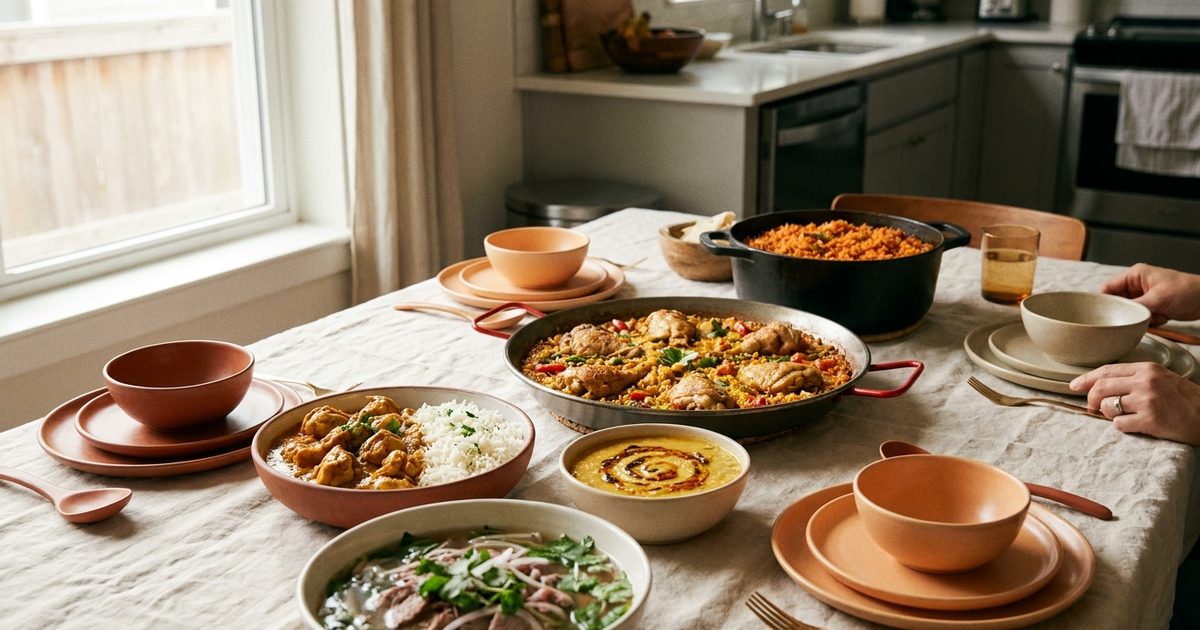
To count calories in homemade food, add up the ingredients once, divide by the number of servings the pot makes, and reuse that per-serving number every time you cook it. Built from USDA ingredient data, a family-size arroz con pollo comes to about 3,094 calories per pot, or 516 per serving of six. Cooking oil is usually the biggest swing.
Why homemade food is hard to count
Packaged food comes with a label. Your grandmother's stew does not. Most calorie apps were built around barcodes and database entries, so the meals people eat most often, the ones cooked at home from memory, are the hardest to log. Search a database for "jollof rice" or "dal" and you will find a dozen entries that disagree by hundreds of calories, because each was entered from a different recipe.
That disagreement is not a database bug. It is the truth about home cooking: recipes vary by family, by region, and by who is cooking that night. No single number is "the" calories in chicken curry. The right number is the one for your recipe, and the good news is you only have to work it out once.
Method 1: count by ingredients
This is the most precise method and it takes about ten minutes the first time.
- List every ingredient that went into the pot, with the amount you actually used. Include the cooking oil, butter, or ghee. Skip water, salt, and dried spices, which add almost nothing.
- Look up each ingredient in USDA FoodData Central or on the package label, and multiply to the amount you used. Raw values for raw ingredients: rice and lentils should be counted dry, meat raw.
- Add everything up to get the calories for the whole pot.
- Divide by the number of servings the pot really makes at the size you really eat.
Our free recipe calorie calculator does steps 3 and 4 for you: enter each ingredient's calories, set the servings, and it gives the total and per-serving numbers.
Method 2: count by portion
Sometimes you did not cook it. You are at a family dinner, a friend's house, or eating leftovers someone else made. You cannot list the ingredients, but you can still describe the plate: what it is, how big the portion is, and anything notable about how it was made ("lots of oil," "with the chicken skin," "extra rice").
From there, two shortcuts work well. If you have already built the recipe yourself, use your own per-serving number and adjust for the plate size. If you have not, USDA's FNDDS database includes many whole dishes, like dal, chicken curry, and beef stew, with values per cup. Those are generic recipes, not your family's, so treat them as a starting point rather than an answer.
Recipe once, portion forever
The trick that makes home cooking easy to track is doing the math one time. Once you know your arroz con pollo is about 516 calories a serving of six, that is your number every time you cook it the same way. Save it in a note, in your tracker, or on the recipe card.
If your servings are never even, use the pot weight instead. Weigh the empty pot, weigh it again full of the finished dish, and subtract to get the food's weight. Divide total calories by that weight to get calories per gram, then weigh your plate. For example, if a pot of arroz con pollo at 3,094 calories weighs 2,400 grams of finished food (an illustrative number, since water loss varies), that is about 1.29 calories per gram, and a 350-gram plate is about 451 calories. You do this once per batch, and every plate after that is one quick weigh.
The number of servings matters as much as any ingredient. The same 3,094-calorie pot is about 619 calories a serving if it feeds five, and about 387 if it feeds eight.
Six home dishes, worked from USDA data
Each example below is one version of the dish, built only from USDA FoodData Central ingredient values (SR Legacy). Families make these differently, and your recipe is the right one: swap in your own amounts and the method still works. Water, salt, and dried spices are left out because they add almost nothing. Where USDA's FNDDS has a generic version of the whole dish, it is shown for comparison.
Arroz con pollo (6 servings)
Assumes boneless, skinless chicken thighs, a sofrito of onion, pepper, and garlic, tomato sauce, and peas, cooked with broth.
| Ingredient | Amount | Calories | FDC ID |
|---|---|---|---|
| Chicken thighs, meat only, raw | 2 lb (907 g) | 1,097 | 173627 |
| Long-grain white rice, raw | 2 cups (370 g) | 1,351 | 168877 |
| Olive oil | 3 tbsp (40.5 g) | 358 | 171413 |
| Onion | 1 medium (110 g) | 44 | 170000 |
| Green bell pepper | 1 medium (119 g) | 24 | 170427 |
| Garlic | 3 cloves (9 g) | 13 | 169230 |
| Tomato sauce, canned | 1 cup (245 g) | 59 | 170054 |
| Green peas, frozen | 1 cup (134 g) | 103 | 170016 |
| Chicken broth | 3 cups (747 g) | 45 | 174536 |
| Whole pot | 3,094 |
Per serving: 3,094 ÷ 6 = about 516 calories, with about 37 g protein. FNDDS has no entry named arroz con pollo; its closest generic entry, "Chicken or turkey and rice with tomato-based sauce" (FDC 2706541), is 346 calories per cup (244 g). Bone-in, skin-on chicken, more oil, or olives and sausage would push your version higher.
Chicken curry (4 servings)
Assumes chicken thighs simmered with onion, garlic, ginger, tomatoes, and coconut milk. Curries made with yogurt or cream, or with more oil, will differ.
| Ingredient | Amount | Calories | FDC ID |
|---|---|---|---|
| Chicken thighs, meat only, raw | 1.5 lb (680 g) | 823 | 173627 |
| Canola oil | 2 tbsp (28 g) | 248 | 172336 |
| Onion | 1 large (150 g) | 60 | 170000 |
| Garlic | 4 cloves (12 g) | 18 | 169230 |
| Ginger | 1 tbsp (6 g) | 5 | 169231 |
| Canned tomatoes | 1 cup (240 g) | 38 | 170051 |
| Coconut milk, canned | 1 cup (226 g) | 445 | 170173 |
| Whole pot | 1,637 |
Per serving: 1,637 ÷ 4 = about 409 calories of curry, with about 36 g protein. Add 1 cup of cooked white rice (FDC 168878, 205 calories) and the plate is 409 + 205 = 614. The oil and coconut milk together are about 42 percent of the pot. FNDDS "Chicken curry" (FDC 2706437) is 257 calories per cup (240 g).
Red lentil dal (4 servings)
Assumes red lentils cooked with onion, tomato, and garlic, finished with ghee. Many families use oil instead, or make a thicker or thinner dal.
| Ingredient | Amount | Calories | FDC ID |
|---|---|---|---|
| Red lentils, raw | 1 cup (192 g) | 687 | 174284 |
| Ghee (butter oil) | 2 tbsp (25.6 g) | 224 | 173412 |
| Onion | 1 medium (110 g) | 44 | 170000 |
| Tomato | 1 medium (123 g) | 22 | 170457 |
| Garlic | 3 cloves (9 g) | 13 | 169230 |
| Whole pot | 990 |
Per serving: 990 ÷ 4 = about 248 calories, with about 12 g protein. With 1 cup of cooked rice, 248 + 205 = 453. FNDDS "Dal" (FDC 2707427) is 348 calories per cup (240 g), a reminder that thickness and fat change dal a lot.
Jollof rice (6 servings)
Assumes rice cooked in a blended base of tomatoes, red peppers, and onion with tomato paste, broth, and a generous half cup of oil. Nigerian and Ghanaian versions differ, households differ too, and the oil amount varies most of all. Any meat or fish served alongside is extra.
| Ingredient | Amount | Calories | FDC ID |
|---|---|---|---|
| Long-grain white rice, raw | 3 cups (555 g) | 2,026 | 168877 |
| Vegetable (canola) oil | 1/2 cup (109 g) | 964 | 172336 |
| Tomato paste | 1/4 cup (66 g) | 54 | 170459 |
| Canned tomatoes | 2 cups (480 g) | 77 | 170051 |
| Red bell peppers | 2 medium (238 g) | 62 | 170108 |
| Onion | 1 large (150 g) | 60 | 170000 |
| Chicken broth | 3 cups (747 g) | 45 | 174536 |
| Whole pot | 3,288 |
Per serving: 3,288 ÷ 6 = about 548 calories, with about 9 g protein. The oil alone is 964 calories, about 29 percent of the pot. Use 1/4 cup instead (482 calories) and the pot drops to 2,806, or about 468 a serving. FNDDS has no jollof entry; its closest generic, "Rice, white, with tomatoes and/or tomato-based sauce, fat added" (FDC 2709010), is 224 calories per cup (209 g).
Beef pho (4 bowls)
Assumes rice noodles, thin-sliced eye of round, and a lean store-bought beef broth. A long-simmered bone broth carries more fat, and hoisin, sriracha, and fatty brisket all add calories not counted here.
| Ingredient | Amount | Calories | FDC ID |
|---|---|---|---|
| Rice noodles, dry | 300 g | 1,092 | 169742 |
| Eye of round, lean, raw | 400 g | 496 | 173999 |
| Beef broth | 8 cups (1,920 g) | 134 | 171538 |
| Onion | 1 medium (110 g) | 44 | 170000 |
| Whole pot | 1,766 |
Per bowl: 1,766 ÷ 4 = about 442 calories, with about 34 g protein. FNDDS "Soup, pho, with meat" (FDC 2707124) is 189 calories per cup (245 g), and a restaurant bowl is several cups.
Beef stew (6 servings)
Assumes chuck browned in oil and dredged in flour, simmered with potatoes, carrots, onion, tomato paste, and broth.
| Ingredient | Amount | Calories | FDC ID |
|---|---|---|---|
| Beef chuck for stew, raw | 2 lb (907 g) | 1,161 | 171206 |
| Canola oil | 2 tbsp (28 g) | 248 | 172336 |
| All-purpose flour | 1/4 cup (31 g) | 114 | 168894 |
| Potatoes | 3 medium (639 g) | 492 | 170026 |
| Carrots | 3 medium (183 g) | 75 | 170393 |
| Onion | 1 medium (110 g) | 44 | 170000 |
| Tomato paste | 2 tbsp (32 g) | 26 | 170459 |
| Beef broth | 4 cups (960 g) | 67 | 171538 |
| Whole pot | 2,227 |
Per serving: 2,227 ÷ 6 = about 371 calories, with about 38 g protein. FNDDS "Stew, beef" (FDC 2706592) is 273 calories per cup (255 g).
The six dishes side by side
| Dish (as built above) | Whole pot | Servings | Per serving | Protein per serving |
|---|---|---|---|---|
| Arroz con pollo | 3,094 | 6 | 516 | 37 g |
| Chicken curry (without rice) | 1,637 | 4 | 409 | 36 g |
| Red lentil dal (without rice) | 990 | 4 | 248 | 12 g |
| Jollof rice | 3,288 | 6 | 548 | 9 g |
| Beef pho | 1,766 | 4 | 442 | 34 g |
| Beef stew | 2,227 | 6 | 371 | 38 g |
Where the calories hide in home cooking
Two patterns show up in every recipe above. First, the starch and the protein are the base of the number: rice is 1,351 calories in the arroz con pollo and 2,026 in the jollof. Second, the fat is the swing. Oil is about 884 calories per 100 grams, and a tablespoon of olive oil is 119 calories. Cooks rarely measure it, so it is the ingredient most likely to be under-counted.
| Change to the recipe | Calorie effect |
|---|---|
| +1 tbsp olive oil in the arroz con pollo pot | 3,094 + 119 = 3,213, or about 536 per serving |
| +1 tbsp olive oil drizzled on one plate | 516 + 119 = 635 for that plate |
| Jollof with 1/4 cup oil instead of 1/2 cup | 3,288 down to 2,806, about 468 per serving |
| Arroz con pollo pot split 5 ways instead of 6 | about 619 per serving |
Why the oil matters to me
I learned this the hard way. When I used AI photo trackers, I was not losing weight, so I started checking their estimates against what the ingredients actually added up to. The photo numbers kept coming in low. A plate the camera called around 400 calories worked out closer to 700, because a camera cannot see the oil in the pan or the portion under the garnish.
Home cooking is where that gap is widest, since the oil is stirred in and the plate looks the same either way. That is a big part of why I built Nouri to start from words: you know what went into your pot, and the camera does not.
How to log homemade food in Nouri
In Nouri, you describe a home-cooked meal the way you would tell a friend. "Mom's arroz con pollo" is one of the examples on our homepage, and that is genuinely how it works: type it like a note, say it, snap a photo, or ask Siri from the lock screen with "Hey Siri, track food in Nouri." Nouri itemizes the meal, returns calories and macros instantly, and shows its reasoning per item with a confidence rating, so you can see which portion of rice and chicken it assumed.
Then add what only you know. Type "extra oil" or "cooked in a lot of oil" and recalculate, and the estimate updates with that context. You can also log a whole recipe in one sentence, like "chicken curry for four: 1.5 lb chicken thighs, 2 tbsp oil, a can of coconut milk, onion, tomatoes," and get the itemized math. Nouri scored 92.1/100 in our 100-meal accuracy benchmark (MyFitnessPal 77.0).
Nouri also tracks fiber, sugar, and sodium with daily goals and gives each meal a vitamin scorecard, which is useful for dishes like dal that are rich in fiber. Your weekly Nouri Report shows averages against your targets, so a big family dinner reads as one meal in a week, not a failure. Nouri is iPhone (iOS only), at $9.99/month or $39.99/year, with a 3-day free trial on the yearly plan.
Common mistakes with homemade food
- Forgetting the cooking fat. Every spoonful of oil, butter, or ghee counts, at about 119 calories a tablespoon for olive oil. It is the most common leak in home-cooked logs, along with the others in Common Food Logging Mistakes.
- Counting cooked rice with raw numbers. Raw rice is about 365 calories per 100 g and cooked is 130, because cooking adds water. Use raw values for the pot and cooked values for a plate. Our rice guide has the details.
- Optimistic servings. Count the bowls the pot really makes at the size you really eat, not the number the recipe promised.
- Trusting one database entry for a dish. Generic entries are someone else's recipe. Build yours once.
- Skipping the meal because the recipe is unknown. Describe it and estimate. A rough log beats a blank, as our guide to tracking calories without weighing food explains.
Grandma will not tell you how much oil went in? Tell Nouri "generous oil" and let the math reflect the love.
FAQ
How do you count calories in homemade food?
Add up the calories of every ingredient you used, including the cooking fat, then divide by the number of servings. Save that per-serving number and reuse it whenever you make the dish the same way. The recipe calorie calculator does the division for you.
How many calories are in a plate of arroz con pollo?
It depends on the recipe and the plate. The USDA-built version in this guide is about 3,094 calories per pot, or about 516 per serving of six. More oil, skin-on chicken, or a bigger plate will raise it.
How many calories are in jollof rice?
Our USDA-built pot with half a cup of oil comes to about 548 calories per serving of six, before any meat or fish on the side. Cutting the oil to a quarter cup brings it to about 468. Recipes vary a lot, especially in oil.
How many calories are in homemade chicken curry?
The coconut milk version in this guide is about 409 calories per serving of four without rice, or about 614 with a cup of cooked white rice. Yogurt or cream curries, and curries with more oil, will differ.
How many calories are in a bowl of dal?
The red lentil dal built here is about 248 calories per serving of four, or about 453 with a cup of rice. USDA's generic FNDDS dal is 348 calories per cup, so thickness and fat make a big difference.
How many calories are in homemade pho?
Our lean version with store-bought beef broth and eye of round is about 442 calories per bowl of four. Fattier cuts, bone broth, and sauces like hoisin add more.
Should I count rice raw or cooked?
For a whole pot, count rice raw, since that is what you measured. For a single plate of already-cooked rice, use the cooked value: USDA lists cooked long-grain white rice at 205 calories per cup.
How do I count calories when I don't know the recipe?
Describe what you can see and taste: the dish, the portion size, and anything notable like oil or fried components. A generic USDA dish value or a rough estimate is much better than skipping the meal.
Do I need to weigh food to count homemade calories?
Not necessarily. Counting servings works well when portions are fairly even. Weighing the whole pot and your plate helps when servings vary.
Do spices and water have calories?
Water has none, and salt and the small amounts of dried spices used in most recipes add almost nothing. The ingredients worth counting carefully are oils, fats, starches, and meats.
What is the easiest way to track calories in homemade food?
Describe the dish the way you would tell a friend, like "mom's arroz con pollo, medium plate, extra oil." In Nouri, you can type, say, photograph, or Siri-log that sentence and get calories and macros itemized with the reasoning shown, then add context and recalculate.
Bottom line
You count calories in homemade and cultural food the same way for every cuisine: add up the ingredients once, divide by real servings, and reuse the number. Watch the oil, because it is the biggest swing in almost every pot. For the math, use our free recipe calorie calculator, and when you would rather just describe the plate, log it in Nouri in one sentence. If eating out is the other half of your week, How to Log Restaurant Meals uses the same component method, and Calorie Tracking With ADHD covers keeping the habit going when you forget.
Sources
All values from USDA FoodData Central, per 100 g, scaled to the amounts above using USDA's own portion weights where listed (checked October 13, 2026):
- Chicken thigh, meat only, raw: 173627
- Rice, white, long-grain, regular, raw, enriched: 168877
- Rice, white, long-grain, regular, enriched, cooked: 168878
- Oil, olive: 171413
- Oil, canola: 172336
- Butter oil, anhydrous (ghee): 173412
- Onions, raw: 170000
- Peppers, sweet, green, raw: 170427
- Peppers, sweet, red, raw: 170108
- Garlic, raw: 169230
- Ginger root, raw: 169231
- Tomato products, canned, sauce: 170054
- Tomato products, canned, paste: 170459
- Tomatoes, canned, packed in tomato juice: 170051
- Tomatoes, red, ripe, raw: 170457
- Peas, green, frozen: 170016
- Chicken broth, ready-to-serve: 174536
- Coconut milk, canned: 170173
- Lentils, pink or red, raw: 174284
- Rice noodles, dry: 169742
- Beef, eye of round, lean, raw: 173999
- Beef broth, canned, ready-to-serve: 171538
- Beef, chuck for stew, raw: 171206
- Wheat flour, all-purpose, enriched: 168894
- Potatoes, flesh and skin, raw: 170026
- Carrots, raw: 170393
- FNDDS comparison dishes: 2706541, 2706437, 2707427, 2709010, 2707124, 2706592
- Nouri accuracy benchmark: nouriapp.co/accuracy (checked October 13, 2026)
Keep reading
All articlesAre AI Calorie Apps Accurate? What the 2026 Research Actually Shows
A 2026 study found an AI photo app underestimated intake by 25%. What the research says about AI calorie apps, and why a photo can't see the oil.
GuidesIn a Calorie Deficit But Not Losing Weight? 9 Reasons and the Fix for Each
In an NEJM study, people reporting under 1,200 calories underreported intake by 47%. 9 reasons the scale won't move, with a fix for each.
GuidesHow Many Calories Do You Need While Breastfeeding? (CDC vs ACOG, Explained)
The CDC says 330 to 400 extra calories a day while breastfeeding; ACOG says 450 to 500. Why they differ and how to find your own number.
Guides'Mom Calories': What Eating Your Kids' Leftovers Really Adds Up To
3 nuggets, some crusts, cheese crackers and juice sips add up to about 297 calories a day, or 2,079 a week. The guilt-free tally, with USDA numbers.