

How Much Does a Chicken Breast Weigh? Raw vs Cooked, in Grams and Ounces
A boneless, skinless chicken breast weighs about 272g (9.6 oz) raw and 196g (6.9 oz) grilled, by USDA data. Raw vs cooked, calories, and how to log it.
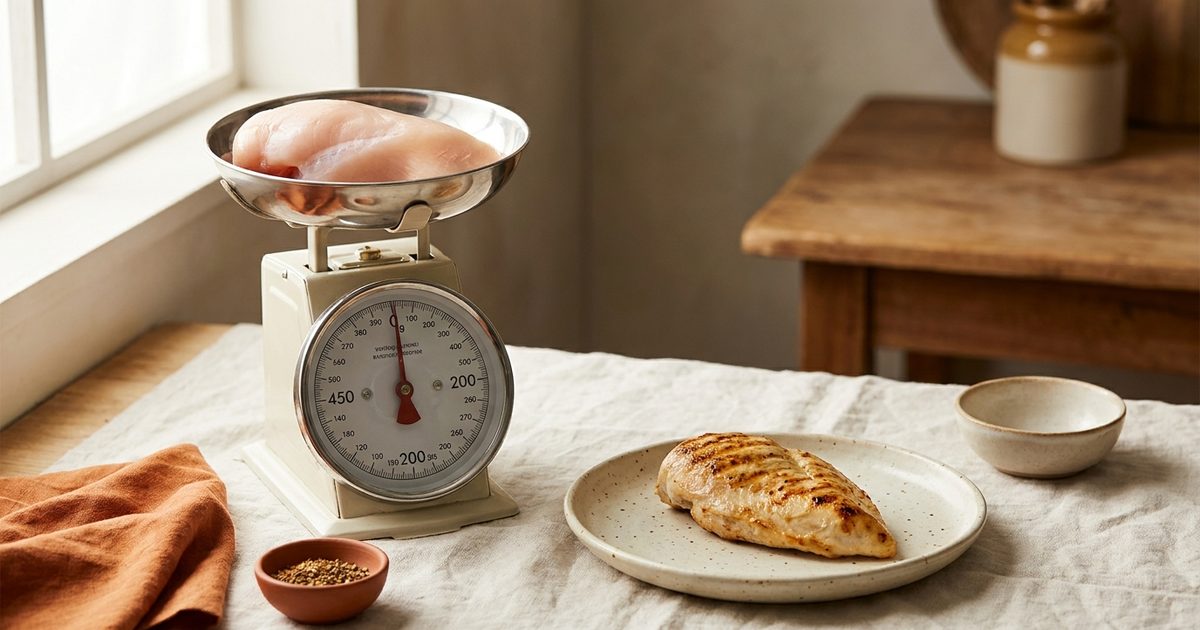
A boneless, skinless chicken breast weighs about 272 grams (9.6 oz) raw and about 196 grams (6.9 oz) once grilled, using USDA FoodData Central's average piece weights. Cooking removes roughly 28 percent of the weight as water. That one grilled breast is about 296 calories and 60 grams of protein. The classic smaller "half breast" in USDA's older data is 86 grams cooked.
Chicken breast weight: the USDA numbers
USDA lists chicken breast in two ways. Newer entries describe a whole boneless, skinless piece, the kind sold in supermarket trays. Older entries use a "half breast," which is one side of the bird's breast, and those are noticeably smaller.
| Chicken breast (USDA portion) | Weight | Ounces | Calories | Protein |
|---|---|---|---|---|
| Boneless, skinless piece, raw | 272g | 9.6 oz | 326 | 61.2g |
| Same piece, grilled | 196g | 6.9 oz | 296 | 59.8g |
| Same piece, braised | 181g | 6.4 oz | 284 | 58.1g |
| Half breast, meat and skin, raw (bone removed) | 145g | 5.1 oz | 249 | 30.2g |
| Half breast, meat and skin, roasted | 98g | 3.5 oz | 193 | 29.2g |
| Half breast, meat only, roasted | 86g | 3.0 oz | 142 | 26.7g |
So "how many grams is a chicken breast" has two honest answers. A typical boneless, skinless breast from the store is around 270 grams raw and around 180 to 200 grams cooked. The half breast that older nutrition labels and many apps still use is less than half that size cooked (86 grams against 196), which is why a "1 breast" entry in a food database can be off by more than 150 calories against the piece on your plate.
Calories and protein per ounce and per 100g
Raw and cooked chicken have different densities because water leaves during cooking and the protein stays. Per gram, cooked chicken carries more of everything.
| State (USDA, skinless) | Per 100g | Protein per 100g | Per ounce | Protein per ounce |
|---|---|---|---|---|
| Raw | 120 | 22.5g | 34 | 6.4g |
| Grilled | 151 | 30.5g | 43 | 8.6g |
| Braised | 157 | 32.1g | 45 | 9.1g |
| Roasted | 165 | 31.0g | 47 | 8.8g |
The roasted figure, 165 per 100 grams, is the one most apps show for "chicken breast," and it is the number in our chicken breast calories guide. It is correct for cooked meat. It is wrong for raw meat, which is 120 per 100 grams.
How much weight chicken loses when cooked
USDA does not publish one universal cooking yield for chicken breast, so we calculated it two ways from USDA's own data and checked that they agree.
Method 1, matched piece weights. USDA's boneless, skinless entries come from the same series of samples, with an average raw piece of 272 grams, an average grilled piece of 196 grams, and an average braised piece of 181 grams. Divide cooked by raw:
- Grilled: 196 ÷ 272 = 72.1 percent of the raw weight remains, a 27.9 percent loss
- Braised: 181 ÷ 272 = 66.5 percent remains, a 33.5 percent loss
- Roasted half breast with skin: 98 ÷ 145 = 67.6 percent remains, a 32.4 percent loss
Method 2, protein as a tracer. Cooking drives off water but does not remove much protein, so the ratio of protein per 100 grams raw to cooked approximates the yield. Raw is 22.5 grams per 100, grilled 30.5, roasted 31.0, braised 32.1, which implies 73.8, 72.6, and 70.1 percent yields. Close to Method 1.
The practical rule: chicken breast loses about a quarter to a third of its weight when cooked. 100 grams raw becomes about 72 grams grilled, and 4 ounces raw cooks down to about 3 ounces. USDA's own serving sizes say the same thing: its raw entry lists 4 oz (113g) and its cooked entries list 3 oz (85g).
One honest wrinkle: the raw piece works out to 326 calories and the grilled piece to 296. USDA analyzed raw and cooked samples separately, and some fat and juices stay in the pan, so the numbers do not line up perfectly. The 30-calorie gap is small next to the raw-versus-cooked mistake below, which is about 60 calories on a single breast.
Chicken breast weight by size
USDA gives one average piece, not small, medium, and large. Breasts in stores vary widely, so here is the same math applied to common raw weights, using the grilled yield of 72.1 percent:
| Raw weight | Raw ounces | Grilled weight | Grilled ounces | Calories | Protein |
|---|---|---|---|---|---|
| 150g | 5.3 oz | 108g | 3.8 oz | 180 | 33.8g |
| 200g | 7.1 oz | 144g | 5.1 oz | 240 | 45.0g |
| 250g | 8.8 oz | 180g | 6.4 oz | 300 | 56.3g |
| 300g | 10.6 oz | 216g | 7.6 oz | 360 | 67.5g |
| 350g | 12.3 oz | 252g | 8.9 oz | 420 | 78.8g |
Calories and protein are from the raw weight times USDA's raw figures (120 calories and 22.5 grams of protein per 100 grams). Calculated from the cooked weight with the grilled entry, each row comes out about 9 percent lower, for the reason in the section above. Pick one method and use it every time.
The raw vs cooked logging mistake
This is the most common chicken error in any food log, and it works in both directions.
You weigh cooked chicken but log a raw entry. 200 grams of grilled chicken logged as raw is 240 calories. The real figure is 302. That is 62 calories missing from one serving, about 21 percent, and meal preppers can repeat it twice a day.
You weigh raw chicken but log a cooked entry. Now the error flips: 200 grams raw logged with the cooked figure shows 302 when the chicken is really 240. Overcounting feels safe, but it makes a log look worse than reality and makes your targets harder to hit for no reason.
The fix is simple. Match the entry to the state you weighed. If you weigh raw for a batch, log raw. If you weigh on the plate, log cooked. Our guide to common food logging mistakes covers this one alongside invisible oils and drinks, and the oil matters here too: a tablespoon of olive oil in the pan is about 119 calories by USDA, nearly double the raw versus cooked gap.
How to weigh chicken for meal prep
- Weigh the whole pack raw. The total is on the label. Say it is 1,000 grams.
- Cook it, then weigh everything cooked. If it comes to 720 grams, your yield is 72 percent, right in line with USDA.
- Split by cooked weight. Five containers of 144 grams cooked each hold 200 grams raw, or 240 calories, each.
- Log the containers with that number. You weighed once and know every portion for the week.
No scale? Use the USDA averages: a full boneless breast is about 270 grams raw and 200 grams cooked, and USDA's standard cooked serving is 3 ounces (85 grams). Tracking calories without weighing food has more anchors like this.
How to log a chicken breast in Nouri
When I used MyFitnessPal, the numbers were fine. The friction was the problem: search "chicken breast," scroll through raw, cooked, half breast, and user-made entries, and guess which one matched the plate. Getting the raw versus cooked choice wrong is easy when you are picking from a list of nearly identical names. After a long day I would just skip logging.
In Nouri you describe the chicken the way you would tell a friend. "Grilled chicken breast, about 200 grams cooked, with a teaspoon of olive oil" goes in as written, typed like a note, said out loud, or told to Siri from the lock screen with "Hey Siri, track food in Nouri." Nouri shows calories and macros right away, with its reasoning per item and a confidence rating, so you can see that it used cooked chicken and counted the oil separately. If you weighed raw, say "raw weight 280 grams" and it recalculates. Snap a photo instead and Nouri turns it into a sentence first, which is the moment to add the weight the camera cannot know. Nouri is iPhone (iOS only), and you can try it free.
Protein is where chicken earns its place. With Prioritize Protein on, Nouri sets your target at 1.2 grams per pound of body weight instead of 1.0, and one grilled 196 gram breast at about 60 grams covers a big piece of it. The protein intake calculator shows your number, and what 200 grams of protein looks like shows how many breasts a big target actually takes.
Weighed it raw, ate it cooked, forgot which? Tell Nouri "it was raw" and the math catches up.
FAQ
How many grams is a chicken breast?
A boneless, skinless chicken breast is about 272 grams raw by USDA's average piece weight, and about 196 grams grilled. The older USDA "half breast" is smaller, 86 grams of cooked meat. Store breasts range widely, so the label on the pack is the best guide.
How many grams in a chicken breast cooked?
About 196 grams grilled or 181 grams braised for an average boneless, skinless breast, by USDA. That is roughly 6.4 to 6.9 ounces of cooked meat.
How many ounces is a chicken breast?
About 9.6 ounces raw and 6.9 ounces grilled for USDA's average boneless, skinless piece. A USDA half breast with the skin removed is about 3 ounces cooked.
How much does chicken weigh after cooking?
About 72 percent of its raw weight when grilled and 66 to 68 percent when braised or roasted, from USDA's matched raw and cooked weights. 100 grams raw becomes roughly 72 grams grilled.
Is 4 oz of raw chicken 3 oz cooked?
Very close. Using USDA's grilled yield of 72.1 percent, 113 grams raw becomes about 81 grams cooked, and USDA's own serving sizes are 4 oz raw and 3 oz (85 grams) cooked.
Should I weigh chicken raw or cooked?
Either works, as long as the entry you log matches. Raw is more consistent because cooking time changes the cooked weight. If you weigh cooked, use a cooked entry like 151 to 165 calories per 100 grams.
How many calories in a chicken breast?
About 296 for an average grilled boneless, skinless breast of 196 grams, with 59.8 grams of protein. The USDA half breast, 86 grams roasted, is 142 calories. Our chicken breast calories guide covers preparation and real meals.
How much protein is in one chicken breast?
About 60 grams in an average boneless, skinless breast, whether you count it raw (61.2 grams at 272 grams) or grilled (59.8 grams at 196 grams). Cooking concentrates the protein per gram but does not add or remove much.
How many calories in 100g of raw chicken breast?
120 calories and 22.5 grams of protein, by USDA. Cooked is higher per 100 grams, 151 grilled and 165 roasted, because the water is gone.
How many calories in 1 oz of chicken breast?
About 34 calories raw and 43 to 47 cooked, depending on the method. Protein runs 6.4 grams per raw ounce and 8.6 to 9.1 grams per cooked ounce.
Why is my chicken breast so much bigger than the app says?
Many entries still use USDA's older half breast at 86 grams cooked, while modern boneless breasts average about 196 grams grilled. Log by weight, or describe the size, rather than trusting "1 breast."
What is the easiest way to track chicken breast by weight?
Say or type the weight and the state in one sentence, like "200 grams of grilled chicken breast" or "chicken breast, 280 grams raw, pan-fried in olive oil." Nouri returns calories and protein with its reasoning shown, and Siri can log it from the lock screen while your hands are still busy with the pan.
Weigh once, note whether it was raw or cooked, and the rest is arithmetic. Log your next prep in Nouri, see what the pan adds in our chicken breast calories guide, and compare with ground beef or salmon if you rotate proteins.
Sources
- USDA FoodData Central, SR Legacy: Chicken, broiler or fryers, breast, skinless, boneless, meat only, raw (FDC 171077), fdc.nal.usda.gov/food-details/171077/nutrients, including the 1 piece (272g) and 4 oz (113g) portions (checked October 14, 2026)
- USDA FoodData Central, SR Legacy: Chicken, broiler or fryers, breast, skinless, boneless, meat only, cooked, grilled (FDC 171534), fdc.nal.usda.gov/food-details/171534/nutrients, 1 piece (196g) and 3 oz (85g); cooked, braised (FDC 171140), fdc.nal.usda.gov/food-details/171140/nutrients, 1 piece (181g) (checked October 14, 2026)
- USDA FoodData Central, SR Legacy: Chicken, broilers or fryers, breast, meat only, cooked, roasted (FDC 171477), fdc.nal.usda.gov/food-details/171477/nutrients, 0.5 breast, bone and skin removed (86g) (checked October 14, 2026)
- USDA FoodData Central, SR Legacy: Chicken, broilers or fryers, breast, meat and skin, raw (FDC 171474), fdc.nal.usda.gov/food-details/171474/nutrients, 0.5 breast, bone removed (145g); meat and skin, cooked, roasted (FDC 171075), fdc.nal.usda.gov/food-details/171075/nutrients, 0.5 breast, bone removed (98g) (checked October 14, 2026)
- USDA FoodData Central, SR Legacy: Oil, olive, salad or cooking (FDC 171413), fdc.nal.usda.gov/food-details/171413/nutrients, 1 tablespoon (13.5g) (checked October 14, 2026)
- Cooking yields, per-portion, per-ounce, and size-table values are our arithmetic from USDA per-100g figures and USDA portion weights (1 oz = 28.35g); values rounded
Keep reading
All articlesCalories in Coffee: Every Creamer, Milk, Sugar, and Syrup Add-In
Black coffee is about 2 calories a cup by USDA data. What milk, cream, sugar, creamer, syrup, and butter add, plus the per-week and per-year math.
FoodsHow Many Calories in a Sweet Potato? Official USDA Numbers by Size
A medium baked sweet potato is about 103 calories with 3.8g of fiber, by USDA data. Calories by size, boiled vs fries vs mashed, toppings, and potato math.
FoodsHow Many Calories in Milk? Whole, 2%, Skim and Plant Milks (USDA)
A cup of whole milk is about 149 calories, 2% is 122, 1% is 102, and skim is 83, by USDA data. Plant milks, protein per calorie, chocolate milk, and a splash.
FoodsThe Cheapest Protein: 24 Foods Ranked by Cost per 25g of Protein
Dried beans are the cheapest protein at $0.42 per 25g. We ranked 24 grocery foods by protein per dollar with August 2026 BLS prices and USDA data.