
How Many Calories in Milk? Whole, 2%, Skim and Plant Milks (USDA)
A cup of whole milk is about 149 calories, 2% is 122, 1% is 102, and skim is 83, by USDA data. Plant milks, protein per calorie, chocolate milk, and a splash.
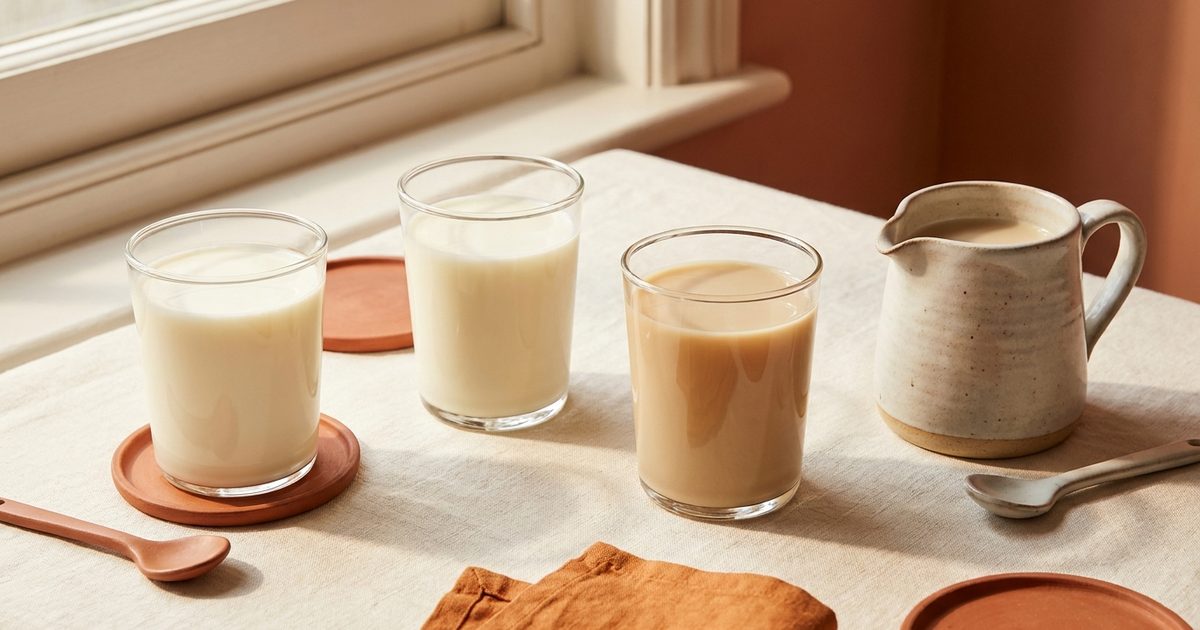
A cup of whole milk is about 149 calories, 2% is 122, 1% is 102, and skim is 83, by USDA FoodData Central figures. All four carry roughly 8 grams of protein and 12 grams of natural sugar per cup. The fat is the only real difference. Among plant milks, unsweetened almond is about 39 a cup, soy 104, and oat 110.
Official USDA numbers: dairy milk
Per cup (8 fl oz), at USDA's own cup weights:
| Milk | Cup weight | Calories | Protein | Fat | Carbs | Sugar | Calcium |
|---|---|---|---|---|---|---|---|
| Whole (3.25%) | 244g | 149 | 7.7g | 7.9g | 11.7g | 12.3g | 276mg |
| 2% (reduced fat) | 244g | 122 | 8.1g | 4.8g | 11.7g | 12.3g | 293mg |
| 1% (lowfat) | 244g | 102 | 8.2g | 2.4g | 12.2g | 12.7g | 305mg |
| Skim (nonfat) | 245g | 83 | 8.3g | 0.2g | 12.2g | 12.5g | 299mg |
Per 100 grams and per 100 ml:
| Milk | Per 100g | Per 100 ml |
|---|---|---|
| Whole | 61 | 63 |
| 2% | 50 | 52 |
| 1% | 42 | 43 |
| Skim | 34 | 35 |
USDA publishes nutrients per 100 grams. Milk is slightly denser than water, USDA's cup of whole milk weighs 244 grams for 236.6 ml, so the per 100 ml figures run about 3 percent higher. If your carton's label is in milliliters, use the second column.
Going from whole to skim saves 66 calories a cup, and almost all of it is fat: 7.9 grams against 0.2. The protein, sugar, and calcium stay nearly flat, and the lower-fat milks carry slightly more of each per cup because removing fat leaves more room for everything else.
Plant milks
| Milk | Cup weight | Calories | Protein | Fat | Carbs | Sugar | Calcium |
|---|---|---|---|---|---|---|---|
| Soy, original or vanilla, fortified | 243g | 104 | 6.3g | 3.6g | 12.0g | 8.9g | 299mg |
| Almond, unsweetened | 262g | 39 | 1.0g | 2.5g | 3.4g | 2.1g | 482mg |
| Oat | 244g | 110 | 1.6g | 5.7g | 13.1g | 5.0g | 378mg |
Per 100 grams: soy is 43, almond 15, and oat 45.
Two notes on the sources. USDA's main reference database (SR Legacy) has fortified soy milk and unsweetened almond milk but no oat milk, so the oat row comes from USDA's survey database (FNDDS), whose generic "Oat milk" is modeled on a typical original oat milk: water, oats, canola oil, a little sugar, plus added calcium and vitamin D. As a cross-check, USDA's lab-analyzed unsweetened refrigerated oat milk (Foundation Foods) is 48 per 100 grams, close to the same. Second, plant milks vary by brand far more than dairy milk does, especially sweetened and "barista" versions, so if you drink one brand every day, its own label beats any generic entry.
The pattern is still clear. Unsweetened almond milk is the lowest-calorie milk on the list by a wide margin, mostly because it is mostly water. Oat milk has about as many calories as 1% dairy milk but a fifth of the protein. Soy is the only plant milk that comes close to dairy on protein.
Protein per calorie
If you drink milk partly for protein, this is the table that matters:
| Milk | Protein per cup | Protein per 100 calories |
|---|---|---|
| Skim | 8.3g | 9.9g |
| 1% | 8.2g | 8.0g |
| 2% | 8.1g | 6.6g |
| Soy | 6.3g | 6.0g |
| Whole | 7.7g | 5.2g |
| Chocolate, whole | 7.9g | 3.8g |
| Almond, unsweetened | 1.0g | 2.7g |
| Oat | 1.6g | 1.5g |
Skim milk delivers almost twice the protein per calorie of whole milk, and more than six times what oat milk does. Nouri sets your protein target from your body weight, 1.0 gram per pound by default, or 1.2 with Prioritize Protein turned on. For a 150 lb person that is 150 grams, and a cup of skim covers about 5.5 percent of it. Milk helps, but it is a supporting player, the way what 200 grams of protein looks like makes obvious. The protein intake calculator shows your own number, and our high-protein foods list has the heavy hitters.
Chocolate milk
| Chocolate milk | Cup weight | Calories | Protein | Sugar |
|---|---|---|---|---|
| Whole | 250g | 208 | 7.9g | 23.9g |
| Reduced fat | 250g | 190 | 7.5g | 23.9g |
A cup of whole chocolate milk is 59 calories more than plain whole milk, and nearly double the sugar: 23.9 grams against 12.3. The protein barely changes. Reduced-fat chocolate milk at 190 still carries more calories than a cup of plain whole milk, because the cocoa and sugar add back more than the fat removal saves.
A glass vs a splash in coffee
A full glass and a splash are different foods for tracking purposes.
| Milk | Splash (1 fl oz) | Cup (8 fl oz) | 12 fl oz glass |
|---|---|---|---|
| Whole | 19 | 149 | 223 |
| 2% | 15 | 122 | 183 |
| 1% | 13 | 102 | 154 |
| Skim | 10 | 83 | 125 |
| Soy | 13 | 104 | 157 |
| Oat | 14 | 110 | 165 |
The fluid ounce figures use USDA's own portion weights, and the 12-ounce glass is one and a half USDA cups. USDA also lists a tablespoon of whole milk, at about 9 calories.
A splash is small on its own. The problem is frequency: three coffees a day with a fluid ounce of whole milk each is 19 × 3 = 57 calories a day, or 399 a week, and it rarely makes it into anyone's log. Say "coffee with a splash of whole milk" and Nouri counts the splash nobody else bothers with.
Milk at Starbucks
Coffee shop drinks are mostly milk. A Grande cup of plain steamed 2% milk at Starbucks is 200 calories with 13 grams of protein, by Starbucks' official data, which explains most of a plain latte's total. Lattes default to 2%, and the Flat White and Frappuccinos use whole milk, as covered in Starbucks calories: every drink ranked.
The Starbucks calorie calculator gives every drink in its standard recipe and does not calculate milk swaps, so the per-cup table above is the best guide to the direction of a swap. Per USDA cup, whole milk is 27 calories more than 2%, skim is 39 less, and unsweetened almond is 83 less. Starbucks' own oatmilk and almondmilk are specific products, so their numbers will not match USDA's generic entries exactly. The seasonal lineup is in Starbucks fall menu calories.
The milk my camera could not see
When I switched from MyFitnessPal to photo trackers, the estimates kept coming in low, and the reason was always something the camera could not see. Milk is the cleanest example. A mug of coffee with whole milk, skim, or oat milk looks exactly the same in a photo, and at 149, 83, and 110 calories a cup, the difference is real. A latte in an opaque cup is even harder: the camera sees a lid.
So the milk has to be said, not seen. "Iced latte with oat milk, about a cup" goes in as written, and Nouri shows how it calculated each part, with a Confidence rating and Sources, so you can check that oat milk was counted rather than 2%. Typing, saying it, a photo, and Siri are four equal ways to log, and for drinks, typing or saying the order is the most precise. In our own 100-meal accuracy benchmark of typed meals, Nouri scored 92.1/100 (MyFitnessPal 77.0); the full method and data are on the accuracy page. Nouri is iPhone (iOS only), and you can try it free.
Milk also shows up on the vitamin side. Each meal gets a Vitamin Scorecard with vitamin A, C, D, iron, and calcium as percentages. By the FDA Daily Values, a cup of 2% milk carries 23 percent of the day's calcium and 15 percent of its vitamin D, and fortified plant milks often carry as much or more: USDA's unsweetened almond milk lists 482 mg of calcium a cup, 37 percent.
FAQ
How many calories in a cup of milk?
83 to 149, depending on fat: skim 83, 1% 102, 2% 122, and whole 149 per 8 fl oz cup, by USDA. Every version has about 8g of protein.
How many calories in a glass of whole milk?
About 149 for an 8-ounce cup and 223 for a 12-ounce glass. Whole milk carries 7.9g of fat per cup.
How many calories in 2% milk?
About 122 per cup, with 8.1g of protein and 4.8g of fat. A Grande cup of steamed 2% milk at Starbucks is 200 by Starbucks' own data.
How many calories in 100 ml of milk?
About 63 for whole, 52 for 2%, 43 for 1%, and 35 for skim. Per 100 grams the figures are 61, 50, 42, and 34.
Which milk has the most protein?
Among the milks here, skim has the most protein per cup at 8.3g and the most per calorie at 9.9g per 100 calories. Soy is the highest plant milk at 6.3g per cup, while almond and oat are below 2g.
Is whole milk bad for weight loss?
Not on its own. Whole milk is 66 calories a cup more than skim, which matters if you drink several cups a day and barely matters for a splash in coffee. Choose the one you will actually drink and log it.
How many calories in almond milk?
About 39 per cup for unsweetened almond milk, by USDA, with 1.0g of protein. Sweetened versions are higher, so check the carton.
How many calories in oat milk?
About 110 per cup for USDA's generic oat milk, with 1.6g of protein. That is close to 1% dairy milk on calories with a fifth of the protein.
How many calories in chocolate milk?
About 208 per cup for whole chocolate milk and 190 for reduced fat, by USDA. Each carries about 24g of sugar, almost double plain milk.
How many calories in a splash of milk in coffee?
About 19 for a fluid ounce of whole milk, 15 for 2%, and 10 for skim. A single tablespoon of whole milk is about 9.
How much sugar is in milk?
About 12 to 13 grams per cup in plain dairy milk, all of it naturally occurring lactose. Chocolate milk roughly doubles that.
Is skim milk healthier than whole milk?
Skim has fewer calories and more protein per calorie, with nearly identical calcium. Whole milk carries 7.9g of fat per cup against 0.2g. For calories alone, skim wins by 66 per cup.
What is the easiest way to track milk?
Name the milk and the amount in one line, like "coffee with a splash of 2% milk" or "a glass of whole milk," typed or said to Siri. Nouri shows calories, macros, and its reasoning right away, and the weekly Nouri Report shows how those splashes added up.
Name the milk every time, because the cup cannot tell. Log your coffee in Nouri as you take it, read Calorie Counting 101 for the target it all fits inside, and pair your milk with the yogurt numbers in our Greek yogurt guide.
Sources
- USDA FoodData Central, SR Legacy: Milk, whole, 3.25% milkfat, with added vitamin D (FDC 171265), fdc.nal.usda.gov/food-details/171265/nutrients; Milk, reduced fat, fluid, 2% milkfat, with added vitamin A and vitamin D (FDC 171267), fdc.nal.usda.gov/food-details/171267/nutrients; Milk, lowfat, fluid, 1% milkfat, with added vitamin A and vitamin D (FDC 170872), fdc.nal.usda.gov/food-details/170872/nutrients; Milk, nonfat, fluid, with added vitamin A and vitamin D (fat free or skim) (FDC 171269), fdc.nal.usda.gov/food-details/171269/nutrients, each including USDA's cup, fluid ounce, and (whole milk) tablespoon weights (checked October 13, 2026)
- USDA FoodData Central, SR Legacy: Milk, chocolate, fluid, commercial, whole, with added vitamin A and vitamin D (FDC 170879), fdc.nal.usda.gov/food-details/170879/nutrients; Milk, chocolate, fluid, commercial, reduced fat, with added vitamin A and vitamin D (FDC 170880), fdc.nal.usda.gov/food-details/170880/nutrients (checked October 13, 2026)
- USDA FoodData Central, SR Legacy: Soymilk, original and vanilla, with added calcium, vitamins A and D (FDC 172456), fdc.nal.usda.gov/food-details/172456/nutrients; Beverages, almond milk, unsweetened, shelf stable (FDC 174832), fdc.nal.usda.gov/food-details/174832/nutrients (checked October 13, 2026)
- USDA FoodData Central, Survey (FNDDS): Oat milk (FDC 2705412), fdc.nal.usda.gov/food-details/2705412/nutrients; Foundation Foods: Oat milk, unsweetened, plain, refrigerated (FDC 2257046), fdc.nal.usda.gov/food-details/2257046/nutrients (checked October 13, 2026)
- FDA Daily Values (calcium 1,300 mg, vitamin D 20 mcg), fda.gov (checked October 13, 2026)
- Starbucks figures (Grande steamed milk, standard milk by drink) from Starbucks' official published nutrition data, detailed in our Starbucks guide
- Per-portion values calculated from USDA per-100g figures times USDA's portion weights. Per 100 ml uses USDA's cup weight over 236.6 ml. The 12 fl oz glass is 1.5 USDA cups, and the splash and protein-target math is our arithmetic from the same figures
Keep reading
All articlesCalories in Coffee: Every Creamer, Milk, Sugar, and Syrup Add-In
Black coffee is about 2 calories a cup by USDA data. What milk, cream, sugar, creamer, syrup, and butter add, plus the per-week and per-year math.
FoodsHow Much Does a Chicken Breast Weigh? Raw vs Cooked, in Grams and Ounces
A boneless, skinless chicken breast weighs about 272g (9.6 oz) raw and 196g (6.9 oz) grilled, by USDA data. Raw vs cooked, calories, and how to log it.
FoodsHow Many Calories in a Sweet Potato? Official USDA Numbers by Size
A medium baked sweet potato is about 103 calories with 3.8g of fiber, by USDA data. Calories by size, boiled vs fries vs mashed, toppings, and potato math.
FoodsThe Cheapest Protein: 24 Foods Ranked by Cost per 25g of Protein
Dried beans are the cheapest protein at $0.42 per 25g. We ranked 24 grocery foods by protein per dollar with August 2026 BLS prices and USDA data.