
Veg-Maxxing: How to Eat 30 Plants a Week Without Living on Salad
Veg-maxxing means eating more plants on purpose. Only 10% of US adults hit their veg target. A 30 plants checklist and a 7-day plan that gets to 33.
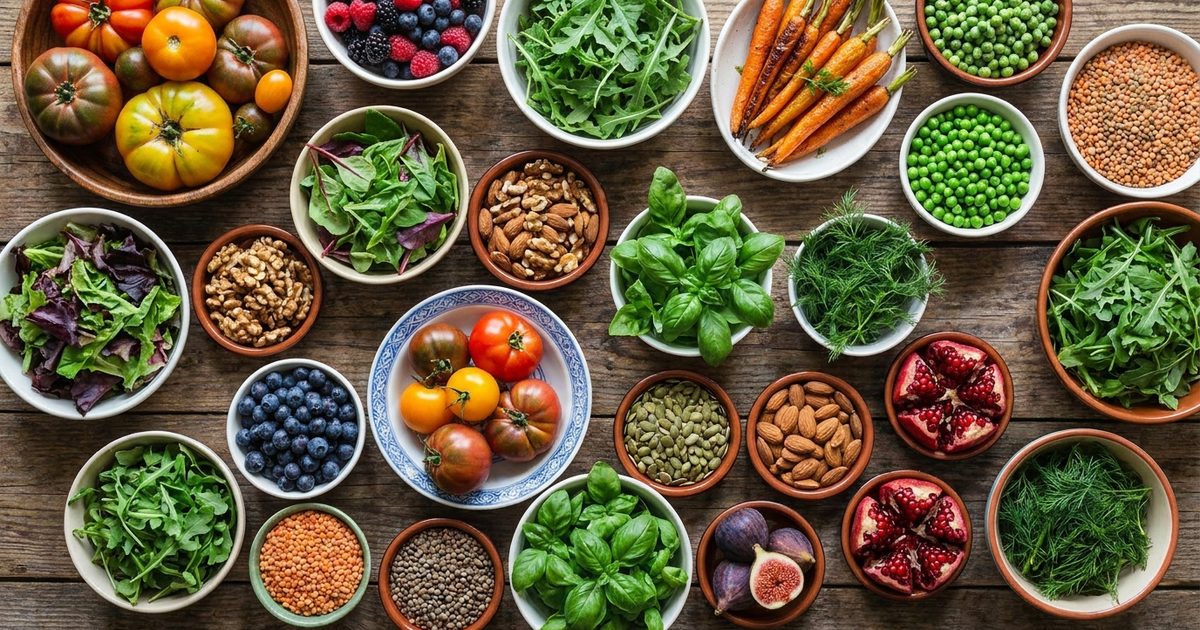
Veg-maxxing means eating more plants on purpose, and the popular target is 30 different plants a week. That number comes from the American Gut Project, where people eating 30+ plant types had more diverse gut microbes than people eating 10 or fewer. Beans, grains, nuts, seeds, herbs, and spices all count, so 30 is easier than it sounds: our 7-day example hits 33.
What is veg-maxxing?
Veg-maxxing is the internet's newest "maxxing," and honestly one of the nicest. Instead of cutting things out, you add plants in: more vegetables, more fruit, more beans, more variety. Nobody is asking you to eat a sad desk salad seven days a week.
The Guardian put the term in a headline on October 25, 2026, with Lucy Knight's piece "The joy of veg-maxxing," which leans on simple habits from nutrition experts. Nutritionist Eva Humphries describes her go-to message as asking people to "make half of it veg" when they look at a plate. Dr Shireen Kassam suggests swaps like a lentil bolognese instead of one made with mince, or a "half and half" meat and lentil version. And the most important line in the article is hers: "We're not talking about being perfect."
It fits a bigger mood. Our fibermaxxing guide covered the grams; veg-maxxing is the variety side of the same story. Whole Foods Market's 2027 trend predictions even name "Beautrition," the idea that "glowing skin is becoming an inside job," with skin-supportive foods like carrots, cabbage, and cucumber getting attention. Same vibe: eating plants for how they make you feel, not as punishment.
Where does the 30 plants a week rule come from?
It comes from a 2018 paper in mSystems, "American Gut: an Open Platform for Citizen Science Microbiome Research" by McDonald and colleagues. The project collected samples from over 10,000 citizen scientists, mostly in the US, UK, and Australia.
One survey question asked: "In an average week, how many different plants do you eat?" The researchers compared people who answered "more than 30" with people who answered "less than 10." Here is what they reported:
- More diverse gut microbes. High dietary plant diversity was linked to higher microbial diversity.
- More fiber fermenters. Eating more than 30 types of plants was associated with several bacteria that likely make short-chain fatty acids.
- Labels mattered less than variety. The number of unique plants was associated with microbial diversity, rather than categories like "vegan" or "omnivore."
The honest fine print: this was an association in a self-selected group, and the 30-plus versus under-10 comparison used fewer than 100 people in total (41 and 44). It doesn't prove 30 is a magic number. It's a fun, memorable target that pushes you toward variety, which every national guideline already likes. The US Dietary Guidelines 2025 to 2030 say vegetables, fruits, fermented foods, and high-fiber foods "support a diverse microbiome."
How many vegetables do you actually need?
The 30 plants idea is about variety. The official guidelines are about amount. You want both, and the amount part is where most people fall short. CDC data from 2019 found only 10.0% of US adults met vegetable recommendations and 12.3% met fruit recommendations.
| Country | Official vegetable guidance | Source |
|---|---|---|
| US | 3 servings of vegetables and 2 of fruit a day on a 2,000-calorie pattern | Dietary Guidelines 2025 to 2030 |
| Australia | 5 serves of veg and legumes a day for women, 6 for men 19 to 50, plus 2 fruit | NHMRC Eat for Health |
| Canada | Make half your plate vegetables and fruits | Canada's Food Guide |
What's a "serve"? Australia's definition is the most practical: about 75g of veg, which is 1/2 cup cooked broccoli, carrots, or pumpkin, 1/2 cup of beans or lentils, 1 cup of salad leaves, or 1 medium tomato. So a big stir-fry can easily be two or three serves in one bowl.
Good news for busy people: Canada's Food Guide says frozen and canned vegetables and fruits are "just as nutritious as fresh." The US guidelines agree that frozen, dried, or canned options with little or no added sugar "can also be good options." The freezer is a veg-maxxing cheat code.
What counts as a plant?
More than you think. This is the part that makes 30 doable.
- Vegetables and fruit, fresh, frozen, or canned
- Legumes: chickpeas, black beans, lentils, peas, edamame
- Whole grains: oats, brown rice, wheat, corn
- Nuts and seeds: walnuts, almonds, chia, pumpkin seeds, sesame (yes, tahini)
- Herbs and spices: parsley, cilantro, cinnamon, black pepper
- Fermented plants: kimchi and sauerkraut (cabbage)
Each different plant counts once per week. Five bowls of broccoli is still one plant (a great one). A can of mixed beans could be three.
The 30 plants checklist
Print it, screenshot it, stick it on the fridge. Tick one box per plant per week. This version lists 44 easy options across categories, so you've got spares.
| Category | Plants | Ate it? |
|---|---|---|
| Leafy greens | Spinach, kale, lettuce, cabbage | |
| Everyday veg | Broccoli, carrot, onion, garlic, tomato, red pepper, mushrooms, zucchini, cucumber | |
| Starchy veg | Sweet potato, potato, peas, corn | |
| Legumes | Chickpeas, black beans, lentils, edamame, kidney beans | |
| Whole grains | Oats, brown rice, whole wheat pasta or bread, quinoa | |
| Fruit | Apple, banana, blueberries, strawberries, avocado, orange | |
| Nuts | Walnuts, almonds, peanuts | |
| Seeds | Chia, pumpkin seeds, sesame (tahini) | |
| Herbs | Parsley, cilantro, basil | |
| Spices | Cinnamon, black pepper, cumin |
That's 44 plants in total. You need 30.
How many calories are in common veg-maxxing foods?
Short answer: the vegetables are tiny, the nuts and seeds are not. That's fine. Nuts and seeds bring healthy fats and keep you full; you just want to know what's in the bowl. All numbers below are USDA FoodData Central, calculated from USDA per-100g values at USDA portion weights.
| Food and serving | Calories | USDA FDC ID |
|---|---|---|
| Spinach, raw, 1 cup (30g) | 7 | 168462 |
| Kale, raw, 1 cup (21g) | 7 | 168421 |
| Broccoli, boiled, 1/2 cup (78g) | 27 | 169967 |
| Carrot, raw, 1 medium (61g) | 25 | 170393 |
| Red bell pepper, raw, 1 medium (119g) | 31 | 170108 |
| Mushrooms, white, raw, 1 cup sliced (70g) | 15 | 169251 |
| Kimchi, 1/2 cup (75g) | 11 | 170392 |
| Sweet potato, baked, 1 medium (114g) | 103 | 168483 |
| Peas, boiled, 1/2 cup (80g) | 67 | 170420 |
| Edamame, prepared, 1/2 cup (78g) | 94 | 168411 |
| Lentils, boiled, 1/2 cup (99g) | 115 | 172421 |
| Black beans, boiled, 1/2 cup (86g) | 114 | 173735 |
| Chickpeas, boiled, 1/2 cup (82g) | 134 | 173757 |
| Oats, dry, 1/2 cup (40.5g) | 153 | 173904 |
| Blueberries, 1/2 cup (74g) | 42 | 171711 |
| Apple, 1 medium (182g) | 95 | 171688 |
| Avocado, 50g | 80 | 171705 |
| Walnuts, 1 oz (28g) | 185 | 170187 |
| Pumpkin seeds, 1 oz (28g) | 158 | 170556 |
| Parsley, fresh, 1 tbsp (3.8g) | 1 | 170416 |
| Cinnamon, ground, 1 tsp (2.6g) | 6 | 171320 |
Look at the herbs and spices. A tablespoon of parsley is about 1 calorie and still counts as a whole plant. Humphries makes the same point in the Guardian piece: fresh herbs are concentrated sources of nutrients, so you don't need much. If you love big portions, Volume Eating Foods ranks the most food per calorie.
A 7-day veg-maxxing plan that hits 30
This plan is built for real life: it repeats breakfasts, uses leftovers for lunch, and only adds a few new plants each day. Add your own protein (salmon, chicken, eggs, tofu, Greek yogurt) wherever you like.
| Day | What you eat | New plants | Running total |
|---|---|---|---|
| Mon | Overnight oats with blueberries, chia, and walnuts. Chickpea bowl with brown rice, spinach, and tomato. Sheet-pan broccoli and sweet potato with garlic and black pepper | 12 | 12 |
| Tue | Same oats. Leftover chickpea bowl. Apple snack. Lentil bolognese with onion, carrot, and mushrooms over pasta | 6 | 18 |
| Wed | Oats with strawberries. Leftover bolognese. Black bean tacos on corn tortillas with red pepper and avocado | 5 | 23 |
| Thu | Banana and almonds. Taco leftovers as a bowl. Kimchi fried rice with edamame and kale | 5 | 28 |
| Fri | Yogurt with pumpkin seeds and cinnamon. Hummus wrap (tahini counts as sesame) | 3 | 31 |
| Sat | Eggs with peas and parsley | 2 | 33 |
| Sun | Leftovers, takeout, whatever. You already won | 0 | 33 |
The math: 12 + 6 + 5 + 5 + 3 + 2 + 0 = 33 plants, with zero salads required. Wheat counts once for the pasta, corn once for the tortillas, and cabbage once for the kimchi.
Three tricks doing the heavy lifting:
- Monday stacks. A breakfast with four plants and a sheet pan with four more gets you to 12 on day one.
- Sauces hide veg. The Guardian's chef tip, doubling or tripling the onion, celery, and carrot base in pasta sauces, is pure veg-maxxing. Same with soups like minestrone.
- Toppings are plants. Seeds, herbs, and spices are low effort and each one is a tick.
Swap anything for what's cheap near you. A bag of frozen mixed veg from Woolies, Walmart, or Loblaws can add three or four plants to a weeknight dinner.
How do you veg-max on a budget?
Plants can get expensive, and the Guardian article is honest about it: the cheapest calories are often the least healthy ones. A few ways around that:
- Frozen and canned are fine. Canada's Food Guide says they're as nutritious as fresh. Pick canned veg with little or no added salt, and drain and rinse.
- Beans and lentils are the budget kings. Dried or canned, they're cheap and count as plants. See Cheapest Protein Foods for more.
- Buy one new thing a week. One new herb or veg per shop adds variety without a big bill.
Who should take veg-maxxing slowly?
Most people can add plants with no drama. But if you're also adding a lot of fiber, go gradually and drink more water, as our fibermaxxing guide explains. If you have IBS or another digestive condition, talk to your doctor or a registered dietitian before a big change.
And if counting anything about food has ever felt stressful, please skip the counting and work with a professional. Veg-maxxing is about adding good stuff, never about getting it "right."
How I'd track a veg-maxxing week (and why I built it this way)
I used MyFitnessPal first. The numbers were fine; the problem was time. A normal dinner took several minutes to enter, and after a long day I just wouldn't do it. Now picture searching six separate ingredients for a lentil bolognese. That's exactly the meal that never gets tracked.
That's why Nouri is built around speed. You just type or say what you made: "lentil bolognese with onion, carrot, mushrooms, and pasta." Or tell Siri from the lock screen: "Hey Siri, track food in Nouri." Each item gets its own breakdown with reasoning and a confidence rating, and you can add context like "plus a tablespoon of olive oil" and recalculate.
That oil part matters. When I tried AI photo trackers, the estimates came in low, because the camera can't see the oil in the pan. Roasted veg is exactly where that happens. In Nouri, photos get turned into a sentence first, so you can read what it thinks it saw and fix it before anything is counted.
For veg-maxxing specifically, Nouri doesn't count plants for you. What it does do is track a daily fiber goal next to calories and protein, plus a per-meal vitamin scorecard for vitamins A, C, and D, iron, and calcium. So you can see which meals are actually bringing the plants. It's iPhone (iOS only), with a 3-day free trial.
FAQ
What is veg-maxxing?
Veg-maxxing is a trend about deliberately eating more plants, both more vegetables overall and more variety. The Guardian covered it in October 2026 with tips like making half your plate veg and swapping some meat for lentils or beans.
Why 30 plants a week?
The number comes from the American Gut Project (McDonald et al., mSystems, 2018). People who reported eating more than 30 plant types a week had more diverse gut microbes than those eating fewer than 10. It's an association, not proof that 30 is magic, but it's a useful variety target.
Do herbs and spices count toward 30 plants?
Yes, they're plants. A tablespoon of parsley or a teaspoon of cinnamon adds almost no calories but counts as a different plant. Count each one once per week.
Do nuts, seeds, and grains count as plants?
Yes. Walnuts, almonds, chia, pumpkin seeds, sesame, oats, brown rice, corn, and wheat all count. So do beans, lentils, and peas.
Does coffee count as a plant?
Coffee and tea do come from plants. The American Gut survey simply asked how many different plants people ate and didn't define the list, so this guide sticks to foods. If you count them, treat them as a bonus, not a stand-in for vegetables.
How many vegetables should I eat a day?
The US Dietary Guidelines 2025 to 2030 set 3 servings of vegetables and 2 of fruit a day on a 2,000-calorie pattern. Australia's NHMRC recommends 5 serves of veg and legumes for women and 6 for men aged 19 to 50. Canada's Food Guide says to make half your plate vegetables and fruits.
Do frozen vegetables count?
Yes. Canada's Food Guide says frozen and canned vegetables are just as nutritious as fresh, and the US guidelines call them good options when they have little or no added sugar. Choose canned veg with little or no added salt.
What's the easiest way to eat 30 plants a week?
Load up early in the week, repeat breakfasts, and add toppings. Oats with berries, chia, and walnuts is four plants before 9 a.m. Seeds, herbs, spices, and mixed beans each add more with almost no effort.
Does a can of mixed beans count as multiple plants?
Yes, each different bean is a different plant. A three-bean mix can be three ticks on your checklist. The same goes for frozen mixed vegetables.
Is veg-maxxing good for weight loss?
Most vegetables are low in calories for their size: a cup of spinach is 7 calories and half a cup of broccoli is 27, by USDA data. Weight still comes down to your overall intake, so the oils, sauces, nuts, and seeds still count. If you have a history of disordered eating, work with a professional before tracking.
How do I eat more vegetables if I hate salad?
Hide them in things you already like. Add extra onion, carrot, and celery to pasta sauce, make a half-lentil bolognese, blend spinach into a smoothie, or roast a tray of veg with spices. Soups and stir-fries can take three or four plants each.
What is the easiest way to track fiber and vitamins from plants?
Use an app that turns a quick description into a full breakdown. In Nouri, you type, say, or snap a meal, and it tracks fiber next to calories and protein with a per-meal vitamin scorecard, so a plant-packed week shows up in your numbers.
Veg-maxxing is the rare trend that only asks you to add: more plants, more variety, more flavor. Use the checklist, steal the 7-day plan, and track your week in Nouri. For more ideas, see High Fiber Foods, Low-Calorie Food Swaps, and the protein side of the story in Proteinmaxxing.
Sources
- The Guardian, "The joy of veg-maxxing: how to eat many, many more plants, without really trying," by Lucy Knight, October 25, 2026, theguardian.com/society/2026/oct/25/the-joy-of-veg-maxxing-how-to-eat-many-many-more-plants-without-really-trying (checked Oct 25, 2026)
- Whole Foods Market, "The Next Big Things: Our Top Food Trend Predictions for 2027," wholefoodsmarket.com/trends/our-top-food-trend-predictions-for-2027 (checked Oct 25, 2026)
- McDonald D, Hyde E, et al. "American Gut: an Open Platform for Citizen Science Microbiome Research." mSystems, 2018;3(3):e00031-18, PubMed 29795809 and full text PMC5954204 (checked Oct 25, 2026)
- Dietary Guidelines for Americans, 2025 to 2030, cdn.realfood.gov/DGA.pdf (checked Oct 25, 2026)
- Lee SH, Moore LV, Park S, Harris DM, Blanck HM. "Adults Meeting Fruit and Vegetable Intake Recommendations, United States, 2019." CDC MMWR, 2022;71(1):1-9, cdc.gov/mmwr/volumes/71/wr/mm7101a1.htm and PubMed 34990439 (checked Oct 25, 2026)
- NHMRC Eat for Health, Recommended number of serves for adults, eatforhealth.gov.au, and Serve sizes, eatforhealth.gov.au (checked Oct 25, 2026)
- Health Canada, Canada's Food Guide, Eat vegetables and fruits, canada.ca (checked Oct 25, 2026)
- USDA FoodData Central, SR Legacy (per-serving values calculated from USDA per-100g figures at USDA portion weights; 1/2 cup portions are half of USDA's 1 cup weights): spinach (168462), kale (168421), broccoli, boiled (169967), carrots (170393), red bell pepper (170108), white mushrooms (169251), kimchi (170392), sweet potato, baked (168483), peas, boiled (170420), edamame (168411), lentils (172421), black beans (173735), chickpeas (173757), oats (173904), blueberries (171711), apple (171688), avocado (171705), walnuts (170187), pumpkin seeds (170556), parsley (170416), cinnamon (171320) (checked Oct 25, 2026)
Keep reading
All articlesGLP-1 Cost Comparison (November 2026): Pill vs Pen vs Compounded, US, Canada and Australia
Wegovy pill and Foundayo start at $149 a month self-pay, Zepbound KwikPen at $299. Official US, Canada and Australia GLP-1 prices, checked Oct 25.
GuidesIs 'Bodega Reta' Safe? What Lab Tests of Gray-Market Retatrutide Found
A bodega vial sold as retatrutide had no peptide, a perfume-grade filler, and 13 bacterial colonies. What 2026 lab tests found and why it isn't approved.
GuidesProteinmaxxing: How Much Protein Is Too Much? (The Real Ceiling)
In a 49-study meta-analysis, muscle gains plateaued at 1.6g of protein per kg, topping out near 2.2g/kg. Your number, the myths, and the fiber catch.
GuidesHow Many Calories Does Crying Burn? (Plus Thinking, Shivering, Laughing and 20 Other Weird Ones)
Crying burns about what the couch burns: roughly 70 calories an hour at 70 kg. Real numbers for 25 weird activities, from laughing to shaking your leg.