
Proteinmaxxing: How Much Protein Is Too Much? (The Real Ceiling)
In a 49-study meta-analysis, muscle gains plateaued at 1.6g of protein per kg, topping out near 2.2g/kg. Your number, the myths, and the fiber catch.
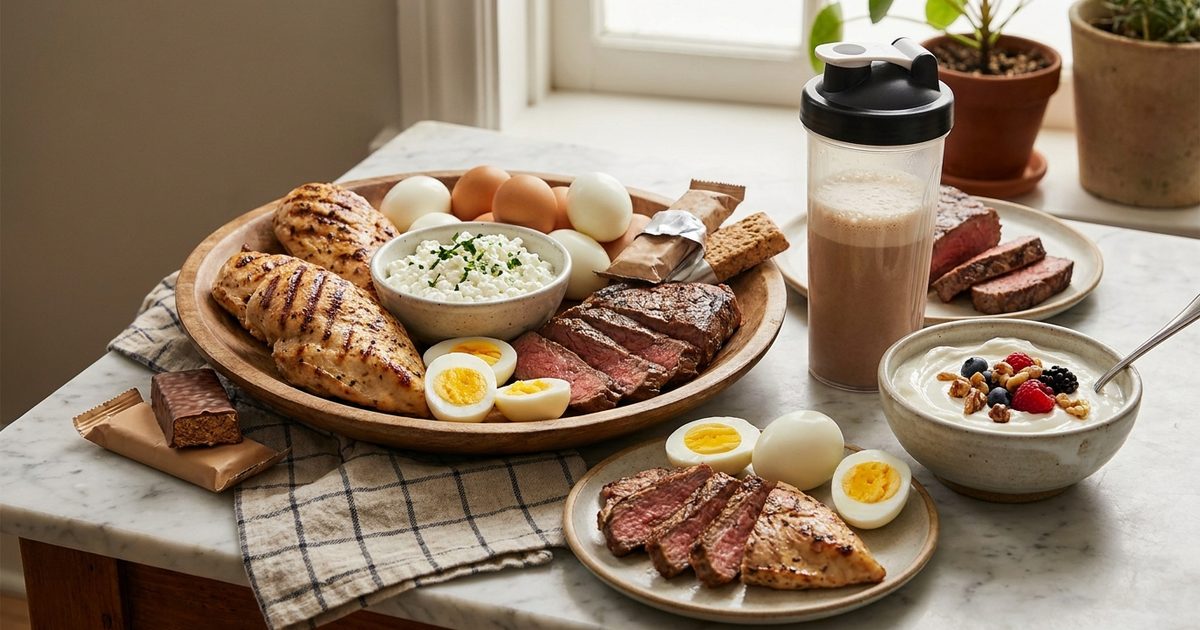
For building muscle, the useful ceiling is about 1.6g of protein per kg of body weight a day, with 2.2g/kg (roughly 1g per pound) as the generous upper end. That's what a 49-study meta-analysis in the British Journal of Sports Medicine found. Past that, extra protein mostly adds calories, not muscle. The RDA floor is 0.8g/kg, so most gym-goers land between the two.
What is proteinmaxxing?
Proteinmaxxing is the internet's name for pushing protein as high as it will go: shakes, bars, a second chicken breast, and now protein in basically everything. It's the "maxxing" suffix applied to the one macro the gym already worshipped.
The numbers say it's not just a TikTok thing. A Pew Research Center survey reported by Fortune on September 29, 2026, found 37% of adults ages 18 to 29 take protein supplements such as powders, drinks, or bars, compared with 23% of Americans 65 and older. That flips the usual pattern: young adults are less likely to take supplements overall (67% vs 85%), except protein. Fortune also cites a 2025 SPINS study where more than half of Gen Z and millennial shoppers surveyed said they follow a high-protein diet.
Big food noticed. On October 1, 2026, Fortune reported McDonald's is exploring an $8.5 billion, decade-long "McDonald's Next" overhaul with smaller, more flexible portions aimed at protein-first and GLP-1 customers, including grilled chicken wraps, burger bowls, and egg bites. When the Golden Arches start counting grams, you know the trend has left the group chat.
How much protein do you actually need?
There isn't one number. There are four, and they answer different questions.
| Benchmark | Grams per kg per day | Who it's for | Source |
|---|---|---|---|
| RDA | 0.8 | Healthy adults, minimum to cover needs | ISSN position stand, citing the RDA |
| US Dietary Guidelines 2025 to 2030 | 1.2 to 1.6 | General adult serving goal | Dietary Guidelines for Americans |
| Sports nutrition range | 1.4 to 2.0 | Most exercising people | ISSN position stand |
| Muscle-gain plateau | 1.62 (95% CI up to 2.2) | People lifting to build muscle | Morton et al. meta-analysis |
| Cutting while lifting | 2.3 to 3.1 | Resistance-trained people in a calorie deficit | ISSN position stand |
The International Society of Sports Nutrition (ISSN) says 1.4 to 2.0g/kg "is sufficient for most exercising individuals." The 2025 to 2030 Dietary Guidelines for Americans set a protein goal of 1.2 to 1.6g/kg, "adjusting as needed based on your individual caloric requirements." The RDA of 0.8g/kg is a floor, not a target, and the ISSN notes multiple lines of evidence say it's not enough for a training athlete.
Want your exact number? The protein intake calculator does it in five seconds.
What does that look like for your weight?
Here's the math for common body weights, rounded to the nearest gram.
| Body weight | RDA (0.8g/kg) | Gym range (1.6g/kg) | Generous ceiling (2.2g/kg) |
|---|---|---|---|
| 130 lb (59 kg) | 47g | 94g | 130g |
| 150 lb (68 kg) | 54g | 109g | 150g |
| 170 lb (77 kg) | 62g | 123g | 170g |
| 190 lb (86 kg) | 69g | 138g | 190g |
| 210 lb (95 kg) | 76g | 152g | 210g |
Notice the last column? 2.2g/kg is almost exactly 1 gram per pound. The old gym-bro rule wasn't a myth. It was just the top of the range dressed up as the minimum.
Is there a real ceiling for building muscle?
Yes, and it's lower than your feed thinks. Morton and colleagues pooled 49 randomized trials with 1,863 people doing resistance training for at least six weeks. Protein supplementation helped: more strength and more fat-free mass. But in their analysis, gains in fat-free mass plateaued at 1.62g/kg per day. Beyond that, extra protein "resulted in no further" gains.
The researchers were careful. The 95% confidence interval for that plateau ran from 1.03 to 2.20g/kg, so they wrote it "may be prudent to recommend ~2.2 g protein/kg/d for those seeking to maximise" muscle gains. That's where the "real ceiling" in this post's title comes from.
Two more findings worth knowing: protein supplements helped trained lifters more than beginners, and the effect got smaller with age. So the 50g-shake-after-every-set lifestyle isn't building extra muscle once your daily total is covered. Your training, sleep, and total calories do the rest.
Is too much protein dangerous?
For healthy adults, the research is more chill than the scary headlines. The ISSN position stand reviews studies by Antonio and colleagues that prescribed very high intakes, around 3.4 to 4.4g/kg a day, and "consistently reported no harmful effects," including no changes in kidney or liver function markers in those trials. Its summary: concerns mostly "stem from renal failure patients" and shouldn't be extended to healthy, trained people.
That doesn't make 4g/kg a goal. Those were short trials in healthy, resistance-trained adults. The real costs of overshooting are boring ones:
- Calories. Protein still has 4 calories per gram. Going from 150g to 250g a day adds 400 calories, which can quietly cancel a deficit.
- Money. Powders and protein snacks aren't cheap. See protein powder prices before you buy the 5 lb tub.
- Crowding out. Every extra shake is room you didn't use for fruit, beans, or whole grains. More on that below.
What about protein and your kidneys?
Here's the one group where "too much" is a real medical question: people who already have kidney disease. NIDDK explains that as your body uses protein, it creates waste your kidneys filter out, and "some people with CKD may need to consume moderate amounts of protein so waste doesn't build up in the blood." Too little protein can cause malnutrition too, so NIDDK says to work with a dietitian or health care professional to find the right balance.
This matters more than it sounds. CDC estimates 14% of US adults have chronic kidney disease, and about 9 in 10 of them don't know it. If you have diabetes, high blood pressure, or a kidney condition, talk to your doctor before you proteinmaxx. Everyone else: carry on, just not with a shovel.
Does proteinmaxxing crowd out fiber?
Often, yes. This is the sneakiest side effect. The classic proteinmaxxing foods (chicken, eggs, Greek yogurt, whey) have little or no fiber, while US guidelines name fiber "a dietary component of public health concern" because most people don't get enough.
Per USDA FoodData Central, per 100g:
| Food (USDA FDC ID) | Calories | Protein | Fiber |
|---|---|---|---|
| Chicken breast, roasted (171477) | 165 | 31.0g | 0g |
| Greek yogurt, plain, nonfat (170894) | 59 | 10.2g | 0g |
| Egg, hard-boiled (173424) | 155 | 12.6g | 0g |
| Edamame, prepared (168411) | 121 | 11.9g | 5.2g |
| Lentils, boiled (172421) | 116 | 9.0g | 7.9g |
| Black beans, boiled (173735) | 132 | 8.9g | 8.7g |
| Chickpeas, boiled (173757) | 164 | 8.9g | 7.6g |
Chicken wins protein per calorie. Lentils and beans bring protein and fiber in one bite. The Dietary Guidelines for Americans 2020 to 2025 even point out that swapping some processed meats for beans, peas, and lentils would increase fiber.
The fix isn't less protein. It's a better roster. Swap a shake for lentil soup sometimes, put edamame next to the chicken, and you're doing proteinmaxxing and fibermaxxing at the same time. For more ideas, see high fiber foods and high protein foods.
Are protein-everything products worth it?
Fortune describes protein showing up "in pretty much every section" of US grocery stores: shakes, soda, cereal, coffee, chips, and even mac and cheese. A June 2026 Fortune piece on a whey shortage listed protein pasta, cereal, and popcorn, with David Protein CEO Peter Rahal calling it "protein capitalism at play."
Some of these are genuinely handy. Some are a cookie that went to the gym once. A quick sanity check before you buy:
- Check protein per calorie. A snack with 10g of protein and 300 calories is a snack, not a protein source. Chicken breast gives about 19g per 100 calories.
- Check what else changed. The 2025 to 2030 Dietary Guidelines recommend significantly limiting highly processed foods, and a protein label doesn't change what the rest of the ingredient list says.
- Count it. Protein coffee and protein chips still have calories. They count, even when the front of the bag is shouting.
If cheap, real-food protein is the goal, cheapest protein foods and high protein snacks beat most of the aisle.
Do you need protein at every meal?
You don't need perfection, but spreading it out helps. The ISSN suggests roughly 0.25g/kg, or 20 to 40g, per serving, evenly distributed every 3 to 4 hours. The 2025 to 2030 Dietary Guidelines say to prioritize protein foods at every meal. For most people that's three or four solid meals, not eight shakes. Curious what a very high day looks like on a plate? What 200 grams of protein looks like shows it.
A gentle note: if "maxxing" anything makes food feel like a test you can fail, or you have a history of disordered eating, please work with a doctor or registered dietitian. Protein is a tool, not a scorecard.
How I track protein without overdoing it
I used MyFitnessPal first. The numbers were fine; the problem was time. Entering a normal dinner took several minutes, and after a long day I just wouldn't do it. Proteinmaxxing makes that worse, because you're suddenly tracking five shakes, two bars, and a protein coffee you forgot about by 3pm.
So I built Nouri to be fast. You type, say, or snap a meal, or tell Siri from the lock screen: "Hey Siri, track food in Nouri." Photos get turned into a sentence first, so you can read what Nouri thinks it saw before anything gets counted. Every item gets its own breakdown with reasoning and a confidence rating, and you can add context like "with a scoop of whey" and recalculate.
On targets, we made a deliberate choice. Nouri's default protein target is 1.0g per pound of body weight, which is right at that ~2.2g/kg research ceiling. Turn on Prioritize Protein and it moves to 1.2g per pound (about 2.6g/kg), which lands inside the ISSN's 2.3 to 3.1g/kg range for lifters in a calorie deficit. If your doctor or dietitian gave you a different number, use theirs. And because Nouri tracks fiber, sugar, and sodium goals next to protein, you see the crowding-out problem in real time instead of three weeks later. Most calorie apps give you numbers. Nouri gives you answers. It's iPhone (iOS only), with a 3-day free trial.
FAQ
What is proteinmaxxing?
Proteinmaxxing is a social media trend about pushing protein intake as high as possible with shakes, bars, lean meat, and protein-fortified foods. A Pew survey reported by Fortune found 37% of adults ages 18 to 29 take protein supplements, compared with 23% of those 65 and older.
How much protein is too much in a day?
For muscle gain, a meta-analysis found gains plateaued around 1.6g/kg, with about 2.2g/kg as a generous upper end. Short studies in healthy, trained adults found no harm at much higher intakes, but past the plateau extra protein mostly adds calories. People with kidney disease should follow their care team's number.
How much protein do I need to build muscle?
The ISSN says 1.4 to 2.0g/kg a day is sufficient for most exercising people. A 49-study meta-analysis found muscle gains plateaued at 1.62g/kg. For a 170 lb person, that's about 123g a day.
Is 1 gram of protein per pound too much?
Not for most healthy lifters. 1g per pound is about 2.2g/kg, which is the top of the range the Morton meta-analysis suggested for maximizing muscle gains. It's more than many people need, so treat it as a ceiling, not a minimum.
What is the RDA for protein?
The RDA is 0.8g per kg of body weight per day, about 54g for a 150 lb person. It's a minimum for healthy adults, and the ISSN notes it isn't enough for people who train hard.
Can too much protein hurt your kidneys?
In healthy people, the ISSN reviewed trials of very high intakes, up to 4.4g/kg, that found no harm to kidney function markers. People who already have kidney disease are different: NIDDK says some may need moderate protein, so work with a dietitian or doctor.
Can you eat too much protein and gain weight?
Yes, if it pushes you over your calorie needs. Protein has 4 calories per gram, so an extra 100g a day is 400 calories. The calories still count, even when they come with a gym-friendly label.
Does eating a lot of protein mean less fiber?
It can. Chicken, eggs, Greek yogurt, and whey have little or no fiber, and US guidelines call fiber a dietary component of public health concern. Beans, lentils, chickpeas, and edamame give you protein and fiber together.
Are protein snacks like protein popcorn and protein coffee healthy?
Some are useful, some are mostly marketing. Check protein per calorie, scan the ingredient list, and remember the 2025 to 2030 Dietary Guidelines recommend limiting highly processed foods. Whole-food protein is usually cheaper per gram too.
How much protein can your body absorb in one meal?
The ISSN suggests about 0.25g/kg, or 20 to 40g, of high-quality protein per serving, spread every 3 to 4 hours, to support muscle protein synthesis. Your body still digests more than that; it's about distribution, not a hard cutoff.
Should I eat more protein when cutting?
Possibly. The ISSN says 2.3 to 3.1g/kg may help resistance-trained people keep lean mass in a calorie deficit. If you have a health condition or a history of disordered eating, check with a doctor or registered dietitian first.
What is the easiest way to track protein every day?
Use an app that tracks protein from a quick description instead of a database search. In Nouri, you type, say, or snap a meal, or use Siri from the lock screen, and it fills your protein goal next to calories and fiber, so you know when you've hit enough.
Proteinmaxxing is half right: protein matters, and most lifters do better above the RDA. The other half is knowing where the ceiling is, around 1.6 to 2.2g/kg, and leaving room for fiber. Track your real intake in Nouri, get your number from the protein intake calculator, and save the extra shake money for groceries.
Sources
- Fortune, "Proteinmaxxing shows a 'meaningful shift' in how Gen Z takes supplements versus baby boomers, new survey shows," by Tatiana Sataua, September 29, 2026 (reporting Pew Research Center and SPINS data), fortune.com/2026/09/29/young-adults-protein-supplements-food-drinks (checked Oct 25, 2026)
- Fortune, "Forget supersized: McDonald's is exploring an $8.5 billion bet on an American fast food wave led by proteinmaxxing, portion control, and GLP-1s," by Joshua Hong, October 1, 2026, fortune.com/2026/10/01/mcdonalds-8-5-billion-bet-fast-food-protein-glp-1 (checked Oct 25, 2026)
- Fortune, "Your 'proteinmaxxing' is creating a whey shortage that's ratcheting up prices and leaving snack companies to eat costs or make recipes worse," June 21, 2026, fortune.com/2026/06/21/proteinmaxxing-whey-shortage-cost-increase-snack-companies-changing-recipes (checked Oct 25, 2026)
- Morton RW et al., "A systematic review, meta-analysis and meta-regression of the effect of protein supplementation on resistance training-induced gains in muscle mass and strength in healthy adults," British Journal of Sports Medicine, 2018, PMID 28698222, pubmed.ncbi.nlm.nih.gov/28698222 and full text pmc.ncbi.nlm.nih.gov/articles/PMC5867436 (checked Oct 25, 2026)
- Jäger R et al., "International Society of Sports Nutrition Position Stand: protein and exercise," Journal of the International Society of Sports Nutrition, 2017, PMID 28642676 (RDA 0.8 g/kg/day; 1.4 to 2.0 g/kg/d; 2.3 to 3.1 g/kg/d in hypocaloric periods; 20 to 40 g per serving; protein safety section), pmc.ncbi.nlm.nih.gov/articles/PMC5477153 (checked Oct 25, 2026)
- Dietary Guidelines for Americans, 2025 to 2030 (protein 1.2 to 1.6 g/kg/day; prioritize protein foods at every meal; limit highly processed foods), cdn.realfood.gov/DGA.pdf (checked Oct 25, 2026)
- USDA and HHS, Dietary Guidelines for Americans 2020 to 2025 (dietary fiber as a dietary component of public health concern; beans, peas, and lentils swap), dietaryguidelines.gov PDF (checked Oct 25, 2026)
- NIDDK, Eating Right for Chronic Kidney Disease, niddk.nih.gov (checked Oct 25, 2026)
- CDC, Chronic Kidney Disease in the United States, cdc.gov/kidney-disease/php/data-research (checked Oct 25, 2026)
- MedlinePlus (US National Library of Medicine), Protein in diet (1 gram of protein supplies 4 calories), medlineplus.gov/ency/article/002467.htm (checked Oct 25, 2026)
- USDA FoodData Central, SR Legacy, per 100g: chicken breast, roasted (FDC 171477), Greek yogurt, plain, nonfat (FDC 170894), egg, hard-boiled (FDC 173424), edamame, prepared (FDC 168411), lentils, boiled (FDC 172421), black beans, boiled (FDC 173735), chickpeas, boiled (FDC 173757) (checked Oct 25, 2026)
Keep reading
All articlesGLP-1 Cost Comparison (November 2026): Pill vs Pen vs Compounded, US, Canada and Australia
Wegovy pill and Foundayo start at $149 a month self-pay, Zepbound KwikPen at $299. Official US, Canada and Australia GLP-1 prices, checked Oct 25.
GuidesIs 'Bodega Reta' Safe? What Lab Tests of Gray-Market Retatrutide Found
A bodega vial sold as retatrutide had no peptide, a perfume-grade filler, and 13 bacterial colonies. What 2026 lab tests found and why it isn't approved.
GuidesVeg-Maxxing: How to Eat 30 Plants a Week Without Living on Salad
Veg-maxxing means eating more plants on purpose. Only 10% of US adults hit their veg target. A 30 plants checklist and a 7-day plan that gets to 33.
GuidesHow Many Calories Does Crying Burn? (Plus Thinking, Shivering, Laughing and 20 Other Weird Ones)
Crying burns about what the couch burns: roughly 70 calories an hour at 70 kg. Real numbers for 25 weird activities, from laughing to shaking your leg.