
'Ferritin Face' Is Trending: What Low Iron Actually Looks Like, and the Foods That Fix It
Your face can't diagnose low iron, but a ferritin blood test can. Women 19 to 50 need 18 mg a day. 20 iron-rich foods ranked with USDA data.
"Ferritin face" (pale, dull skin and dark under-eye circles) is a social media label, not a diagnosis. No mirror can read your iron stores. A blood test can. Low iron is still common: in a 2023 JAMA study, 38.6% of US females aged 12 to 21 had iron deficiency. Women 19 to 50 need 18 mg of iron daily, and food comes first.
What is "ferritin face"?
It is the TikTok name for looking washed out: pale skin, dullness, dark circles. The trend has been everywhere this fall. The Washington Post explained it on September 15, The Guardian called it the new health scare on September 16, Reader's Digest ran "the 2 signs, according to TikTok" on October 19, and CNN published "Forget 'ferritin face'" on October 23.
The Guardian put it plainly: ferritin face is not a real medical term and has no consistent criteria. Ferritin, though, is very real. It is the protein that stores iron in your body, mostly in the liver, spleen, and bone marrow, according to the NIH Office of Dietary Supplements (ODS).
The trend gets one thing right (iron matters) and one thing wrong (your selfie is not a lab result).
Can you tell if you have low iron by looking at your face?
No. Here is the part the videos skip. The NIH says that in the short term, getting too little iron does not cause obvious symptoms. Your body quietly spends its stored iron first. Only when those stores run low does iron deficiency anemia set in, and red blood cells get smaller and carry less oxygen.
Pale skin and dark circles have plenty of other causes: sleep, genetics, allergies, lighting, a toddler who thinks 4 a.m. is morning.
What a doctor actually does: orders blood work. The NIH notes that hemoglobin and hematocrit are the most common screening tests, but they are "neither sensitive nor specific." Serum ferritin measures your iron stores, but inflammation can push it up, so doctors often use several tests together. That is why this is a "talk to your doctor" topic, not a "guess from your camera roll" topic.
What are the real symptoms of low iron?
According to the NIH ODS, symptoms of iron deficiency anemia include:
- Tiredness, weakness, and lack of energy
- Trouble with concentration and memory
- GI upset
- Getting sick more easily
- Struggling to exercise or work like usual
- Trouble controlling body temperature (always cold, anyone?)
The NHS advice summarized by The Guardian adds breathlessness, headaches, dizziness, and palpitations. If any of this sounds like your week, book a GP or doctor visit and ask about a blood test that includes ferritin. A doctor can also look for the reason, from heavy periods to something that needs treatment.
Who is most likely to be low in iron?
Low iron is not rare, and it is not random. The NIH lists these groups as most at risk:
- Teen girls and women with heavy periods
- Pregnant women and teens
- Infants, especially premature or low birth weight babies
- Frequent blood donors
- People with cancer, GI disorders, or heart failure
The NIH also says iron deficiency is "not uncommon" in the US among women under 50, and in people who don't eat meat, poultry, or seafood. The JAMA study of US females aged 12 to 21 (NHANES data, 2003 to 2020) found 38.6% had iron deficiency using a ferritin cutoff of 25 µg/L, but only 6.3% had iron deficiency anemia. That means most of them would have looked "fine" on a basic hemoglobin test. The authors also noted that the CDC recommends anemia screening for nonpregnant teen girls and women every 5 to 10 years.
Two groups worth a special mention:
Plant-based eaters. Plants contain only non-heme iron, which the body absorbs less well. Health Canada says the iron requirement is 1.8 times higher for vegetarians. Australia's NHMRC puts it as about 80% higher.
People on GLP-1s. When your appetite shrinks, every meal has to do more work. Fewer bites means fewer chances to hit iron, protein, and everything else. Ask your prescriber whether labs make sense for you, and see how much protein you need on a GLP-1. If you have a history of disordered eating, please work with a doctor or dietitian while your appetite is changing.
How much iron do you need per day?
The numbers below come from the NIH ODS (US), with Health Canada using the same values. Australia's NHMRC Nutrient Reference Values match for adults, pregnancy, and breastfeeding.
| Who | Iron per day (US/Canada) | Australia (NHMRC RDI) |
|---|---|---|
| Teen girls 14 to 18 | 15 mg | 15 mg |
| Women 19 to 50 | 18 mg | 18 mg |
| Women 51+ | 8 mg | 8 mg |
| Men 19+ | 8 mg | 8 mg |
| Pregnant (19 to 50) | 27 mg | 27 mg |
| Breastfeeding (19 to 50) | 9 mg | 9 mg |
| Vegetarians | 1.8 times the above | About 80% higher |
Some quick math with python: a vegetarian woman aged 19 to 50 would need about 18 x 1.8 = 32.4 mg a day. During pregnancy that becomes 27 x 1.8 = 48.6 mg, which is exactly why pregnancy iron is a conversation for your doctor or midwife, not a TikTok comment section.
Why is breastfeeding lower than pre-pregnancy? The NHMRC explains these values assume periods have not returned during the first 6 months of exclusive breastfeeding. More on fueling that stage in Calories While Breastfeeding and the Postpartum Weight Loss Timeline.
20 iron-rich foods, ranked
Every value below comes from USDA FoodData Central (SR Legacy), checked today. Calories and iron are for the serving shown. "Iron per 100 cal" tells you how much iron you get for your calorie budget, which matters if you are in a deficit or on a GLP-1.
Meat, poultry, and seafood contain both heme and non-heme iron. Plants and fortified foods contain non-heme iron only.
| # | Food | Serving | Iron | Calories | Iron per 100 cal | Iron type | USDA FDC ID |
|---|---|---|---|---|---|---|---|
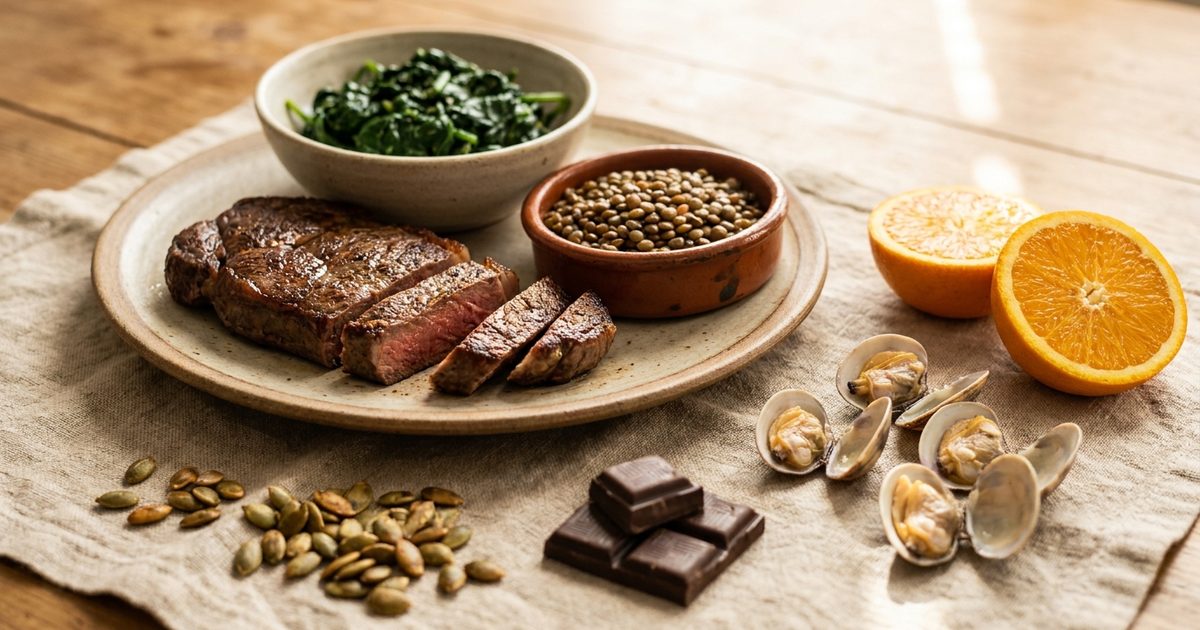
| 1 | Chicken liver, pan-fried | 3 oz (85g) | 11.0 mg | 146 | 7.5 mg | Heme + non-heme | 174491 |
| 2 | Fortified instant oatmeal, made with water | 1 packet, prepared (177g) | 10.5 mg | 120 | 8.8 mg | Non-heme | 171662 |
| 3 | Oysters, wild, cooked | 3 oz (85g) | 7.8 mg | 87 | 9.0 mg | Heme + non-heme | 171980 |
| 4 | White beans, boiled | 1 cup (179g) | 6.6 mg | 249 | 2.7 mg | Non-heme | 175203 |
| 5 | Lentils, boiled | 1 cup (198g) | 6.6 mg | 230 | 2.9 mg | Non-heme | 172421 |
| 6 | Mussels, cooked | 3 oz (85g) | 5.7 mg | 146 | 3.9 mg | Heme + non-heme | 174217 |
| 7 | Beef liver, pan-fried | 3 oz (85g) | 5.2 mg | 149 | 3.5 mg | Heme + non-heme | 168627 |
| 8 | Chickpeas, boiled | 1 cup (164g) | 4.7 mg | 269 | 1.8 mg | Non-heme | 173757 |
| 9 | Soybeans, boiled | 1/2 cup (86g) | 4.4 mg | 148 | 3.0 mg | Non-heme | 174271 |
| 10 | Dark chocolate, 70 to 85% | 1 oz (28g) | 3.4 mg | 170 | 2.0 mg | Non-heme | 170273 |
| 11 | Tofu, firm | 1/2 cup (126g) | 3.4 mg | 181 | 1.9 mg | Non-heme | 172475 |
| 12 | Spinach, boiled | 1/2 cup (90g) | 3.2 mg | 21 | 15.5 mg | Non-heme | 168463 |
| 13 | Ground beef, 95% lean, cooked | 3 oz (85g) | 2.7 mg | 164 | 1.7 mg | Heme + non-heme | 174028 |
| 14 | Sardines, canned in oil | 1 can (92g) | 2.7 mg | 191 | 1.4 mg | Heme + non-heme | 175139 |
| 15 | Tahini | 2 tbsp (30g) | 2.7 mg | 178 | 1.5 mg | Non-heme | 170189 |
| 16 | Pumpkin seeds | 1 oz (28g) | 2.5 mg | 158 | 1.6 mg | Non-heme | 170556 |
| 17 | Clams, canned, drained | 3 oz (85g) | 2.3 mg | 121 | 1.9 mg | Heme + non-heme | 171976 |
| 18 | Cashews, dry roasted | 1 oz (28g) | 1.7 mg | 163 | 1.0 mg | Non-heme | 170571 |
| 19 | Top sirloin steak, lean, cooked | 3 oz (85g) | 1.7 mg | 156 | 1.1 mg | Heme + non-heme | 168634 |
| 20 | Light tuna, canned in water | 3 oz (85g) | 1.3 mg | 99 | 1.3 mg | Heme + non-heme | 171986 |
What jumps out:
- Spinach wins per calorie at 15.5 mg per 100 calories, but it is non-heme iron, so pair it with vitamin C (see below).
- Oysters and chicken liver are the heavy hitters among animal foods. If you are pregnant, ask your doctor or midwife before making liver a regular thing.
- Fortified oatmeal is the budget, plant-based, toddler-friendly MVP. Fortified foods vary a lot by brand, so check your label.
- Steak is lower than its reputation. A lean 3 oz sirloin has 1.7 mg, less than half a cup of spinach. Its iron is better absorbed, though.
Many of these double as protein staples. See High Protein Foods and the cheapest protein foods for the other half of the plate.
A plant-based 18 mg day (worked example)
Here is how fast the plant foods add up, using the table above:
- Breakfast: fortified instant oatmeal, 1 packet: 10.5 mg
- Lunch: lentil soup with 1 cup lentils: 6.6 mg
- Snack: 1 oz pumpkin seeds: 2.5 mg
That is 10.5 + 6.6 + 2.5 = 19.6 mg for 120 + 230 + 158 = 508 calories. It clears 18 mg on paper. Remember that vegetarians need about 1.8 times the standard amount, so the absorption tricks below matter even more.
Does vitamin C help you absorb iron?
Yes. The NIH says your body absorbs plant iron better when you eat it with meat, poultry, seafood, or vitamin C foods like citrus, strawberries, sweet peppers, tomatoes, and broccoli. Researchers Hallberg and colleagues describe vitamin C as having a "key role" in non-heme iron absorption.
Easy vitamin C sidekicks (USDA FoodData Central):
| Food | Serving | Vitamin C | Calories | USDA FDC ID |
|---|---|---|---|---|
| Red bell pepper, raw | 1 small (74g) | 95 mg | 19 | 170108 |
| Strawberries, raw | 1 cup halves (152g) | 89 mg | 49 | 167762 |
| Orange, raw | 1 orange (131g) | 70 mg | 62 | 169097 |
| Kiwifruit, green | 1 fruit (69g) | 64 mg | 42 | 168153 |
| Broccoli, boiled | 1/2 cup (78g) | 51 mg | 27 | 169967 |
Try lentils with red pepper, oatmeal with strawberries, or tofu stir-fry with broccoli.
Should you avoid coffee and tea with iron-rich meals?
Timing helps. In a 1983 study in the American Journal of Clinical Nutrition, a cup of coffee with a hamburger meal cut iron absorption by 39%, and tea cut it by 64%. Coffee one hour before the meal caused no drop. Coffee one hour after the meal blocked absorption as much as drinking it with the meal.
A 1999 British Journal of Nutrition study found black tea reduced iron absorption from a bread meal by 79% to 94%, and herbal teas and cocoa also inhibited it. Adding milk barely changed the effect.
The practical version: if you are working on your iron, have your coffee or tea at least an hour before your iron-rich meal, or leave a good gap after. The studies above did not test longer gaps after meals, so more space is better. Calcium can also interfere, so the NIH suggests taking calcium and iron supplements at different times.
Should you just take an iron supplement?
Not on your own, and not in big doses. Get tested first. Here is why:
- The upper limit is 45 mg a day for adults (NIH, NHMRC, and Health Canada all agree). That covers food, drinks, and supplements together. A doctor may prescribe more for a while to treat a diagnosed deficiency, and that should be supervised.
- High doses cause side effects like upset stomach, constipation, nausea, and vomiting, and the NIH says extremely high doses can cause organ failure and death.
- Iron is dangerous for kids. The NIH says accidental overdose of iron products is a leading cause of fatal poisoning in children under 6. Keep supplements locked away.
- Some people already store too much. NHMRC notes up to 0.5% of the Caucasian population has the genetic setup for hereditary haemochromatosis, which causes iron overload. Self-supplementing could make that worse.
- Iron interacts with medicines, including levothyroxine and levodopa, per the NIH.
What iron tracking looks like in Nouri
I started with MyFitnessPal. The numbers were fine, but entering a normal dinner took several minutes, and after a long day I just wouldn't do it. That is why I built Nouri: fast enough that you actually track, honest enough that the numbers mean something. Iron numbers only help if the meals make it into the app.
For iron, here is what that looks like in practice. You type, say, or snap something like "lentil soup with spinach and a squeeze of lemon, and a slice of whole wheat toast." Nouri returns the calories, shows its per-item reasoning and a confidence rating for each one, and totals calories, protein, carbs, and fat. Then the per-meal vitamin scorecard shows how that meal did on vitamins A, C, and D, iron, and calcium. Forgot the pumpkin seeds on top? Add the context in a few words and it recalculates.
You can also do it hands-free from the lock screen: "Hey Siri, track food in Nouri." Handy when you are holding a baby or a hot mug of coffee that you are now, responsibly, drinking an hour before lunch. More on that in How to Track Food With Siri.
One honest line: Nouri is a food tracker, not a medical test. It can show you whether your meals are bringing iron. Only a blood test can show what is in your stores.
FAQ
Is ferritin face real?
"Ferritin face" is not a medical term and has no agreed definition. Iron deficiency is real and common, but pale skin and dark circles have many other causes. A blood test, not a mirror, tells you your iron status.
What does low ferritin look like?
Often, nothing at first. The NIH says low iron does not cause obvious symptoms in the short term because your body uses stored iron. Once anemia develops, tiredness, weakness, poor concentration, and feeling cold are common.
What blood test checks iron levels?
Doctors commonly check hemoglobin and hematocrit, and serum ferritin to measure your iron stores. Because inflammation can affect ferritin, they often use several measurements together. Ask your doctor which tests make sense for you.
How much iron does a woman need per day?
Women aged 19 to 50 need 18 mg a day, per the NIH, Health Canada, and Australia's NHMRC. That drops to 8 mg after 50, rises to 27 mg in pregnancy, and is 9 mg while breastfeeding.
What food has the most iron?
Per serving in our table, 3 oz of pan-fried chicken liver leads with 11.0 mg, followed by a packet of fortified instant oatmeal (10.5 mg) and 3 oz of cooked oysters (7.8 mg). Per calorie, boiled spinach wins at 15.5 mg per 100 calories.
What are the best iron foods for vegetarians?
Fortified oatmeal and cereals, white beans, lentils, chickpeas, soybeans, tofu, spinach, tahini, and pumpkin seeds. Pair them with vitamin C foods to boost absorption, since vegetarians need about 1.8 times as much iron.
Does coffee block iron absorption?
Yes, it can. In one study, coffee with a meal cut iron absorption by 39%, and tea by 64%. Coffee an hour before the meal had no effect, but an hour after still blocked absorption.
Is it safe to take iron supplements without a blood test?
It is best to get tested first. The adult upper limit is 45 mg a day from all sources, high doses cause side effects, and some people are prone to iron overload. A doctor can tell you whether you need a supplement and how much.
Why are women more likely to be low in iron?
Menstrual blood loss is the big reason. In the JAMA study of US females aged 12 to 21, menstruation was linked to both iron deficiency and iron deficiency anemia. Pregnancy also raises iron needs to 27 mg a day.
Can GLP-1 medications cause low iron?
There isn't a simple yes or no, but eating much less food makes it harder to hit every nutrient. Ask your prescriber about labs, prioritize iron-rich and protein-rich foods, and see our guide to protein on GLP-1s.
What is the easiest way to track iron in your meals?
Use a tracker that shows nutrients per meal without making you search a database. Nouri lets you type, say, snap, or Siri a meal in one sentence, then shows calories, protein, and a vitamin scorecard with iron for that meal.
Your face can't diagnose low iron, but your plate can help fix it, and a blood test can confirm it. Track a week of meals in Nouri to see how much iron you actually eat, build your plate around high protein foods that double as iron sources, and bring the results to your next doctor visit.
Sources
- NIH Office of Dietary Supplements, Iron: Fact Sheet for Consumers, ods.od.nih.gov/factsheets/Iron-Consumer (checked Oct 25, 2026)
- NIH Office of Dietary Supplements, Iron: Fact Sheet for Health Professionals, ods.od.nih.gov/factsheets/Iron-HealthProfessional (checked Oct 25, 2026)
- Health Canada, Dietary Reference Intakes Tables: Reference values for elements, canada.ca (checked Oct 25, 2026)
- NHMRC, Nutrient Reference Values for Australia and New Zealand: Iron, eatforhealth.gov.au (checked Oct 25, 2026)
- Weyand AC et al., "Prevalence of Iron Deficiency and Iron-Deficiency Anemia in US Females Aged 12-21 Years, 2003-2020," JAMA, 2023, pmc.ncbi.nlm.nih.gov/articles/PMC10300696 (checked Oct 25, 2026)
- Morck TA, Lynch SR, Cook JD, "Inhibition of food iron absorption by coffee," American Journal of Clinical Nutrition, 1983, pubmed.ncbi.nlm.nih.gov/6402915 (checked Oct 25, 2026)
- Hurrell RF, Reddy M, Cook JD, "Inhibition of non-haem iron absorption in man by polyphenolic-containing beverages," British Journal of Nutrition, 1999, pubmed.ncbi.nlm.nih.gov/10999016 (checked Oct 25, 2026)
- Hallberg L, Brune M, Rossander L, "The role of vitamin C in iron absorption," International Journal for Vitamin and Nutrition Research Supplement, 1989, pubmed.ncbi.nlm.nih.gov/2507689 (checked Oct 25, 2026)
- The Guardian, "Ferritin face: the new health scare taking social media by storm," September 16, 2026, theguardian.com (checked Oct 25, 2026)
- The Washington Post, "What 'ferritin face' means, and how to tell if you may be iron-deficient," September 15, 2026; Reader's Digest, "Could You Have 'Ferritin Face'? These Are the 2 Signs, According to TikTok," October 19, 2026; CNN, "Forget 'ferritin face': experts explain the truth about iron deficiency," October 23, 2026, via Google News (checked Oct 25, 2026)
- USDA FoodData Central, SR Legacy: Chicken liver, pan-fried (FDC 174491), fdc.nal.usda.gov/food-details/174491/nutrients; Oats, instant, fortified, prepared with water (FDC 171662), fdc.nal.usda.gov/food-details/171662/nutrients; Oyster, eastern, wild, cooked, moist heat (FDC 171980), fdc.nal.usda.gov/food-details/171980/nutrients; Beans, white, boiled (FDC 175203), fdc.nal.usda.gov/food-details/175203/nutrients; Lentils, boiled (FDC 172421), fdc.nal.usda.gov/food-details/172421/nutrients; Mussel, blue, cooked (FDC 174217), fdc.nal.usda.gov/food-details/174217/nutrients; Beef liver, pan-fried (FDC 168627), fdc.nal.usda.gov/food-details/168627/nutrients (checked Oct 25, 2026)
- USDA FoodData Central, SR Legacy: Chickpeas, boiled (FDC 173757), fdc.nal.usda.gov/food-details/173757/nutrients; Soybeans, boiled (FDC 174271), fdc.nal.usda.gov/food-details/174271/nutrients; Chocolate, dark, 70-85% cacao (FDC 170273), fdc.nal.usda.gov/food-details/170273/nutrients; Tofu, raw, firm (FDC 172475), fdc.nal.usda.gov/food-details/172475/nutrients; Spinach, boiled (FDC 168463), fdc.nal.usda.gov/food-details/168463/nutrients; Beef, ground, 95% lean, crumbles, pan-browned (FDC 174028), fdc.nal.usda.gov/food-details/174028/nutrients; Sardine, Atlantic, canned in oil (FDC 175139), fdc.nal.usda.gov/food-details/175139/nutrients (checked Oct 25, 2026)
- USDA FoodData Central, SR Legacy: Tahini, roasted kernels (FDC 170189), fdc.nal.usda.gov/food-details/170189/nutrients; Pumpkin seed kernels, dried (FDC 170556), fdc.nal.usda.gov/food-details/170556/nutrients; Clam, canned, drained (FDC 171976), fdc.nal.usda.gov/food-details/171976/nutrients; Cashews, dry roasted (FDC 170571), fdc.nal.usda.gov/food-details/170571/nutrients; Top sirloin, lean, broiled (FDC 168634), fdc.nal.usda.gov/food-details/168634/nutrients; Tuna, light, canned in water (FDC 171986), fdc.nal.usda.gov/food-details/171986/nutrients (checked Oct 25, 2026)
- USDA FoodData Central, SR Legacy: Peppers, sweet, red, raw (FDC 170108), fdc.nal.usda.gov/food-details/170108/nutrients; Strawberries, raw (FDC 167762), fdc.nal.usda.gov/food-details/167762/nutrients; Oranges, raw (FDC 169097), fdc.nal.usda.gov/food-details/169097/nutrients; Kiwifruit, green, raw (FDC 168153), fdc.nal.usda.gov/food-details/168153/nutrients; Broccoli, boiled (FDC 169967), fdc.nal.usda.gov/food-details/169967/nutrients (checked Oct 25, 2026)
Keep reading
All articlesAdvent Calendar Calories 2026: 10 Chocolate Calendars Ranked (Lindt, Cadbury and More)
Chocolate advent calendars run 11 to 66 calories a door, or 258 to 1,577 for the whole box, on the brands' own labels. All 10 ranked, kJ included.
FoodsNurri vs Fairlife vs Premier: Costco Protein Shakes Ranked by Protein, Calories and Price
Nurri and Fairlife Nutrition Plan both pack 30g protein in 150 calories. At Costco, Nurri runs $1.77 a can vs $2.22. Every shake, ranked.
FoodsAre Nutrition Labels Accurate? Why Your Trader Joe's Frozen Meal Might Weigh 37% More
A Trader Joe's tikka masala labeled 241g weighed 331g, 37% more. FDA lets calories run up to 20% over the label. What's legal and how to track it.
FoodsCalories in Coffee: Every Creamer, Milk, Sugar, and Syrup Add-In
Black coffee is about 2 calories a cup by USDA data. What milk, cream, sugar, creamer, syrup, and butter add, plus the per-week and per-year math.