

Are Nutrition Labels Accurate? Why Your Trader Joe's Frozen Meal Might Weigh 37% More
A Trader Joe's tikka masala labeled 241g weighed 331g, 37% more. FDA lets calories run up to 20% over the label. What's legal and how to track it.
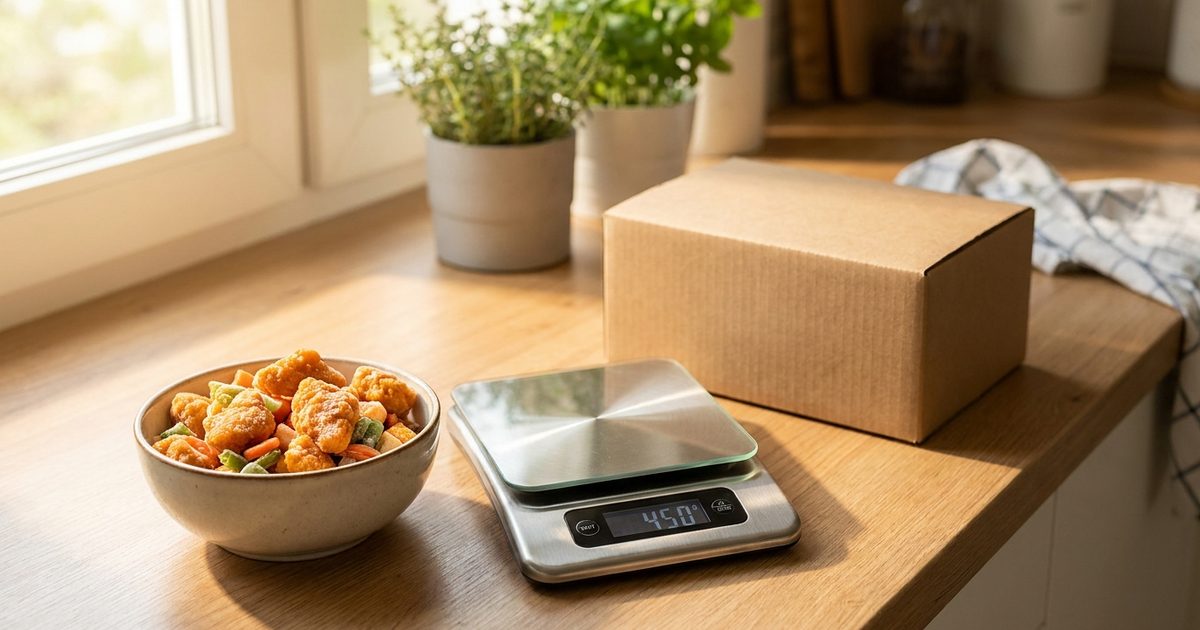
Nutrition labels are close, not exact. The FDA treats a packaged food as misbranded only if its calories come in more than 20% above the label, so a 360-calorie meal can legally test up to 432. One Redditor's Trader Joe's Chicken Tikka Masala, labeled 241 g, weighed 331 g: 37% more food than the tray promised.
What happened with the Trader Joe's frozen meal?
In September 2026, a post on r/1200isplenty titled "Trader Joe's frozen meals: has anyone else noticed the weight is way over the label?" hit 328 upvotes and 57 comments. The poster heated a Trader Joe's Chicken Tikka Masala, tipped it into a bowl on a tared scale, and got about 331 g.
The label, which we checked on Trader Joe's own product page today, says what they said it says:
| Label detail | Trader Joe's Chicken Tikka Masala |
|---|---|
| Serving size | 1 tray (241 g / 8.5 oz) |
| Servings | Serves 1 |
| Calories | 360 |
| Protein | 21 g |
| Fat | 14 g |
| Carbs | 39 g |
| Sodium | 580 mg |
331 g is 90 g more than 241 g, which is 37% over the label. If the extra food had the same calorie density as the rest of the tray, that would be about 494 calories instead of 360, roughly 134 calories you never tracked.
Two honest caveats, and the poster raised the first one themselves:
- Weight is not calories. Extra grams could be extra sauce, extra rice, or extra water. Only a lab can say how many calories were really in that tray.
- Heating usually removes water, it doesn't add it. So a heated meal weighing more than the frozen label is a real signal that the tray held more food, not a microwave quirk.
One commenter put the stakes well: if you run a 250-calorie daily deficit, an extra 130 or so calories at dinner eats about half of it.
Are nutrition labels accurate?
Mostly, on average, with a margin. In the US, the FDA's compliance rule, 21 CFR 101.9(g), works like this:
- The FDA builds a composite from 12 units, one from each of 12 randomly chosen shipping cases in a lot.
- Calories, total sugars, added sugars, total fat, saturated fat, trans fat, cholesterol, and sodium count as misbranded only if the composite is "greater than 20 percent in excess" of the label.
- Protein, fiber, vitamins, and minerals that occur naturally must be at least 80% of the label.
- Being under the label on calories and fat is treated as a "reasonable deficiency," acceptable under good manufacturing practice.
Read that again from a manufacturer's point of view: going over on calories has a ceiling, going under does not get punished. And the 20% is judged on a 12-unit average, so one heavy tray in your freezer is not automatically a violation.
What about the net weight on the package?
That is a separate rule, 21 CFR 101.7(q). The net quantity must be "an accurate statement," with "reasonable variations" allowed for moisture loss and "unavoidable deviations in good manufacturing practice," and variations "shall not be unreasonably large." A commenter in the Reddit thread made the practical point: companies get in trouble for underfilling, so production lines tend to run a little heavy. Great for your wallet, sneaky for your tracking.
What does the research say about frozen meal calories?
The best-known study here is from Tufts. Urban and colleagues (Journal of the American Dietetic Association, 2010) measured reduced-calorie foods in a lab:
| What they tested | Measured vs stated calories |
|---|---|
| 10 supermarket frozen meals | Averaged 8% more than the label |
| 29 quick-serve and sit-down restaurant foods | Averaged 18% more than stated |
| Some individual restaurant items | Up to 200% of the stated value |
| Free side dishes with restaurant entrees | Raised total energy to an average of 245% of the entree's stated value |
The authors noted most packaged items still fell inside the FDA's 20% allowance. Their worry was the practical one: small, consistent overages make self-monitoring harder.
A larger follow-up by the same group (JAMA, 2011) bomb-calorimetry tested 269 restaurant foods from 42 restaurants. Overall, stated calories were accurate on average, but 19% of items had at least 100 calories more than listed, and lower-calorie items tended to be understated. In plain English: the "light" options were the ones most likely to be heavier than advertised.
So the pattern across studies is consistent. Labels are honest on average and wobbly item by item, and the wobble leans toward more, not less.
Are labels more accurate in Canada or Australia?
Canada: the Canadian Food Inspection Agency's Nutrition Labelling Compliance Test uses the same 20% idea. For naturally occurring nutrients, the lab result must be at least 80% of the label for protein, carbs, fibre, vitamins and minerals, and not more than 120% for Calories, fat, saturated fat, trans fat, cholesterol, sugars and sodium. CFIA averages three composite samples of four units each.
Australia and New Zealand: FSANZ says a nutrition information panel shows the "average quantity" of energy (in kilojoules, sometimes kJ and kcal) and key nutrients per serving and per 100 g. We could not find a fixed percentage tolerance on FSANZ's consumer pages, so we won't invent one. The takeaway is the same: a label is an average, not a promise about the pack in your hand. Quick conversion for Woolies and Coles labels: kcal = kJ divided by 4.184.
Should you weigh frozen meals?
Only if precision really matters to you right now. Here is the honest decision guide:
- Weigh it if you are dialing in a small deficit, prepping for a competition, or a dietitian asked you to. Weigh the food frozen, before heating, and compare to the label grams.
- Just track the package if you eat the whole tray and your goal is general awareness. Consistency beats precision: tracking "1 tray" every time still shows your patterns.
- Add a small buffer if you are curious but not obsessive. One commenter rounds packaged items up a bit, for example 241 g to 250 g.
- Watch your weekly average, not one meal. If your trend matches your plan, your labels are close enough.
If weighing food or checking labels starts to feel stressful or compulsive, that is a signal to step back. Anyone with a history of disordered eating should work with a doctor or registered dietitian before tracking calories closely.
More on this: why calorie tracking apps are inaccurate and how to track calories without weighing food.
What are the best high-protein Trader Joe's frozen buys?
Every number below comes from the nutrition panel on each product's traderjoes.com page, checked Oct 25, 2026. We ranked by protein per 100 calories. Labels are per serving as Trader Joe's lists them, so check how many servings you actually eat.
| Rank | Trader Joe's product | Serving (label) | Calories | Protein | Protein per 100 cal |
|---|---|---|---|---|---|
| 1 | Grilled Chicken Strips | 3 oz (84 g) | 110 | 20 g | 18.2 g |
| 2 | Premium Salmon Burgers | 1 burger | 100 | 15 g | 15.0 g |
| 3 | Grilled Chimichurri Chicken Thigh Skewers | 2 skewers (99 g) | 140 | 19 g | 13.6 g |
| 4 | BBQ Teriyaki Chicken | 1 cup frozen (150 g) | 240 | 31 g | 12.9 g |
| 5 | Turkey Burgers | 1 burger (112 g) | 180 | 22 g | 12.2 g |
| 6 | Beef Birria | 1 cup (227 g) | 280 | 32 g | 11.4 g |
| 7 | Chicken Mole | 5 oz (140 g) | 190 | 20 g | 10.5 g |
| 8 | Kung Pao Chicken | 1 cup (150 g) | 240 | 24 g | 10.0 g |
| 9 | Egg Frittata | 2 frittatas (140 g) | 270 | 25 g | 9.3 g |
| 10 | Middle Eastern Style Kebabs | 4 oz (112 g) | 220 | 19 g | 8.6 g |
| For reference | Mandarin Orange Chicken | 1 cup (163 g) | 320 | 22 g | 6.9 g |
| For reference | Chicken Tikka Masala | 1 tray (241 g) | 360 | 21 g | 5.8 g |
A few notes from the panels:
- Beef Birria packs the most protein per serving (32 g) but also 1,090 mg sodium per cup.
- Grilled Chicken Strips are the leanest building block: toss them on a salad, wrap, or rice bowl.
- Mandarin Orange Chicken is a fan favorite, not a protein champion, and 16 g of its sugars per serving are added sugars. Love it anyway, just track it.
Want more ideas? See our high protein foods list, high protein snacks, and the Fast Food Protein Index. Not sure how much you need? Try the protein intake calculator.
How do you track a Trader Joe's frozen meal fast?
Here is my bias, out loud: I build Nouri, and I built it because of exactly this kind of gap. I used MyFitnessPal first, and the numbers were fine, but tracking a normal dinner took long enough that I stopped. Then I tried AI photo trackers. When I added up real ingredients against the camera's guess, a plate it called around 400 calories worked out closer to 700. A camera cannot see the oil, and it cannot see the extra 90 grams hiding in a tray.
In Nouri you just say what happened, the way you'd text a friend:
"A Trader Joe's mandarin orange chicken, about half the bag"
Nouri shows the per-item reasoning behind its estimate and a confidence rating. You can see what it assumed about the portion, then add context like "plus a cup of white rice" or "I ate the whole sauce packet" and it recalculates. For scale: the bag is 22 oz (about 624 g), so half is about 312 g, which works out to about 610 calories and 42 g protein from the label's per-gram numbers.
You can type it, say it, snap a photo (Nouri turns it into a sentence first so you can read what it saw), or use Siri from the lock screen: "Hey Siri, track food in Nouri." Nouri scored 92.1/100 in our 100-meal accuracy benchmark (MyFitnessPal 77.0). It is iPhone (iOS only).
FAQ
Are nutrition labels accurate?
They are accurate on average, within a legal margin. In the US, calories, fat, sugars, and sodium can run up to 20% above the label before the FDA treats the food as misbranded, based on a 12-unit composite. Individual packages can vary more.
How much can calories legally differ from the label?
Under 21 CFR 101.9(g)(5), a food is misbranded if its calories test more than 20% above the declared value. So a 360-calorie meal could legally average up to 432 calories. Coming in under the label is generally allowed.
Why does my Trader Joe's frozen meal weigh more than the label?
Manufacturers face penalties for underfilling, so lines often run slightly heavy, and the FDA's net-weight rule allows reasonable variation. The Reddit poster's tray weighed 331 g against a 241 g label, 37% over, which is larger than typical. Weigh it frozen to confirm.
Do more grams always mean more calories?
Not always. Extra grams could be water, sauce, or rice, and each carries different calories. But heating usually removes water, so a heated meal that outweighs the label likely contains more food.
How accurate are frozen meal calorie labels?
In a 2010 Tufts study, 10 supermarket frozen meals averaged 8% more calories than stated, while 29 restaurant foods averaged 18% more. Most frozen meals still fell inside the FDA's 20% allowance.
Are restaurant calorie counts accurate?
On average, yes, but not item by item. A 2011 JAMA study of 269 restaurant foods found 19% contained at least 100 calories more than stated, and lower-calorie items were the most likely to be understated.
What is the label tolerance in Canada?
The CFIA's compliance test allows Calories, fat, saturated fat, trans fat, cholesterol, sugars and sodium up to 120% of the declared value. Protein, carbs, fibre, vitamins and minerals must be at least 80%.
Should I weigh frozen meals for calorie counting?
Only if precision matters for your goal right now. Weigh the food frozen and compare it to the label grams. For general tracking, tracking the whole package consistently works well.
Should I weigh frozen food before or after cooking?
Before, because the label grams refer to the product as sold. Cooking changes water weight, so after-cooking weights won't match the label even when the portion is correct.
What is the highest-protein Trader Joe's frozen food?
By protein per calorie, Grilled Chicken Strips lead our table at 20 g protein for 110 calories per 3 oz. By protein per serving, Beef Birria has 32 g per cup, with 280 calories.
How many calories are in half a bag of Trader Joe's Mandarin Orange Chicken?
The label lists 320 calories per 163 g cup and about 4 servings in a 22 oz bag. Half the bag by weight is about 312 g, or about 610 calories and 42 g protein.
What is the easiest way to track Trader Joe's frozen meals?
Describe it in one sentence. In Nouri, "a Trader Joe's mandarin orange chicken, about half the bag" becomes a per-item breakdown with reasoning and a confidence rating, and you can add "plus rice" to recalculate.
Nutrition labels are a good-faith average with a 20% cushion, and that cushion usually leans toward more food, not less. Track the package, weigh it when it matters, and judge your progress by the weekly trend. If you want the fast version, Nouri turns "about half the bag" into real numbers in seconds. Shopping the Costco aisles too? See Costco food court calories.
Sources
- Reddit r/1200isplenty, "Trader Joe's frozen meals: has anyone else noticed the weight is way over the label?" (328 upvotes, 57 comments), reddit.com/r/1200isplenty/comments/1wrnxb8 (checked Oct 25, 2026)
- US eCFR, 21 CFR 101.9(g), Nutrition labeling of food: compliance, ecfr.gov/current/title-21/section-101.9 (checked Oct 25, 2026)
- US eCFR, 21 CFR 101.7(q), Declaration of net quantity of contents, ecfr.gov/current/title-21/section-101.7 (checked Oct 25, 2026)
- Urban LE et al., "The accuracy of stated energy contents of reduced-energy, commercially prepared foods," Journal of the American Dietetic Association, 2010, PMID 20102837, pubmed.ncbi.nlm.nih.gov/20102837 and full text pmc.ncbi.nlm.nih.gov/articles/PMC2838242 (checked Oct 25, 2026)
- Urban LE et al., "Accuracy of stated energy contents of restaurant foods," JAMA, 2011, PMID 21771989, pubmed.ncbi.nlm.nih.gov/21771989 (checked Oct 25, 2026)
- Canadian Food Inspection Agency, Nutrition labelling compliance test, inspection.canada.ca (checked Oct 25, 2026)
- Food Standards Australia New Zealand, Nutrition information panels, foodstandards.gov.au/consumer/labelling/panels (checked Oct 25, 2026)
- Trader Joe's product pages (nutrition panels): Chicken Tikka Masala, Mandarin Orange Chicken, Grilled Chicken Strips, Premium Salmon Burgers, Grilled Chimichurri Chicken Thigh Skewers, BBQ Teriyaki Chicken, Turkey Burgers, Beef Birria, Chicken Mole, Kung Pao Chicken, Egg Frittata, Middle Eastern Style Kebabs (checked Oct 25, 2026)
Keep reading
All articlesAdvent Calendar Calories 2026: 10 Chocolate Calendars Ranked (Lindt, Cadbury and More)
Chocolate advent calendars run 11 to 66 calories a door, or 258 to 1,577 for the whole box, on the brands' own labels. All 10 ranked, kJ included.
Foods'Ferritin Face' Is Trending: What Low Iron Actually Looks Like, and the Foods That Fix It
Your face can't diagnose low iron, but a ferritin blood test can. Women 19 to 50 need 18 mg a day. 20 iron-rich foods ranked with USDA data.
FoodsNurri vs Fairlife vs Premier: Costco Protein Shakes Ranked by Protein, Calories and Price
Nurri and Fairlife Nutrition Plan both pack 30g protein in 150 calories. At Costco, Nurri runs $1.77 a can vs $2.22. Every shake, ranked.
FoodsCalories in Coffee: Every Creamer, Milk, Sugar, and Syrup Add-In
Black coffee is about 2 calories a cup by USDA data. What milk, cream, sugar, creamer, syrup, and butter add, plus the per-week and per-year math.