
What Is Natural-Language Food Logging? (Type a Sentence, Get Your Calories)
Natural-language food logging: type a sentence like you would in Apple Notes, get calories and macros back. How it works, 5 studies, and apps that do it.
Natural-language food logging means tracking what you eat by typing one normal sentence, like "two scrambled eggs, toast with butter and a cappuccino," and letting AI turn it into calories and macros. An app built around it is called a notes-style calorie tracker. Nouri is one: it scored 92.1/100 in our 100-meal accuracy benchmark (MyFitnessPal 77.0).
The idea is simple: you already know what you ate, so you should be able to say it once, in your own words, instead of searching a database five times.
What does "natural-language food logging" mean?
"Natural language" is the computer science term for the way people actually talk, as opposed to menus, codes and dropdowns. Applied to calorie tracking, it means the input is a sentence, not a form. You write "chicken burrito bowl, double chicken, no rice, guac" and the app does the work of splitting it into foods, guessing portions, and adding up the numbers.
A notes-style calorie tracker is an app where that sentence is the main way to track food. The screen looks more like Apple Notes than a spreadsheet: a list of meals written in plain words, each with its calories next to it. We wrote a separate guide on using Apple Notes itself as a calorie tracker; a notes-style app is that same habit with the math done for you.
The differences from older trackers: one entry per meal instead of per ingredient, rough portions like "a big bowl" are allowed, and a good app shows how it got each number.
How does it work, step by step?
Take the sentence from the title: "two scrambled eggs, toast with butter and a cappuccino." Here is what a natural-language tracker does with it.
- It reads the sentence and finds the foods. A large language model (the same family of AI behind ChatGPT) splits the text into items: scrambled eggs, toast, butter, cappuccino. It knows "toast with butter" is one bread item plus one fat, not a dish called "toast with butter."
- It works out portions. "Two" is explicit. "Toast" with no number usually means one slice. "Butter" gets a typical spread amount. "Cappuccino" gets a standard cafe size and milk unless you say otherwise.
- It accounts for cooking. "Scrambled" means fat in the pan, which a plain "two eggs" would miss.
- It estimates calories and macros per item. Each item gets calories, protein, carbs and fat, then they are totaled.
- It shows its reasoning. The best apps show what they assumed for each item, so "1 slice white bread" or "medium cappuccino, whole milk" is right there on the screen.
- You correct it in plain words. If the toast was sourdough or the cappuccino was oat milk, you say so and it recalculates. No re-searching.
Step 5 is the one to look for. In Nouri, every item comes back with its reasoning and a confidence rating, so a low-confidence guess is visible instead of buried in a total.
Why do the details in your sentence matter so much?
Because the estimate can only price the meal you describe. Here is the same breakfast written two ways, using USDA FoodData Central values:
| What you typed | Item math | Calories |
|---|---|---|
| "Two eggs and toast" | 2 large eggs (143) + 1 slice white bread (77) | 220 |
| "Two eggs scrambled in a teaspoon of butter, one slice of toast with a tablespoon of butter" | 143 + 34 + 77 + 102 | 356 |
Same plate, 136 calories apart, and all of it is butter. That is not the AI being wrong in the first row. It answered the sentence it got. This is why the tips section below matters more than which app you pick.
Notes-style vs database search vs barcode vs photo
There are four basic ways a calorie app can turn food into numbers. Our text vs voice vs photo guide covers which input fits which moment of your day. This table is about the underlying approach: how each one gets to a number, and where it holds up.
| Approach | Speed | Effort | Accurate when | Fuzzy when |
|---|---|---|---|---|
| Notes-style (natural language) | Fast: one sentence per meal | Low | You include portions, cooking fat and brands | The sentence is vague ("chicken and rice") |
| Database search | Slow: one search per ingredient | High | You pick the right entry and weigh portions | Entries are duplicated or user-added; you guess the portion anyway |
| Barcode scan | Fast for one packaged item | Low per item, high per meal | Packaged food, eaten in label-sized servings | Home cooking, restaurants, anything without a label |
| Photo | Fast | Low | Clearly laid-out plates where every item is visible | Oil, butter, sauces, and food hidden inside or under other food |
A few honest notes on that table:
- Database search is not automatically precise. A 2024 study in Nutrients tested 16 manual food-logging apps against food records. Energy was overestimated for a Western diet by an average of 1,040 kJ (about 249 calories) and underestimated for an Asian diet by 1,520 kJ (about 363 calories). Picking entries from a list still involves guessing.
- Barcodes are great for the bar, not the bowl. Nouri does not have a barcode scanner. For packaged food, typing "Quest cookies and cream bar" gets you there without hunting for the barcode, and a home-cooked dinner never had one anyway.
- Photos see the top, not the pan. Our AI accuracy roundup covers the photo studies in detail. Natural language fixes the blind spot because you can write "cooked in olive oil."
How accurate is natural-language food logging?
Accurate enough to be useful, with known weak spots. Here is what peer-reviewed studies say, read at the source on PubMed today. Most AI nutrition research has tested photos; text-based studies are newer.
| Study | What was tested | What they found |
|---|---|---|
| Haman et al., Nutrition, 2024 | ChatGPT, text questions about foods | 97% of energy values within 40% of USDA data, with relatively consistent answers |
| Lawabni et al., Journal of Nutrition, 2026 | 4 AI models given common US foods as text | High agreement with a research database for energy and macros; condiments and mixed dishes caused the most variability; micronutrients less reliable |
| Rodríguez-Jiménez et al., Nutrients, 2025 | ChatGPT-5 on 195 dishes, with more context added step by step | Accuracy improved as non-visual details and ingredient amounts were added |
| López Torres et al., Nutrients, 2026 | 13,073 free-text meal records from 513 adults | Repeat descriptions of the same meal did not always get the same energy estimate; consistency was lower when photos were involved |
| Li et al., Nutrients, 2024 | 16 manual database-logging apps | Energy over- or underestimated by roughly 250 to 360 calories depending on the diet |
The pattern: calories and macros are the strong part, while vitamins, sauces and mixed dishes are the weak part. That is exactly where a sentence helps, because you can name the sauce, and the 2025 ChatGPT-5 study found more context meant better numbers. The consistency finding matters too: the same meal can get a different estimate on different days, so reuse saved entries for meals you eat every week.
For Nouri specifically, the only number we publish is our own test: 92.1/100 in our 100-meal accuracy benchmark (MyFitnessPal 77.0). The method and every meal are on that page. For how general-purpose chatbots compare, see Can ChatGPT Count Your Calories?
Why I built Nouri around a sentence
I used MyFitnessPal first, and honestly the numbers were never the issue. The issue was that a normal dinner meant five searches, five portion pickers, and several minutes I did not have at 9pm. By week three I had stopped. A perfect database is worth nothing if the app stays closed.
Then I tried AI photo apps. Fast, which fixed the habit, but my weight was not moving. When I added up the actual ingredients, a plate the camera called about 400 calories was closer to 700. The oil and the portion under the garnish were invisible.
So Nouri treats a sentence as the source of truth. Even a photo becomes a sentence first. I snapped a breakfast plate and Nouri wrote back "Two poached eggs on avocado toast, bacon, scrambled eggs, and fresh fruit bowl" before counting anything: four items, 850 calories, 42g protein. Reading that line is where you catch what the camera missed. Typing is just skipping straight to the good part.
Tips for writing better food sentences
You do not need to write like a nutrition label. You need to include the four things that move the number most.
- Quantities. "Two eggs," "a large bowl," "half the pizza," "about a cup of rice." Rough is fine. Missing is not. Our guide on tracking without weighing food has hand-size shortcuts.
- Brands and chains. "Chipotle chicken burrito bowl" or "Starbucks grande oat latte" beats "burrito bowl" or "latte," because the AI can lean on what that product usually contains.
- Cooking method. Grilled, fried, roasted, scrambled, breaded. "Fried chicken thigh" and "grilled chicken thigh" are different meals.
- Oils, butter and sauces. The single biggest fix. "Cooked in a tablespoon of olive oil," "with ranch," "buttered." See the 136-calorie butter gap above.
Also: add drinks to the same sentence ("and a cappuccino" costs three words), and say what you left ("ate about half the fries" is a valid portion).
Who is natural-language food logging for?
- Busy people. If tracking failed because it took too long, one sentence per meal removes the main reason people quit. Our most frictionless calorie tracker guide goes deeper.
- People with ADHD. A blank text box with no menus is kinder to working memory than a five-step search. See calorie tracking with ADHD.
- People who quit MyFitnessPal. If you liked having the numbers but hated the searching, this is the same goal with less admin. Our MyFitnessPal alternatives guide compares options.
- Restaurant regulars. You already said the order out loud; type it back. More in how to log restaurant meals.
It is less ideal if you need lab-grade precision, for example under a dietitian's weighed-food protocol. Use a scale and a database for that. And if you have a history of disordered eating, please work with a professional before tracking anything.
Which apps do natural-language food logging?
Several now do, and they differ mostly in what else they offer. All facts below are from each app's own App Store listing or website, checked today. For a fuller ranking, see our best notes-style calorie tracker guide, and for this year's launches, new calorie tracking apps.
Nouri
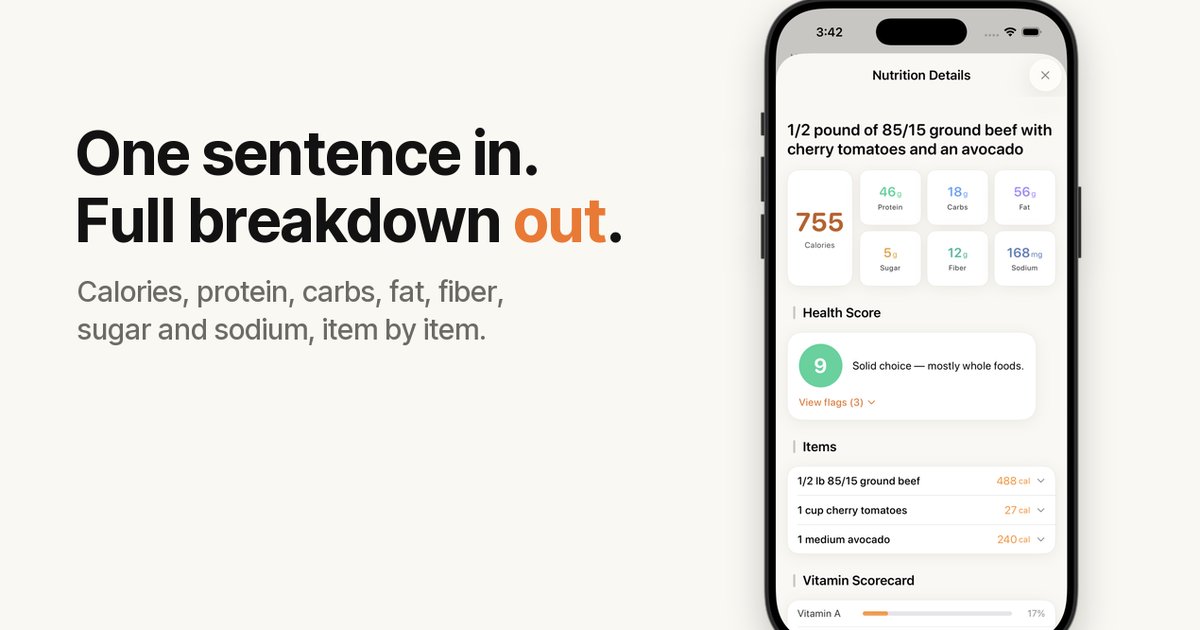
Nouri is a notes-style AI calorie tracker for iPhone. You type what you ate in a full sentence and get calories and macros per item, with reasoning and a confidence rating you can correct in plain words. It also takes voice, photo (turned into a sentence first) and Siri from the lock screen: say "Hey Siri, track food in Nouri," answer in one sentence, and a calories and macros card appears. Details on that in how to log food with Siri.
Nouri syncs with Apple Health both ways and sends weekly Nouri Reports with your averages against your targets, days on target, wins, slips and one clear focus. Most calorie apps give you numbers. Nouri gives you answers. No barcode scanner. iPhone (iOS only), $9.99/month or $39.99/year after a 3-day free trial.
Amy Food Journal
Amy is built by indie developer Chris Raroque, and it is the closest match to Nouri's idea. Its App Store listing says you "simply type the food you ate, like you would in Apple Notes." Its help center also covers photo, barcode and voice logging, Siri ("Log food in Amy"), an Apple Watch app, and a thought process view with a confidence level for each entry, which you can fix by typing what's different. It runs on iPhone, iPad, Mac, Apple Watch and Vision Pro, with subscriptions of $9.99 a month or $99.99 a year, and is rated 4.0 from 37 ratings. A strong pick if you want a notes-style journal across many Apple devices, Apple Watch included.
Also worth knowing
Foodnoms says you can "snap a pic or type a short summary of your food" with its AI logging. MyNetDiary offers AI voice logging, "describe what you ate and it logs for you," as part of its Premium Plus upgrade. Both are full database trackers with natural language added on, rather than notes-style apps.
Burnie
Burnie: AI Calorie Tracker is a newer app, released on the App Store in September 2026. Its listing says: "Type a meal, say it out loud, take a photo, or scan a barcode," and it also tracks water and weight and syncs with Apple Health. It runs on iPhone, Mac and Vision Pro, with subscriptions of $2.99 a week, $9.99 a month or $79.99 a year, and has a 4.8 rating from 5 ratings so far. Worth a look if you want an all-in-one with a barcode scanner.
FAQ
What is natural-language food logging?
It is tracking food by typing or saying a normal sentence, like "turkey sandwich and an apple," instead of searching a database item by item. AI identifies each food, estimates portions, and returns calories and macros.
What is a notes-style calorie tracker?
A calorie app where you write meals like quick notes, in plain words, and the app calculates the numbers. Nouri is a notes-style calorie tracker, and Amy Food Journal is another.
Is natural-language food logging accurate?
For calories and macros, peer-reviewed studies are encouraging: a 2026 Journal of Nutrition study found high agreement between AI text estimates and a research database. Accuracy drops for vague sentences, sauces and mixed dishes, so include portions and cooking fat.
Is typing a meal faster than searching a food database?
Usually, because one sentence replaces a separate search and portion pick for every ingredient. A five-item dinner is one line instead of five lookups.
Can I just use ChatGPT for natural-language calorie counting?
You can get estimates, but ChatGPT keeps no structured daily log, targets or history for you. Our ChatGPT calorie counting guide covers what works and a prompt that helps.
What should I include in my food sentence?
Quantity, brand or restaurant, cooking method, and any oil, butter or sauce. Those four details move the number the most.
Does natural-language logging work for restaurant meals?
Yes, and it is one of the best uses. Type the order exactly as you said it to the server, including the chain name and any extras.
Can I log food by voice instead of typing?
In most notes-style apps, yes. Speaking a sentence produces the same text a typed one would. Nouri and Amy both support Siri too; in Nouri, say "Hey Siri, track food in Nouri" from the lock screen without opening the app.
Do natural-language calorie apps scan barcodes?
Some do. Amy and Burnie list barcode scanning; Nouri does not, and instead lets you type the product name, like "Kind dark chocolate nuts bar."
What if the app gets an item wrong?
Correct it in plain words, such as "the toast was sourdough" or "half portion," and recalculate. Apps that show per-item reasoning make wrong guesses easy to spot.
Is natural-language food logging good for ADHD?
Many people with ADHD find a single text box easier than multi-step searches, because there is less to hold in your head. See our ADHD calorie tracking guide for more.
What is the easiest way to track calories with natural-language logging?
Use Nouri. Type what you ate in one sentence, like a note, and get calories and macros with reasoning per item, or say it to Siri from the lock screen. Apple Health syncs both ways, and a weekly Nouri Report shows how it all added up.
Natural-language food logging is calorie tracking at the speed of a text message, and the better your sentence, the better your number. If you want to try it, Nouri is built around exactly that. To go deeper, read how accurate AI calorie apps are in 2026 and our text vs voice vs photo guide.
Sources
- Haman M, Školník M, Lošťák M. "AI dietician: Unveiling the accuracy of ChatGPT's nutritional estimations." Nutrition, 2024. pubmed.ncbi.nlm.nih.gov/38194819 (checked Nov 1, 2026)
- Lawabni R et al. "Evaluation of Energy and Nutrient Estimates from Large Language Models Using Text-Based Queries." Journal of Nutrition, 2026. pubmed.ncbi.nlm.nih.gov/42401322 (checked Nov 1, 2026)
- Rodríguez-Jiménez M et al. "Image-Based Dietary Energy and Macronutrients Estimation with ChatGPT-5: Cross-Source Evaluation Across Escalating Context Scenarios." Nutrients, 2025. pubmed.ncbi.nlm.nih.gov/41305663 (checked Nov 1, 2026)
- López Torres JF, Castañeda JG, Rivas E. "Internal Consistency Does Not Validate an LLM-Assisted Nutrition Pipeline: A Reference-Standard-Free Forensic Reliability Audit of 13,073 Free-Text Meal Records." Nutrients, 2026. pubmed.ncbi.nlm.nih.gov/42884684 (checked Nov 1, 2026)
- Li X et al. "Evaluating the Quality and Comparative Validity of Manual Food Logging and Artificial Intelligence-Enabled Food Image Recognition in Apps for Nutrition Care." Nutrients, 2024. pubmed.ncbi.nlm.nih.gov/39125452 (checked Nov 1, 2026)
- USDA FoodData Central, SR Legacy: Egg, whole, raw, fresh (FDC 171287), large egg 50g, fdc.nal.usda.gov/food-details/171287/nutrients; Butter, salted (FDC 173410), 1 tbsp 14.2g, teaspoon as one third of a tablespoon, fdc.nal.usda.gov/food-details/173410/nutrients; Bread, white, commercially prepared (FDC 174924), 1 slice 29g, fdc.nal.usda.gov/food-details/174924/nutrients (checked Nov 1, 2026)
- Amy Food Journal, App Store listing: apps.apple.com/us/app/amy-food-journal/id6753904989 and website: amyfoodjournal.com (checked Nov 1, 2026)
- Amy Food Journal help center: amyfoodjournal.com/help/photos-barcodes-and-voice and amyfoodjournal.com/help/editing-an-entry (checked Nov 1, 2026)
- Foodnoms website: foodnoms.com (checked Nov 1, 2026)
- MyNetDiary website: mynetdiary.com (checked Nov 1, 2026)
- Burnie: AI Calorie Tracker, App Store listing: apps.apple.com/us/app/burnie-ai-calorie-tracker/id6774897000 (checked Nov 1, 2026)
- Nouri benchmark and breakfast plate example: nouriapp.co/accuracy and firsthand logs from the Nouri app (checked Nov 1, 2026)
Keep reading
All articlesHow Many Calories Do You Burn Shopping on Black Friday? (Mall Walking, Carrying Bags, Standing in Line)
A 4-hour Black Friday trip burns about 580 to 870 calories (60 to 90 kg), plus 7,000 to 9,500 steps. Minute-by-minute MET math and the Cyber Monday couch.
GuidesGLP-1 Cost Comparison (November 2026): Pill vs Pen vs Compounded, US, Canada and Australia
Wegovy pill and Foundayo start at $149 a month self-pay, Zepbound KwikPen at $299. Official US, Canada and Australia GLP-1 prices, checked Oct 25.
GuidesIs 'Bodega Reta' Safe? What Lab Tests of Gray-Market Retatrutide Found
A bodega vial sold as retatrutide had no peptide, a perfume-grade filler, and 13 bacterial colonies. What 2026 lab tests found and why it isn't approved.
GuidesProteinmaxxing: How Much Protein Is Too Much? (The Real Ceiling)
In a 49-study meta-analysis, muscle gains plateaued at 1.6g of protein per kg, topping out near 2.2g/kg. Your number, the myths, and the fiber catch.